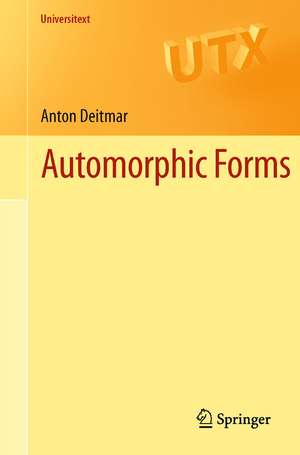
Automorphic Forms: Universitext
Autor Anton Deitmaren Limba Engleză Paperback – 29 aug 2012
Acest manual, publicat în seria Universitext de către Springer, reprezintă o introducere riguroasă și concisă într-un domeniu fundamental al teoriei numerelor și geometriei aritmetice moderne. Automorphic Forms propune o abordare duală, facilitând tranziția de la teoria clasică a formelor modulare către perspectiva contemporană a adelelor și teoriei reprezentărilor. Notăm cu interes strategia didactică a autorului Anton Deitmar, care alege să restricționeze expunerea la corpul numerelor raționale, permițând astfel cititorului să pătrundă în mecanismele esențiale ale teoriei fără a se pierde în complexitatea tehnică a corpurilor de numere generale.
Structura volumului reflectă o progresie logică, debutând cu funcții dublu periodice și forme modulare pentru SL2(Z), urmate de o introducere necesară în numere p-adice și adele. Această bază pregătește terenul pentru subiectele avansate din a doua jumătate a cărții: teza lui Tate, reprezentările automorfe ale GL2(A) și funcțiile L automorfe. Reținem că această ediție din 2012 păstrează stilul laconic și dens care caracterizează și alte lucrări ale autorului, precum A First Course in Harmonic Analysis sau Principles of Harmonic Analysis. Dacă în acele volume Anton Deitmar se concentra pe dualitatea Pontryagin și teorema Plancherel, aici aplică aceleași principii de analiză armonică în contextul formelor automorfe.
Lucrarea completează perspectiva oferită de Modular Forms and Fermat’s Last Theorem de Gary Cornell, adăugând o bază teoretică formală și abstractă care lipsește adesea din volumele axate strict pe istoria demonstrării teoremei lui Fermat. Față de tratamentele enciclopedice, Automorphic Forms rămâne un text de lucru, ideal pentru un curs de un semestru, oferind o cale de acces clară către programul Langlands.
Din seria Universitext
- 13%
 Preț: 398.41 lei
 - 15%
 Preț: 576.20 lei
 - 15%
 Preț: 402.83 lei
 -
 Preț: 404.03 lei
 -
 Preț: 433.98 lei
 - 15%
 Preț: 522.85 lei
 -
 Preț: 406.96 lei
 -
 Preț: 415.00 lei
 - 13%
 Preț: 395.54 lei
 -
 Preț: 376.18 lei
 -
 Preț: 508.41 lei
 -
 Preț: 469.31 lei
 - 15%
 Preț: 511.22 lei
 -
 Preț: 458.21 lei
 - 15%
 Preț: 513.38 lei
 - 19%
 Preț: 469.00 lei
 -
 Preț: 490.45 lei
 - 15%
 Preț: 603.75 lei
 - 15%
 Preț: 459.73 lei
 -
 Preț: 491.89 lei
 -
 Preț: 383.79 lei
 - 20%
 Preț: 319.60 lei
 - 15%
 Preț: 620.17 lei
 - 15%
 Preț: 504.56 lei
 -
 Preț: 482.65 lei
 - 15%
 Preț: 609.03 lei
 - 15%
 Preț: 534.10 lei
 - 15%
 Preț: 529.04 lei
 - 15%
 Preț: 544.31 lei
 -
 Preț: 383.03 lei
 - 15%
 Preț: 477.44 lei
 -
 Preț: 402.52 lei
 - 15%
 Preț: 525.92 lei
 - 15%
 Preț: 616.59 lei
 - 20%
 Preț: 533.29 lei
 - 15%
 Preț: 605.99 lei
 -
 Preț: 401.63 lei
 -
 Preț: 476.65 lei
 -
 Preț: 442.80 lei
 - 15%
 Preț: 529.50 lei
 - 15%
 Preț: 476.18 lei
 - 15%
 Preț: 563.39 lei
 - 15%
 Preț: 656.08 lei
 -
 Preț: 494.60 lei
 -
 Preț: 454.23 lei
 - 15%
 Preț: 453.29 lei
 -
 Preț: 395.89 lei
 -
 Preț: 404.56 lei
 -
 Preț: 392.51 lei
 -
 Preț: 411.21 lei
Preț: 454.33 lei
Preț vechi: 534.51 lei
-15%
Carte tipărită la comandă
Livrare economică 28 noiembrie-12 decembrie
Specificații
ISBN-10: 1447144341
Pagini: 264
Ilustrații: IX, 252 p. 2 illus.
Dimensiuni: 155 x 235 x 15 mm
Greutate: 0.41 kg
Ediția:2012
Editura: Springer
Colecția Universitext
Seria Universitext
Locul publicării:London, United Kingdom
V-ar putea interesa
-
 An Introduction to the Theory of NumbersG. H. Hardy-20%Preț: 440.54 lei548.81 lei
 -
 Combinatorial Commutative AlgebraEzra Miller-15%Preț: 677.28 lei796.80 lei
 -
 Combinatorial Commutative AlgebraEzra Miller-15%Preț: 525.16 lei617.84 lei
 -
 Field and Galois TheoryPatrick Morandi-15%Preț: 608.60 lei716.01 lei
 -
 A First Course in Noncommutative RingsTsit-Yuen Lam-15%Preț: 609.13 lei716.63 lei
 -
 Sheaves in Geometry and LogicSaunders Maclane-15%Preț: 529.43 lei622.85 lei
 -
 AlgebraWilliam A. Adkins-15%Preț: 677.41 lei796.96 lei
 -
 Analysis in Vector SpacesAkcoglu-9%Preț: 1051.65 lei1155.65 lei
 -
 Linear Algebra For DummiesMary Jane SterlingPreț: 136.70 lei
 -
 Book of Abstract AlgebraCharles C. Pinter-24%Preț: 145.17 lei191.38 lei
 -
 Regular PolytopesH S M CoxeterPreț: 100.98 lei
 -
 Introduction to Graph TheoryRichard J Trudeau-19%Preț: 83.63 lei103.54 lei
 -
 Linear AlgebraMartin Anthony-19%Preț: 440.37 lei543.67 lei
 -
 Galois Groups and Fundamental GroupsTamás Szamuely-11%Preț: 516.41 lei580.23 lei
 -
 InequalitiesRadmila Bulajich ManfrinoPreț: 454.59 lei
 -
 A Course in EnumerationMartin Aigner-15%Preț: 567.64 lei667.81 lei
 -
 Preț: 112.54 lei
Public țintă
GraduateDe ce să citești această carte
Această carte se adresează studenților masteranzi și doctoranzilor în matematică care doresc să înțeleagă rolul formelor automorfe în teoria numerelor modernă. Cititorul câștigă o înțelegere clară a legăturii dintre formele modulare clasice și reprezentările grupului GL2(A). Este recomandată pentru claritatea expunerii și pentru modul în care reușește să prezinte subiecte complexe, precum teza lui Tate, într-un format accesibil și bine structurat.
Despre autor
Anton Deitmar este profesor titular și deține catedra de Matematică Pură la Universitatea din Exeter, Marea Britanie. Specialist recunoscut în analiză armonică și teoria numerelor, a fost bursier Heisenberg și a primit premiul principal al Asociației Japoneze de Științe Matematice în 1998. Experiența sa academică este reflectată într-o serie de manuale de succes publicate în limba engleză și germană, apreciate pentru stilul lor concis și rigoarea matematică. În afara activității de cercetare, profesorul Deitmar este pasionat de drumeții montane și practică Aikido, elemente care îi definesc disciplina și echilibrul în scrierea textelor științifice.
Cuprins
Recenzii
“This book covers, in a readable and clear style, the main aspects of the theory of automorphic forms with minimal prerequisites. … this book would serve very well as a one-semester course on automorphic forms, representations, and L-functions. A short guide to the literature is given, which directs interested readers to more thorough (and demanding) sources. … There are also numerous well-written exercises that develop the material further.” (Dominic A. Lanphier, Mathematical Reviews, July, 2013)
“This book is an elementary introduction to the realm of Automorphic forms. There are many books on Automorphic forms but this is the first book that requires only few pre-requisites and definitely is suitable for advanced undergraduate classes and for graduate students. … I would recommend this book if you are interested in starting learn Automorphic forms or you will give a first course on this subject. The book is very recent, very well-written and presents very nice exercises and remarks.” (Philosophy, Religion and Science Book Reviews, bookinspections.wordpress.com, March, 2013)
“The book under review is an excellent introduction to this part of number theory, geared to graduate students or accelerated and enthusiastic advanced undergraduates … . The book comes equipped with nice exercise sets and a collection of strategically placed ‘Remarks’ which will guide the reader to more advanced sources and provide him a broader and more organic perspective on the field.” (Michael Berg, MAA Reviews, January, 2013)
Textul de pe ultima copertă
This text provides a concise introduction to the world of automorphic forms using two approaches: the classic elementary theory and the modern point of view of adeles and representation theory. The reader will learn the important aims and results of the theory by focussing on its essential aspects and restricting it to the 'base field' of rational numbers.
Students interested for example in arithmetic geometry or number theory will find that this book provides an optimal and easily accessible introduction into this topic.