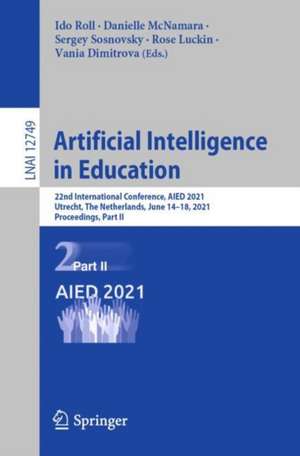
Artificial Intelligence in Education: Lecture Notes in Computer Science, cartea 12749
Editat de Ido Roll, Danielle McNamara, Sergey Sosnovsky, Rose Luckin, Vania Dimitrovaen Limba Engleză Paperback – 12 iun 2021
*The conference was held virtually due to the COVID-19 pandemic.
Din seria Lecture Notes in Computer Science
- 20%
 Preț: 558.53 lei
 - 20%
 Preț: 617.17 lei
 - 20%
 Preț: 571.88 lei
 - 20%
 Preț: 1020.28 lei
 - 20%
 Preț: 851.78 lei
 - 20%
 Preț: 560.93 lei
 - 20%
 Preț: 633.70 lei
 - 20%
 Preț: 675.83 lei
 - 20%
 Preț: 1359.66 lei
 - 20%
 Preț: 620.33 lei
 - 20%
 Preț: 733.68 lei
 - 18%
 Preț: 945.44 lei
 - 15%
 Preț: 558.12 lei
 - 20%
 Preț: 793.92 lei
 - 20%
 Preț: 560.93 lei
 - 20%
 Preț: 748.63 lei
 - 20%
 Preț: 562.49 lei
 - 20%
 Preț: 1032.47 lei
 - 20%
 Preț: 731.82 lei
 - 20%
 Preț: 556.96 lei
 - 20%
 Preț: 1022.15 lei
 - 20%
 Preț: 562.49 lei
 - 20%
 Preț: 560.93 lei
 - 20%
 Preț: 313.10 lei
 - 20%
 Preț: 828.44 lei
 - 20%
 Preț: 560.93 lei
 - 20%
 Preț: 314.86 lei
 - 20%
 Preț: 1033.45 lei
 - 20%
 Preț: 563.29 lei
 - 20%
 Preț: 733.68 lei
 - 20%
 Preț: 1137.10 lei
 - 20%
 Preț: 735.28 lei
 - 20%
 Preț: 1079.23 lei
 - 20%
 Preț: 584.42 lei
 - 20%
 Preț: 854.16 lei
 - 15%
 Preț: 672.87 lei
 - 20%
 Preț: 606.22 lei
 - 20%
 Preț: 1246.46 lei
 - 20%
 Preț: 449.81 lei
 - 20%
 Preț: 984.64 lei
 - 20%
 Preț: 620.33 lei
 - 20%
 Preț: 402.28 lei
 - 20%
 Preț: 316.28 lei
 - 20%
 Preț: 663.69 lei
 - 20%
 Preț: 320.24 lei
 - 20%
 Preț: 343.12 lei
 - 20%
 Preț: 313.87 lei
Preț: 554.32 lei
Preț vechi: 692.91 lei
-20%
Puncte Express: 831
Carte tipărită la comandă
Livrare economică 30 noiembrie-14 decembrie
Livrare prin curier în România Termenul estimat este afișat lângă disponibilitate.
Transport gratuit pentru acest produs Plată online sau ramburs, în funcție de opțiunile comenzii.
Retur gratuit în 14 zile Comandă securizată și suport în română.
Specificații
ISBN-13: 9783030782696
ISBN-10: 3030782697
Pagini: 548
Ilustrații: XLIX, 492 p. 89 illus., 78 illus. in color.
Dimensiuni: 155 x 235 x 30 mm
Greutate: 0.82 kg
Ediția:1st edition 2021
Editura: Springer
Colecția Lecture Notes in Computer Science
Seria Lecture Notes in Computer Science
Locul publicării:Cham, Switzerland
ISBN-10: 3030782697
Pagini: 548
Ilustrații: XLIX, 492 p. 89 illus., 78 illus. in color.
Dimensiuni: 155 x 235 x 30 mm
Greutate: 0.82 kg
Ediția:1st edition 2021
Editura: Springer
Colecția Lecture Notes in Computer Science
Seria Lecture Notes in Computer Science
Locul publicării:Cham, Switzerland
Cuprins
Keynotes.- Scrutability, control and learner models: foundations for learner-centred design in AIED.- Augmenting learning with smart design, smart systems, and intelligence.- Invited Panels.- Mind the Gap: The Bidirectional Relationship between Diversity, Equity, and Inclusion (DEI) and Artificial Intelligence (AI).- Research-based Digital-first Assessments and the Future of Education.- Short Papers.- Open Learner Models for Multi-Activity Educational Systems.- Personal vocabulary recommendation to support real life needs.- AI Ethics Guidelines for K-12 Education: A Review of the Policy Landscape.- Quantitative Analysis to Further Validate WC-GCMS, a Computational Metric of Collaboration in Online Textual Discourse.-Generation of automatic data-driven feedback to students using Explainable Machine Learning.- Interactive Personas: Towards the Dynamic Assessment of Student Motivation within ITS.- Agent-based ClassroomEnvironment Simulation: the Effect of Disruptive Schoolchildren’s Behaviour versus Teacher Control over NeighboursIntegration of Automated Essay Scoring Models using Item Response Theory.- Towards sharing student models across learning systems.- Protecting Student Privacy with Synthetic Data from Generative Adversarial Networks.- Learning Analytics and Fairness: Do Existing Algorithms Serve Everyone Equally?.- Exploiting structured error to improve automated scoring of oral reading fluency.- Data Augmentation for Enlarging Student Feature Space and Improving Random Forest Success.-The School Path Guide: a Practical Introduction to Representation and Reasoning in AI for High School Students.- Kwame: A Bilingual AI Teaching Assistant for Online SuaCode Courses.- Early Prediction of Children’s Disengagement in a Tablet Tutor using Visual Features.- An Educational System for Personalized Teacher Recommendation in K-12 Online Classrooms.- Designing intelligent systems to support medical diagnostic reasoning using process data.- Incorporating Item Response Theory into Knowledge Tracing.- The Automated Model of Comprehension (AMoC) v2.0.- Pre-course Prediction of At-Risk Calculus Students.- Examining Learners' Reflections over Time during Game-based Learning.- Examining the Use of a Teacher Alerting Dashboard During Remote Learning.- Capturing Fairness and Uncertainty in Student Dropout Prediction - A Comparison Study.- Dr. Proctor: A Multi-modal AI-Based Platform for Remote Proctoring in Education.- Multimodal Trajectory Analysis of Visitor Engagement with Interactive Science Museum Exhibits.-Analytics of Emerging and Scripted Roles in Online Discussions: Epistemic Network Analysis Approach.- Towards Automatic Content Analysis of Rhetorical Structure in Brazilian College Entrance Essays.- Contrasting Automatic and Manual Group Formation: A Case Study in a Software Engineering Postgraduate Course.- Aligning Expectations About the Adoption of Learning Analytics in a Brazilian Higher Education Institution.- Interactive Teaching with Groups of Unknown Bayesian Learners.- Multi-Task Learning based Online Dialogic Instruction Detection with Pre-trained Language Models.- Impact of Predictive Learning Analytics on Course Awarding Gap of Disadvantaged students in STEM.- Evaluation of Automated Image Descriptions for Visually Impaired Students.- Way to Go! Effects of Motivational Support and Agents on Reducing Foreign Language Anxiety.- "I didn’t copy his code”: Code Plagiarism Detection with Visual Proof.- An Epistemic Model-Based Tutor for Imperative Programming.- Long Term Retention of Programming Concepts Learned Using Tracing Versus Debugging Tutors.- Facilitating the Implementation of AI-based Assistive Technologies for Persons with Disabilities in Vocational Rehabilitation: A practical Design Thinking Approach.- Quantifying the Impact of Severe Weather Conditions on Online Learning During the COVID-19 Pandemic.- I-Mouse: A Framework for Player Assistance in Adaptive Serious Games.- Parent-EMBRACE: An Adaptive Dialogic Reading Intervention.- Using Fair AI with Debiased Network Embeddings to Support Help Seeking in an Online Math Learning Platform.- A Multimodal Machine Learning Framework for Teacher Vocal Delivery Evaluation.- Solving ESL Sentence Completion Questions via Pre-trained Neural Language Models.- DanceTutor: An ITS for Coaching Novice Ballet Dancers using Pose Recognition of Whole-body Movements.- Tracing Embodied Narratives of Critical Thinking.- Multi-Armed Bandit Algorithms for Online Adaptive Learning: A Survey.- Paraphrasing Academic Text: A Study of Back-translating Anatomy and Physiology with Transformers.- PAKT: A Position-Aware Self-Attentive Approach for Knowledge Tracing.- Identifying Struggling Students by Comparing Online Tutor Clickstreams.- Exploring Dialogism using Language Models.- EduPal leaves no professor behind: Supporting faculty via a peer-powered recommender system.- Computer-Supported Human Mentoring for Personalized and Equitable Math Learning.- Internalisation of Situational Motivation by Addressing the Needs for Competence, Autonomy and Relatedness in an E-Learning Scenario using Gamification.- Learning Association between Learning Objectives and Key Concepts to Generate Pedagogically Valuable Questions.- Exploring the working and effectiveness of norm-model feedback in conceptual modelling – A preliminary report.- A Comparative Study of Learning Outcomes for Online Learning Platforms.- Explaining Engagement: Underrepresented Learner Behaviors in a Virtual Coding Camp.- (342) Using AI to promote equitable classroom instruction: The TalkMoves Application.- Investigating effects of selecting challenging goals.- Modeling Frustration Trajectories and Problem-Solving Behaviors in Adaptive Learning Environments for Introductory Computer Science.- Behavioral Phenotyping for Predictive Model Equity and Interpretability in STEM Education.- Teaching underachieving algebra students to construct models using a simple intelligent tutoring system.- Charisma and Learning: Designing Charismatic Behaviors for Virtual Human Tutors.- AI-Powered Teaching Behavior Analysis by Using 3D-MobileNet and Statistical Optimization.- Assessment2Vec: Learning Distributed Representations of Assessments to Reduce Instructors’ Workload in Marking Exams.- Toward Stable Asymptotic Learning with Simulated Learners.- A word embeddings based clustering approach for collaborative learning group formation.- Intelligent Agents Influx in Schools: Teacher Cultures, Anxiety Levels and Predictable Variations.- WikiMorph: Learning to Decompose Words into Morphological Structures.- Elo-infused Bayesian Knowledge Tracing – an approach to operationalized individualization.- Self-paced Graph Memory Network for Student GPA Prediction and Abnormal Student Detection.- Exploring The Use of Adaptive Experiments To More Rapidly Use Data To Help Students.- A Comparison of Hints vs.Scaffolding in a MOOC with Adult Learners.- An Ensemble Approach for Question-level Knowledge Tracing.- Industry and Innovation.- Scaffolds and Nudges: A Case Study in Learning Engineering Design Improvements.- Condensed Discriminative Question Set for Reliable Exam Score Prediction.- Evaluating the Impact of Research-Based Updates to an Adaptive Assessment.- Back to the Origin: An Intelligent System for Learning Chinese Characters.- Doctoral Consortium.- Automated Assessment of Quality and Coverage of Ideas in Students' Source-based Writing.- Impact of Intelligent Tutoring System (ITS) on Mathematics Achievement using ALEKS.- Automatically Measuring and Scaffolding Mathematics Practices for Content Acquisition.- Contextual Safeguarding in Education: Bayesian network risk analysis for decision support.- Workshops.- Supporting Lifelong Learning.- The First International Workshop on Multimodal Artificial Intelligence in Education (MAIEd).- Challenges and Advances in Team Tutoring (Half-day Virtual Workshop).- Intelligent Textbooks.- Enhance AI Education with Industry and Academia Collaboration - IEEE Learning Technology Standard Committee and Artificial Intelligence Standards Committee.