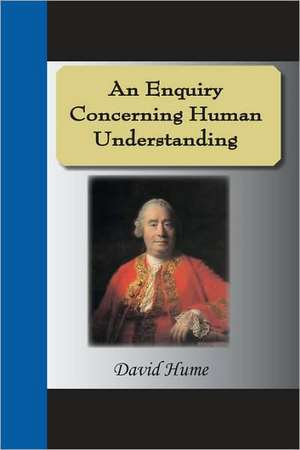
An Enquiry Concerning Human Understanding
Autor David Humeen Limba Engleză Paperback – 13 mai 2008
Structura acestui volum din seria Cambridge Texts in the History of Philosophy este riguros concepută pentru a facilita accesul cercetătorilor și studenților la una dintre cele mai influente scrieri ale iluminismului scoțian. Metodologia editorială adoptată de Stephen Buckle se bazează pe utilizarea versiunii din 1772 a textului, considerată ediția definitivă, pe care o completează cu un aparat critic extensiv și o introducere ce plasează empirismul lui Hume în contextul său istoric și filosofic precis. Notăm cu interes includerea unor scrieri adiționale ale lui Hume, care funcționează ca un instrument de navigație pentru înțelegerea procesului de compoziție și a evoluției argumentelor despre limitele intelectului. Putem afirma că acest volum reprezintă o rafinare a preocupărilor academice ale lui Stephen Buckle, acesta publicând anterior Hume's Enlightenment Tract, o lucrare ce încerca să scoată An Enquiry Concerning Human Understanding din umbra celebrului „Tratat asupra naturii umane”. În acest context, ediția de față nu este doar o simplă republicare, ci o sinteză a cercetărilor sale asupra legii naturale și a ordinii sociale, teme explorate și în Natural Law and the Theory of Property. Cititorii familiarizați cu Reading Hume on Human Understanding de Peter Millican vor aprecia modul în care acest volum aduce nou o perspectivă integrată: nu se limitează la eseuri critice, ci oferă textul primar flancat de documente care îi explică geneza. Spre deosebire de abordarea din Hume's Enquiry (Expanded and Explained), care utilizează comentarii intercalate în text, ediția Cambridge menține integritatea prozei lui Hume, oferind clarificări prin adnotări discrete și o introducere solidă, fiind ideală pentru un studiu academic aprofundat asupra scepticismului moderat și a cauzalității.
Preț: 60.22 lei
Preț vechi: 63.39 lei
-5%
Carte indisponibilă temporar
Specificații
ISBN-10: 1595476938
Pagini: 128
Dimensiuni: 152 x 229 x 8 mm
Greutate: 0.2 kg
Editura: NuVision Publications
Locul publicării:United States
V-ar putea interesa
-
 Owning Your Own ShadowRobert A. JohnsonPreț: 98.33 lei
 -
 -16%Preț: 81.67 lei96.86 lei
 -
 Through the Language GlassGuy Deutscher-18%Preț: 66.07 lei80.15 lei
 -
 Language, Truth and LogicA. J. Ayer-20%Preț: 73.73 lei92.32 lei
 -
 Heart of DarknessJoseph Conrad-29%Preț: 45.42 lei63.76 lei
 -
 Theories of EthicsPhilippa Foot-20%Preț: 326.73 lei407.88 lei
 -
 The Problem of EvilPeter Van InwagenPreț: 262.55 lei
 -
 Good God: The Theistic Foundations of MoralityDavid Baggett-13%Preț: 307.81 lei352.56 lei
 -
 God and Cosmos: Moral Truth and Human MeaningDavid Baggett-11%Preț: 382.88 lei431.73 lei
 -
 The Evidential Argument from EvilDaniel Howard–snyderPreț: 208.24 lei
 -
 Preț: 261.39 lei
 -
 Problems of the SelfBernard WilliamsPreț: 196.69 lei
 -
 The Philosophy of MindPeter SmithPreț: 223.90 lei
 -
 HumeDorothy ColemanPreț: 350.97 lei
 -
 The Moral LandscapeSam Harris-18%Preț: 65.61 lei79.89 lei
 -
 FoundationIsaac Asimov-19%Preț: 52.19 lei64.47 lei
 -
 Second FoundationIsaac Asimov-36%Preț: 41.05 lei64.29 lei
 -
 Foundation and EmpireIsaac Asimov-28%Preț: 46.66 lei64.40 lei
 -
 The Grand DesignLeonard Mlodinow-28%Preț: 77.17 lei107.25 lei
 -
 Introduction to Contemporary EpistemologyJonathan DancyPreț: 283.18 lei
 -
 From a Logical Point of View – Nine Logical Philosophical Essays Rev (Paper)Willard Van Orm QuinePreț: 242.89 lei
 -
 The Problem of EvilDaniel SpeakPreț: 137.90 lei
 -
 -18%Preț: 98.61 lei120.49 lei
 -
 Metaphysics – The Big Questions 2eP van InwagenPreț: 316.65 lei
 -
 Three Dialogues Between Hylas and PhilonousGeorge BerkeleyPreț: 46.70 lei
 -
 Essay Concerning Human UnderstandingJohn LockePreț: 48.81 lei
 -
 Freedom from the KnownJ. Krishnamurti-32%Preț: 61.90 lei91.58 lei
 -
 Teoria sentimentelor moraleADAM SMITHPreț: 55.00 lei
De ce să citești această carte
Această ediție este esențială pentru oricine studiază epistemologia sau istoria filosofiei moderne. Cititorul câștigă o înțelegere clară a modului în care Hume a redefinit limitele cunoașterii umane, beneficiind de un text bazat pe ediția definitivă din 1772. Este un instrument de lucru superior datorită selecției de scrieri conexe care clarifică intențiile autorului, fiind mult mai mult decât o simplă reeditare a unui text clasic.
Despre autor
Stephen Buckle este lector principal în filosofie la Universitatea Catolică Australiană. Expert recunoscut în gândirea secolului al XVIII-lea, Buckle s-a specializat în studiul empirismului britanic și al teoriilor legii naturale. Opera sa include studii de referință precum Hume's Enlightenment Tract și Natural Law and the Theory of Property. Expertiza sa în analiza textelor lui David Hume este dublată de un interes pentru etica aplicată, fiind implicat în dezbateri privind bioetica și experimentarea pe embrioni, ceea ce îi oferă o perspectivă interdisciplinară asupra limitelor rațiunii umane.
Descriere scurtă
Descriere
Oxford Philosophical Texts Series Editor: John Cottingham The Oxford Philosophical Texts series consists of authoritative teaching editions of canonical texts in the history of philosophy from the ancient world down to modern times. Each volume provides a clear, well laid out text together with a comprehensive introduction by a leading specialist, giving the student detailed critical guidance on the intellectual context of the work and the structure and philosophical importance of the main arguments. Endnotes are supplied which provide further commentary on the arguments and explain unfamiliar references and terminology, and a full bibliography and index are also included. The series aims to build up a definitive corpus of key texts in the Western philosophical tradition, which will form a reliable and enduring resource for students and teachers alike. David Hume's aim in writing An Enquiry concerning Human Understanding (1748) was to introduce his philosophy to a European culture in which many educated people read original works of philosophy. He gives an elegant and accessible presentation of strikingly original and challenging views about the limited powers of human understanding, the attractions of scepticism, the compatibility of free will and determinism, and weaknesses in the foundations of religion. Hume's philosophy was highly controversial in the eighteenth century and remains so today.The text printed in this edition is that of the Clarendon critical edition of Hume's works. A substantial introduction by the editor explains the intellectual background to the work and surveys its main themes. The volume also includes detailed explanatory notes on the text, a glossary of terms, a full list of references, and a section of supplementary readings.
Notă biografică
Recenzii
The introduction to this edition discusses the Enquiry’s origin, evolution, and critical reception, while appendices provide examples of contemporary responses to Hume.
“David Hume’s Enquiry concerning Human Understanding is a philosophical masterpiece that explores the nature of human cognition and the limits of our knowledge. This edition of the Enquiry helpfully puts the text in its historical context by presenting it alongside responses from Hume’s most significant 18th-century critics: George Campbell, Thomas Reid, James Beattie, and Immanuel Kant. Lorne Falkenstein’s incisive introduction and editorial comments offer readers, whether novice or expert, a sure hand as they navigate both the deceivingly straightforward text and the critics’ responses.” — Donald C. Ainslie, University of Toronto
“The 1758 edition of An Enquiry concerning Human Understanding was the first to be grouped together with A Dissertation on the Passions, An Enquiry concerning the Principles of Morals, and The Natural History of Religion. This grouping well reflects Hume’s ambition to recast his earlier Treatise on Human Nature, and brings into relief his explicit criticism of religion. In four appendices, Lorne Falkenstein has thoughtfully chosen selections by Hume’s contemporaries who challenge Hume on the central topics of the Enquiry: perception and reasoning, causation, and miracles. Falkenstein adds helpful notes providing further historical context. This is an excellent edition for undergraduate and graduate courses, and will be a welcome new resource for scholars.” — Jacqueline Taylor, University of San Francisco
Cuprins
Abbreviations and References
Introduction
David Hume: A Brief Chronology
A Note on the Texts
Front Matter from the 1758 and 1777 Editions of Hume’s Essays and Treatises on Several Subjects
An Enquiry concerning Human Understanding
- Section 1 Of the different Species of Philosophy
Section 2 Of the Origin of Ideas
Section 3 Of the Association of Ideas
Section 4 Sceptical Doubts concerning the Operations of the Understanding
Section 5 Sceptical Solution of these Doubts
Section 6 Of Probability
Section 7 Of the Idea of necessary Connexion
Section 8 Of Liberty and Necessity
Section 9 Of the Reason of Animals
Section 10 Of Miracles
Section 11 Of a particular Providence and of a future State
Section 12 Of the academical or sceptical Philosophy
Appendix B: From Thomas Reid, An Inquiry into the Human Mind on the Principles of Common Sense (1764) and Essays on the Intellectual Powers of Man (1785)
Appendix C: From James Beattie, An Essay on the Nature and Immutability of Truth (1774)
Appendix D: From Immanuel Kant, Prolegomena to Any Future Metaphysics (1784) and The Critique of Pure Reason (1781/1787)
Select Bibliography
Hume’s Index to the Enquiry