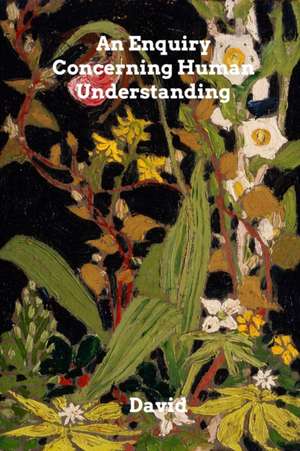
An Enquiry Concerning Human Understanding: Strategic Issues in Health Care Management
Autor David Humeen Limba Engleză Paperback – oct 2019
Preț: 92.60 lei
Puncte Express: 139
Carte tipărită la comandă
Livrare economică 03-17 iunie
Specificații
ISBN-13: 9780464194316
ISBN-10: 0464194318
Pagini: 132
Dimensiuni: 152 x 229 x 7 mm
Greutate: 0.19 kg
Editura: Blurb
ISBN-10: 0464194318
Pagini: 132
Dimensiuni: 152 x 229 x 7 mm
Greutate: 0.19 kg
Editura: Blurb
V-ar putea interesa
-
 Owning Your Own ShadowRobert A. JohnsonPreț: 85.23 lei
 -
 -17%Preț: 76.37 lei92.26 lei
 -
 Through the Language GlassGuy Deutscher-19%Preț: 61.78 lei76.36 lei
 -
 Heart of DarknessJoseph Conrad-30%Preț: 42.59 lei60.73 lei
 -
 Hume: A Very Short IntroductionJames A. Harris-21%Preț: 53.12 lei67.58 lei
 -
 Preț: 53.37 lei
 -
 The Problem of EvilPeter Van InwagenPreț: 239.67 lei
 -
 David Hume: A Treatise of Human Nature: Volume 1: TextsDavid Fate Norton-13%Preț: 295.86 lei339.73 lei
 -
 Good God: The Theistic Foundations of MoralityDavid Baggett-10%Preț: 277.77 lei307.63 lei
 -
 God and Cosmos: Moral Truth and Human MeaningDavid Baggett-12%Preț: 349.26 lei398.10 lei
 -
 The Evidential Argument from EvilDaniel Howard–snyderPreț: 208.24 lei
 -
 CosmosCarl SaganPreț: 116.91 lei
 -
 Preț: 261.39 lei
 -
 The Moral LandscapeSam Harris-19%Preț: 61.36 lei76.09 lei
 -
 FoundationIsaac Asimov-20%Preț: 49.00 lei61.53 lei
 -
 Second FoundationIsaac Asimov-37%Preț: 38.24 lei61.14 lei
 -
 Foundation and EmpireIsaac Asimov-29%Preț: 43.83 lei61.47 lei
 -
 The Grand DesignLeonard Mlodinow-29%Preț: 73.88 lei103.96 lei
 -
 The Problem of EvilDaniel SpeakPreț: 133.56 lei
 -
 -13%Preț: 102.03 lei116.63 lei
 -
 Metaphysics – The Big Questions 2eP van InwagenPreț: 316.65 lei
 -
 A Treatise of Human NatureDavid HumePreț: 71.21 lei
 -
 Three Dialogues Between Hylas and PhilonousGeorge BerkeleyPreț: 46.70 lei
 -
 The Problems of PhilosophyBertrand RussellPreț: 38.67 lei
 -
 Preț: 282.95 lei
 -
 An Essay Concerning Human UnderstandingJohn LockePreț: 46.45 lei
 -
 Freedom from the KnownJ. Krishnamurti-34%Preț: 57.89 lei87.19 lei
 -
 Preț: 87.91 lei
 -
 Teoria sentimentelor moraleADAM SMITHPreț: 55.00 lei
 -
 Enquiry Concerning Human UnderstandingDavid HumePreț: 95.17 lei
Descriere
Descriere de la o altă ediție sau format:
Oxford Philosophical Texts Series Editor: John Cottingham The Oxford Philosophical Texts series consists of authoritative teaching editions of canonical texts in the history of philosophy from the ancient world down to modern times. Each volume provides a clear, well laid out text together with a comprehensive introduction by a leading specialist, giving the student detailed critical guidance on the intellectual context of the work and the structure and philosophical importance of the main arguments. Endnotes are supplied which provide further commentary on the arguments and explain unfamiliar references and terminology, and a full bibliography and index are also included. The series aims to build up a definitive corpus of key texts in the Western philosophical tradition, which will form a reliable and enduring resource for students and teachers alike. David Hume's aim in writing An Enquiry concerning Human Understanding (1748) was to introduce his philosophy to a European culture in which many educated people read original works of philosophy. He gives an elegant and accessible presentation of strikingly original and challenging views about the limited powers of human understanding, the attractions of scepticism, the compatibility of free will and determinism, and weaknesses in the foundations of religion. Hume's philosophy was highly controversial in the eighteenth century and remains so today.The text printed in this edition is that of the Clarendon critical edition of Hume's works. A substantial introduction by the editor explains the intellectual background to the work and surveys its main themes. The volume also includes detailed explanatory notes on the text, a glossary of terms, a full list of references, and a section of supplementary readings.
Oxford Philosophical Texts Series Editor: John Cottingham The Oxford Philosophical Texts series consists of authoritative teaching editions of canonical texts in the history of philosophy from the ancient world down to modern times. Each volume provides a clear, well laid out text together with a comprehensive introduction by a leading specialist, giving the student detailed critical guidance on the intellectual context of the work and the structure and philosophical importance of the main arguments. Endnotes are supplied which provide further commentary on the arguments and explain unfamiliar references and terminology, and a full bibliography and index are also included. The series aims to build up a definitive corpus of key texts in the Western philosophical tradition, which will form a reliable and enduring resource for students and teachers alike. David Hume's aim in writing An Enquiry concerning Human Understanding (1748) was to introduce his philosophy to a European culture in which many educated people read original works of philosophy. He gives an elegant and accessible presentation of strikingly original and challenging views about the limited powers of human understanding, the attractions of scepticism, the compatibility of free will and determinism, and weaknesses in the foundations of religion. Hume's philosophy was highly controversial in the eighteenth century and remains so today.The text printed in this edition is that of the Clarendon critical edition of Hume's works. A substantial introduction by the editor explains the intellectual background to the work and surveys its main themes. The volume also includes detailed explanatory notes on the text, a glossary of terms, a full list of references, and a section of supplementary readings.
Recenzii
Over a series of elegantly written, engaging essays, the Enquiry examines the experiential and psychological sources of meaning and knowledge, the foundations of reasoning about matters that lie beyond the scope of our sensory experience and memory, the nature of belief, and the limitations of our knowledge. The positions Hume takes on these topics have been described as paradigmatically empiricist, sceptical, and naturalist and have been widely influential and even more widely decried.
The introduction to this edition discusses the Enquiry’s origin, evolution, and critical reception, while appendices provide examples of contemporary responses to Hume.
“David Hume’s Enquiry concerning Human Understanding is a philosophical masterpiece that explores the nature of human cognition and the limits of our knowledge. This edition of the Enquiry helpfully puts the text in its historical context by presenting it alongside responses from Hume’s most significant 18th-century critics: George Campbell, Thomas Reid, James Beattie, and Immanuel Kant. Lorne Falkenstein’s incisive introduction and editorial comments offer readers, whether novice or expert, a sure hand as they navigate both the deceivingly straightforward text and the critics’ responses.” — Donald C. Ainslie, University of Toronto
“The 1758 edition of An Enquiry concerning Human Understanding was the first to be grouped together with A Dissertation on the Passions, An Enquiry concerning the Principles of Morals, and The Natural History of Religion. This grouping well reflects Hume’s ambition to recast his earlier Treatise on Human Nature, and brings into relief his explicit criticism of religion. In four appendices, Lorne Falkenstein has thoughtfully chosen selections by Hume’s contemporaries who challenge Hume on the central topics of the Enquiry: perception and reasoning, causation, and miracles. Falkenstein adds helpful notes providing further historical context. This is an excellent edition for undergraduate and graduate courses, and will be a welcome new resource for scholars.” — Jacqueline Taylor, University of San Francisco
The introduction to this edition discusses the Enquiry’s origin, evolution, and critical reception, while appendices provide examples of contemporary responses to Hume.
“David Hume’s Enquiry concerning Human Understanding is a philosophical masterpiece that explores the nature of human cognition and the limits of our knowledge. This edition of the Enquiry helpfully puts the text in its historical context by presenting it alongside responses from Hume’s most significant 18th-century critics: George Campbell, Thomas Reid, James Beattie, and Immanuel Kant. Lorne Falkenstein’s incisive introduction and editorial comments offer readers, whether novice or expert, a sure hand as they navigate both the deceivingly straightforward text and the critics’ responses.” — Donald C. Ainslie, University of Toronto
“The 1758 edition of An Enquiry concerning Human Understanding was the first to be grouped together with A Dissertation on the Passions, An Enquiry concerning the Principles of Morals, and The Natural History of Religion. This grouping well reflects Hume’s ambition to recast his earlier Treatise on Human Nature, and brings into relief his explicit criticism of religion. In four appendices, Lorne Falkenstein has thoughtfully chosen selections by Hume’s contemporaries who challenge Hume on the central topics of the Enquiry: perception and reasoning, causation, and miracles. Falkenstein adds helpful notes providing further historical context. This is an excellent edition for undergraduate and graduate courses, and will be a welcome new resource for scholars.” — Jacqueline Taylor, University of San Francisco
Cuprins
Preface and Acknowledgements
Abbreviations and References
Introduction
David Hume: A Brief Chronology
A Note on the Texts
Front Matter from the 1758 and 1777 Editions of Hume’s Essays and Treatises on Several Subjects
An Enquiry concerning Human Understanding
Appendix B: From Thomas Reid, An Inquiry into the Human Mind on the Principles of Common Sense (1764) and Essays on the Intellectual Powers of Man (1785)
Appendix C: From James Beattie, An Essay on the Nature and Immutability of Truth (1774)
Appendix D: From Immanuel Kant, Prolegomena to Any Future Metaphysics (1784) and The Critique of Pure Reason (1781/1787)
Select Bibliography
Hume’s Index to the Enquiry
Abbreviations and References
Introduction
David Hume: A Brief Chronology
A Note on the Texts
Front Matter from the 1758 and 1777 Editions of Hume’s Essays and Treatises on Several Subjects
An Enquiry concerning Human Understanding
- Section 1 Of the different Species of Philosophy
Section 2 Of the Origin of Ideas
Section 3 Of the Association of Ideas
Section 4 Sceptical Doubts concerning the Operations of the Understanding
Section 5 Sceptical Solution of these Doubts
Section 6 Of Probability
Section 7 Of the Idea of necessary Connexion
Section 8 Of Liberty and Necessity
Section 9 Of the Reason of Animals
Section 10 Of Miracles
Section 11 Of a particular Providence and of a future State
Section 12 Of the academical or sceptical Philosophy
Appendix B: From Thomas Reid, An Inquiry into the Human Mind on the Principles of Common Sense (1764) and Essays on the Intellectual Powers of Man (1785)
Appendix C: From James Beattie, An Essay on the Nature and Immutability of Truth (1774)
Appendix D: From Immanuel Kant, Prolegomena to Any Future Metaphysics (1784) and The Critique of Pure Reason (1781/1787)
Select Bibliography
Hume’s Index to the Enquiry