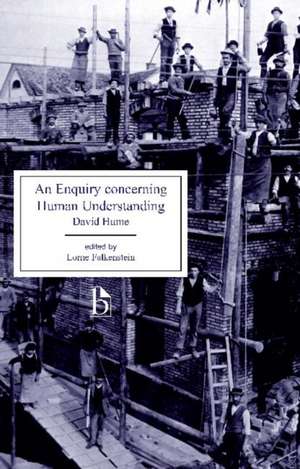
An Enquiry concerning Human Understanding
Autor David Hume Editat de Lorne Falkensteinen Limba Engleză Paperback – 26 aug 2011
The introduction to this edition discusses the Enquiry’s origin, evolution, and critical reception, while appendices provide examples of contemporary responses to Hume.
Preț: 93.75 lei
Preț vechi: 152.21 lei
-38%
Puncte Express: 141
Carte indisponibilă temporar
Doresc să fiu notificat când acest titlu va fi disponibil:
Se trimite...
Specificații
ISBN-13: 9781551118024
ISBN-10: 1551118025
Pagini: 312
Dimensiuni: 140 x 216 x 15 mm
Greutate: 0.4 kg
Editura: BROADVIEW PR
Colecția Broadview Press
Locul publicării:Peterborough, Canada
ISBN-10: 1551118025
Pagini: 312
Dimensiuni: 140 x 216 x 15 mm
Greutate: 0.4 kg
Editura: BROADVIEW PR
Colecția Broadview Press
Locul publicării:Peterborough, Canada
V-ar putea interesa
-
 Owning Your Own ShadowRobert A. JohnsonPreț: 85.23 lei
 -
 -17%Preț: 76.37 lei92.26 lei
 -
 Through the Language GlassGuy Deutscher-19%Preț: 61.78 lei76.36 lei
 -
 Heart of DarknessJoseph Conrad-30%Preț: 42.59 lei60.73 lei
 -
 Hume: A Very Short IntroductionJames A. Harris-21%Preț: 53.12 lei67.58 lei
 -
 Preț: 53.37 lei
 -
 The Problem of EvilPeter Van InwagenPreț: 239.67 lei
 -
 David Hume: A Treatise of Human Nature: Volume 1: TextsDavid Fate Norton-13%Preț: 295.86 lei339.73 lei
 -
 Good God: The Theistic Foundations of MoralityDavid Baggett-10%Preț: 277.77 lei307.63 lei
 -
 God and Cosmos: Moral Truth and Human MeaningDavid Baggett-12%Preț: 349.26 lei398.10 lei
 -
 The Evidential Argument from EvilDaniel Howard–snyderPreț: 208.24 lei
 -
 CosmosCarl SaganPreț: 116.91 lei
 -
 Preț: 261.39 lei
 -
 The Moral LandscapeSam Harris-19%Preț: 61.36 lei76.09 lei
 -
 FoundationIsaac Asimov-20%Preț: 49.00 lei61.53 lei
 -
 Second FoundationIsaac Asimov-37%Preț: 38.24 lei61.14 lei
 -
 Foundation and EmpireIsaac Asimov-29%Preț: 43.83 lei61.47 lei
 -
 The Grand DesignLeonard Mlodinow-29%Preț: 73.88 lei103.96 lei
 -
 The Problem of EvilDaniel SpeakPreț: 133.56 lei
 -
 -13%Preț: 102.03 lei116.66 lei
 -
 Metaphysics – The Big Questions 2eP van InwagenPreț: 316.65 lei
 -
 A Treatise of Human NatureDavid HumePreț: 71.21 lei
 -
 Three Dialogues Between Hylas and PhilonousGeorge BerkeleyPreț: 46.70 lei
 -
 The Problems of PhilosophyBertrand RussellPreț: 38.67 lei
 -
 Preț: 282.95 lei
 -
 An Essay Concerning Human UnderstandingJohn LockePreț: 46.45 lei
 -
 Freedom from the KnownJ. Krishnamurti-34%Preț: 57.89 lei87.19 lei
 -
 Preț: 87.91 lei
 -
 Teoria sentimentelor moraleADAM SMITHPreț: 55.00 lei
 -
 Enquiry Concerning Human UnderstandingDavid HumePreț: 95.17 lei
Recenzii
Over a series of elegantly written, engaging essays, the Enquiry examines the experiential and psychological sources of meaning and knowledge, the foundations of reasoning about matters that lie beyond the scope of our sensory experience and memory, the nature of belief, and the limitations of our knowledge. The positions Hume takes on these topics have been described as paradigmatically empiricist, sceptical, and naturalist and have been widely influential and even more widely decried.
The introduction to this edition discusses the Enquiry’s origin, evolution, and critical reception, while appendices provide examples of contemporary responses to Hume.
“David Hume’s Enquiry concerning Human Understanding is a philosophical masterpiece that explores the nature of human cognition and the limits of our knowledge. This edition of the Enquiry helpfully puts the text in its historical context by presenting it alongside responses from Hume’s most significant 18th-century critics: George Campbell, Thomas Reid, James Beattie, and Immanuel Kant. Lorne Falkenstein’s incisive introduction and editorial comments offer readers, whether novice or expert, a sure hand as they navigate both the deceivingly straightforward text and the critics’ responses.” — Donald C. Ainslie, University of Toronto
“The 1758 edition of An Enquiry concerning Human Understanding was the first to be grouped together with A Dissertation on the Passions, An Enquiry concerning the Principles of Morals, and The Natural History of Religion. This grouping well reflects Hume’s ambition to recast his earlier Treatise on Human Nature, and brings into relief his explicit criticism of religion. In four appendices, Lorne Falkenstein has thoughtfully chosen selections by Hume’s contemporaries who challenge Hume on the central topics of the Enquiry: perception and reasoning, causation, and miracles. Falkenstein adds helpful notes providing further historical context. This is an excellent edition for undergraduate and graduate courses, and will be a welcome new resource for scholars.” — Jacqueline Taylor, University of San Francisco
The introduction to this edition discusses the Enquiry’s origin, evolution, and critical reception, while appendices provide examples of contemporary responses to Hume.
“David Hume’s Enquiry concerning Human Understanding is a philosophical masterpiece that explores the nature of human cognition and the limits of our knowledge. This edition of the Enquiry helpfully puts the text in its historical context by presenting it alongside responses from Hume’s most significant 18th-century critics: George Campbell, Thomas Reid, James Beattie, and Immanuel Kant. Lorne Falkenstein’s incisive introduction and editorial comments offer readers, whether novice or expert, a sure hand as they navigate both the deceivingly straightforward text and the critics’ responses.” — Donald C. Ainslie, University of Toronto
“The 1758 edition of An Enquiry concerning Human Understanding was the first to be grouped together with A Dissertation on the Passions, An Enquiry concerning the Principles of Morals, and The Natural History of Religion. This grouping well reflects Hume’s ambition to recast his earlier Treatise on Human Nature, and brings into relief his explicit criticism of religion. In four appendices, Lorne Falkenstein has thoughtfully chosen selections by Hume’s contemporaries who challenge Hume on the central topics of the Enquiry: perception and reasoning, causation, and miracles. Falkenstein adds helpful notes providing further historical context. This is an excellent edition for undergraduate and graduate courses, and will be a welcome new resource for scholars.” — Jacqueline Taylor, University of San Francisco
Cuprins
Preface and Acknowledgements
Abbreviations and References
Introduction
David Hume: A Brief Chronology
A Note on the Texts
Front Matter from the 1758 and 1777 Editions of Hume’s Essays and Treatises on Several Subjects
An Enquiry concerning Human Understanding
Appendix B: From Thomas Reid, An Inquiry into the Human Mind on the Principles of Common Sense (1764) and Essays on the Intellectual Powers of Man (1785)
Appendix C: From James Beattie, An Essay on the Nature and Immutability of Truth (1774)
Appendix D: From Immanuel Kant, Prolegomena to Any Future Metaphysics (1784) and The Critique of Pure Reason (1781/1787)
Select Bibliography
Hume’s Index to the Enquiry
Abbreviations and References
Introduction
David Hume: A Brief Chronology
A Note on the Texts
Front Matter from the 1758 and 1777 Editions of Hume’s Essays and Treatises on Several Subjects
An Enquiry concerning Human Understanding
- Section 1 Of the different Species of Philosophy
Section 2 Of the Origin of Ideas
Section 3 Of the Association of Ideas
Section 4 Sceptical Doubts concerning the Operations of the Understanding
Section 5 Sceptical Solution of these Doubts
Section 6 Of Probability
Section 7 Of the Idea of necessary Connexion
Section 8 Of Liberty and Necessity
Section 9 Of the Reason of Animals
Section 10 Of Miracles
Section 11 Of a particular Providence and of a future State
Section 12 Of the academical or sceptical Philosophy
Appendix B: From Thomas Reid, An Inquiry into the Human Mind on the Principles of Common Sense (1764) and Essays on the Intellectual Powers of Man (1785)
Appendix C: From James Beattie, An Essay on the Nature and Immutability of Truth (1774)
Appendix D: From Immanuel Kant, Prolegomena to Any Future Metaphysics (1784) and The Critique of Pure Reason (1781/1787)
Select Bibliography
Hume’s Index to the Enquiry
Notă biografică
David Hume (/hjüm/; born David Home; 7 May 1711 NS (26 April 1711 OS) - 25 August 1776)[9] was a Scottish Enlightenment philosopher, historian, economist, and essayist, who is best known today for his highly influential system of philosophical empiricism, scepticism, and naturalism.[1] Beginning with A Treatise of Human Nature (1739-40), Hume strove to create a naturalistic science of man that examined the psychological basis of human nature. Hume argued against the existence of innate ideas, positing that all human knowledge derives solely from experience. This places him with Francis Bacon, Thomas Hobbes, John Locke, and George Berkeley, as a British Empiricist.[10]
Hume argued that inductive reasoning and belief in causality cannot be justified rationally; instead, they result from custom and mental habit. We never actually perceive that one event causes another, but only experience the "constant conjunction" of events. This problem of induction means that to draw any causal inferences from past experience it is necessary to presuppose that the future will resemble the past, a presupposition which cannot itself be grounded in prior experience.[11]
An opponent of philosophical rationalists, Hume held that passions rather than reason govern human behaviour, famously proclaiming that "Reason is, and ought only to be the slave of the passions".[10] Hume was also a sentimentalist who held that ethics are based on emotion or sentiment rather than abstract moral principle. He maintained an early commitment to naturalistic explanations of moral phenomena, and is usually taken to have first clearly expounded the is-ought problem, or the idea that a statement of fact alone can never give rise to a normative conclusion of what ought to be done.[12]
Hume also denied that humans have an actual conception of the self, positing that we experience only a bundle of sensations, and that the self is nothing more than this bundle of causally-connected perceptions. Hume's compatibilist theory of free will takes causal determinism as fully compatible with human freedom.[13] His views on philosophy of religion, including his rejection of miracles and the argument from design for God's existence, were especially controversial for their time.
Hume influenced utilitarianism, logical positivism, the philosophy of science, early analytic philosophy, cognitive science, theology, and many other fields and thinkers. Immanuel Kant credited Hume as the inspiration who had awakened him from his "dogmatic slumbers".