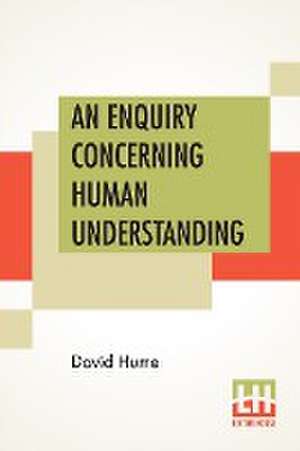
An Enquiry Concerning Human Understanding
Autor David Humeen Limba Engleză Paperback – 21 iun 2019
Preț: 69.76 lei
Puncte Express: 105
Carte tipărită la comandă
Livrare economică 05-19 iunie
Specificații
ISBN-13: 9789353422868
ISBN-10: 9353422868
Pagini: 112
Dimensiuni: 156 x 234 x 6 mm
Greutate: 0.18 kg
Editura: Lector House
ISBN-10: 9353422868
Pagini: 112
Dimensiuni: 156 x 234 x 6 mm
Greutate: 0.18 kg
Editura: Lector House
V-ar putea interesa
-
 Owning Your Own ShadowRobert A. JohnsonPreț: 85.23 lei
 -
 -17%Preț: 76.37 lei92.26 lei
 -
 Through the Language GlassGuy Deutscher-19%Preț: 61.78 lei76.36 lei
 -
 Heart of DarknessJoseph Conrad-30%Preț: 42.59 lei60.73 lei
 -
 Hume: A Very Short IntroductionJames A. Harris-21%Preț: 53.12 lei67.58 lei
 -
 Preț: 53.37 lei
 -
 The Problem of EvilPeter Van InwagenPreț: 239.67 lei
 -
 David Hume: A Treatise of Human Nature: Volume 1: TextsDavid Fate Norton-13%Preț: 295.86 lei339.73 lei
 -
 Good God: The Theistic Foundations of MoralityDavid Baggett-10%Preț: 277.77 lei307.63 lei
 -
 God and Cosmos: Moral Truth and Human MeaningDavid Baggett-12%Preț: 349.26 lei398.10 lei
 -
 The Evidential Argument from EvilDaniel Howard–snyderPreț: 208.24 lei
 -
 CosmosCarl SaganPreț: 116.91 lei
 -
 Preț: 261.39 lei
 -
 The Moral LandscapeSam Harris-19%Preț: 61.36 lei76.09 lei
 -
 FoundationIsaac Asimov-20%Preț: 49.00 lei61.53 lei
 -
 Second FoundationIsaac Asimov-37%Preț: 38.24 lei61.14 lei
 -
 Foundation and EmpireIsaac Asimov-29%Preț: 43.83 lei61.47 lei
 -
 The Grand DesignLeonard Mlodinow-29%Preț: 73.88 lei103.96 lei
 -
 The Problem of EvilDaniel SpeakPreț: 133.56 lei
 -
 -13%Preț: 102.03 lei116.66 lei
 -
 Metaphysics – The Big Questions 2eP van InwagenPreț: 316.65 lei
 -
 A Treatise of Human NatureDavid HumePreț: 71.21 lei
 -
 Three Dialogues Between Hylas and PhilonousGeorge BerkeleyPreț: 46.70 lei
 -
 The Problems of PhilosophyBertrand RussellPreț: 38.67 lei
 -
 Preț: 282.95 lei
 -
 An Essay Concerning Human UnderstandingJohn LockePreț: 46.45 lei
 -
 Freedom from the KnownJ. Krishnamurti-34%Preț: 57.89 lei87.19 lei
 -
 Preț: 87.91 lei
 -
 Teoria sentimentelor moraleADAM SMITHPreț: 55.00 lei
 -
 Enquiry Concerning Human UnderstandingDavid HumePreț: 95.17 lei
Descriere
Descriere de la o altă ediție sau format:
Oxford Philosophical Texts Series Editor: John Cottingham The Oxford Philosophical Texts series consists of authoritative teaching editions of canonical texts in the history of philosophy from the ancient world down to modern times. Each volume provides a clear, well laid out text together with a comprehensive introduction by a leading specialist, giving the student detailed critical guidance on the intellectual context of the work and the structure and philosophical importance of the main arguments. Endnotes are supplied which provide further commentary on the arguments and explain unfamiliar references and terminology, and a full bibliography and index are also included. The series aims to build up a definitive corpus of key texts in the Western philosophical tradition, which will form a reliable and enduring resource for students and teachers alike. David Hume's aim in writing An Enquiry concerning Human Understanding (1748) was to introduce his philosophy to a European culture in which many educated people read original works of philosophy. He gives an elegant and accessible presentation of strikingly original and challenging views about the limited powers of human understanding, the attractions of scepticism, the compatibility of free will and determinism, and weaknesses in the foundations of religion. Hume's philosophy was highly controversial in the eighteenth century and remains so today.The text printed in this edition is that of the Clarendon critical edition of Hume's works. A substantial introduction by the editor explains the intellectual background to the work and surveys its main themes. The volume also includes detailed explanatory notes on the text, a glossary of terms, a full list of references, and a section of supplementary readings.
Oxford Philosophical Texts Series Editor: John Cottingham The Oxford Philosophical Texts series consists of authoritative teaching editions of canonical texts in the history of philosophy from the ancient world down to modern times. Each volume provides a clear, well laid out text together with a comprehensive introduction by a leading specialist, giving the student detailed critical guidance on the intellectual context of the work and the structure and philosophical importance of the main arguments. Endnotes are supplied which provide further commentary on the arguments and explain unfamiliar references and terminology, and a full bibliography and index are also included. The series aims to build up a definitive corpus of key texts in the Western philosophical tradition, which will form a reliable and enduring resource for students and teachers alike. David Hume's aim in writing An Enquiry concerning Human Understanding (1748) was to introduce his philosophy to a European culture in which many educated people read original works of philosophy. He gives an elegant and accessible presentation of strikingly original and challenging views about the limited powers of human understanding, the attractions of scepticism, the compatibility of free will and determinism, and weaknesses in the foundations of religion. Hume's philosophy was highly controversial in the eighteenth century and remains so today.The text printed in this edition is that of the Clarendon critical edition of Hume's works. A substantial introduction by the editor explains the intellectual background to the work and surveys its main themes. The volume also includes detailed explanatory notes on the text, a glossary of terms, a full list of references, and a section of supplementary readings.
Notă biografică
David Hume (/hjüm/; born David Home; 7 May 1711 NS (26 April 1711 OS) - 25 August 1776)[9] was a Scottish Enlightenment philosopher, historian, economist, and essayist, who is best known today for his highly influential system of philosophical empiricism, scepticism, and naturalism.[1] Beginning with A Treatise of Human Nature (1739-40), Hume strove to create a naturalistic science of man that examined the psychological basis of human nature. Hume argued against the existence of innate ideas, positing that all human knowledge derives solely from experience. This places him with Francis Bacon, Thomas Hobbes, John Locke, and George Berkeley, as a British Empiricist.[10]
Hume argued that inductive reasoning and belief in causality cannot be justified rationally; instead, they result from custom and mental habit. We never actually perceive that one event causes another, but only experience the "constant conjunction" of events. This problem of induction means that to draw any causal inferences from past experience it is necessary to presuppose that the future will resemble the past, a presupposition which cannot itself be grounded in prior experience.[11]
An opponent of philosophical rationalists, Hume held that passions rather than reason govern human behaviour, famously proclaiming that "Reason is, and ought only to be the slave of the passions".[10] Hume was also a sentimentalist who held that ethics are based on emotion or sentiment rather than abstract moral principle. He maintained an early commitment to naturalistic explanations of moral phenomena, and is usually taken to have first clearly expounded the is-ought problem, or the idea that a statement of fact alone can never give rise to a normative conclusion of what ought to be done.[12]
Hume also denied that humans have an actual conception of the self, positing that we experience only a bundle of sensations, and that the self is nothing more than this bundle of causally-connected perceptions. Hume's compatibilist theory of free will takes causal determinism as fully compatible with human freedom.[13] His views on philosophy of religion, including his rejection of miracles and the argument from design for God's existence, were especially controversial for their time.
Hume influenced utilitarianism, logical positivism, the philosophy of science, early analytic philosophy, cognitive science, theology, and many other fields and thinkers. Immanuel Kant credited Hume as the inspiration who had awakened him from his "dogmatic slumbers".
Recenzii
Tom Beauchamp has produced two excellent editions, which will remain the standard editions of both Enquiries for years to come. An enormous amount of research has gone into this edition. . . Tom Beauchamp [has given] thirty years of devotion to the writings of Hume brought to . . . a splendid conclusion, . . . Beauchamp has attended to "the extreme Accuracy of Style" that Hume demanded and has produced reliable texts of the two enquires, edited to the highest standards.