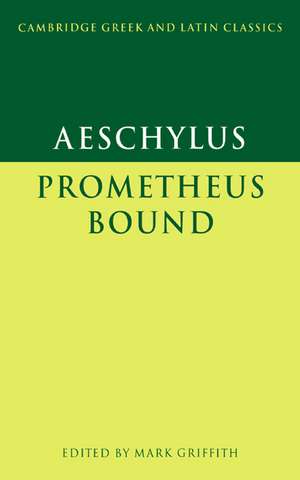
Aeschylus
Autor Aeschylus Editat de Mark Griffith, P. E. Easterlingen Limba Engleză Paperback – 27 noi 2003
Preț: 352.56 lei
Puncte Express: 529
Carte tipărită la comandă
Livrare economică 02-16 decembrie
Livrare prin curier în România Termenul estimat este afișat lângă disponibilitate.
Transport gratuit de la 400.00 lei Plată online sau ramburs, în funcție de opțiunile comenzii.
Retur gratuit în 14 zile Comandă securizată și suport în română.
Specificații
ISBN-13: 9780521270113
ISBN-10: 0521270111
Pagini: 328
Ilustrații: illustrations, map, bibliography, index
Dimensiuni: 127 x 203 x 19 mm
Greutate: 0.4 kg
Editura: Cambridge University Press
Locul publicării:Cambridge, United Kingdom
ISBN-10: 0521270111
Pagini: 328
Ilustrații: illustrations, map, bibliography, index
Dimensiuni: 127 x 203 x 19 mm
Greutate: 0.4 kg
Editura: Cambridge University Press
Locul publicării:Cambridge, United Kingdom
V-ar putea interesa
-
 The Mighty DeadAdam NicolsonPreț: 80.66 lei
-
 Aristophanes' FrogsMark Griffith-13%Preț: 301.22 lei346.15 lei
-
 The IliadHomer-22%Preț: 164.15 lei210.67 lei
-
 The Oxford Companion to Classical LiteratureM.C. HowatsonPreț: 137.84 lei
-
 Latin Course for Schools Part 3L.A. WildingPreț: 164.61 lei
-
 Sophocles: ElectraMichael LloydPreț: 180.69 lei
-
 Classics and the Bible: Hospitality and RecognitionDr John Taylor-11%Preț: 256.34 lei287.29 lei
-
 Euripides: Suppliant WomenIan C. Storey-17%Preț: 180.85 lei217.03 lei
-
 Aeschylean TragedyAlan H. SommersteinPreț: 335.66 lei
-
 Writing Ancient PersiaDr Thomas Harrison-14%Preț: 167.65 lei195.74 lei
-
 Homer: Iliad IHomer-22%Preț: 162.07 lei207.77 lei
-
 The FabliauxNathaniel E. DubinPreț: 201.44 lei
-
 Linear B: An IntroductionJ.T. Hooker-27%Preț: 213.20 lei292.82 lei
-
 AgamemnonAeschylusPreț: 111.87 lei
-
 -15%Preț: 124.54 lei147.34 lei
-
 SenecaChristopher Star-21%Preț: 157.11 lei200.06 lei
-
 OvidCarole E. Newlands-16%Preț: 141.69 lei169.51 lei
-
 Preț: 143.86 lei
-
 Molière: Le TartuffeMolière-17%Preț: 162.02 lei195.64 lei
-
 Zoshchenko: Stories of the 1920sA. Murphy-5%Preț: 161.01 lei169.83 lei
-
 The House of AtreusAeschylusPreț: 155.41 lei
-
 Preț: 125.61 lei
Cuprins
Map; Preface; Introduction; 1. The myth; 2. The plot; 3. The characters; 4. Structure and dramatic technique; 5. Style and metre; 6. The production; 7. Authenticity and date; 8. The text; List of manuscripts; Prometheus Bound; Commentary; Appendix; Bibliography; Index.
Descriere
Mark Griffith examines Hesiod's morality tale of Prometheus and the Aeschylus play, Prometheus Bound.
Notă biografică
Aeschylus (525-456 BC) The father of Greek tragic drama, usually considered the first great writer in the Western theatrical tradition. Only seven plays, of over 70 known titles, are extant. These are The Persians (472 BC), Seven Against Thebes (469 BC), Prometheus Bound (c. 460 BC), The Suppliant Women (c. 460 BC), and the Oresteia trilogy (458 BC), comprising Agamemnon, Choephoroi, and Eumenides. He also wrote numerous satyr plays, which have only survived in fragmentary form. Aeschylus's work is powerful and operatic, using majestic but often innovative language. His attitude to Greek society and religion was generally conservative, although he boldly depicted the sufferings of men and woman when moral systems, and the gods themselves, are in conflict. Legend says he was killed by a tortoise dropped by an eagle (to break the shell) on his bald head (mistaken for a stone). His tombstone makes no mention of his literary works, referring only to his service at the Battle of Marathon (490 BC).