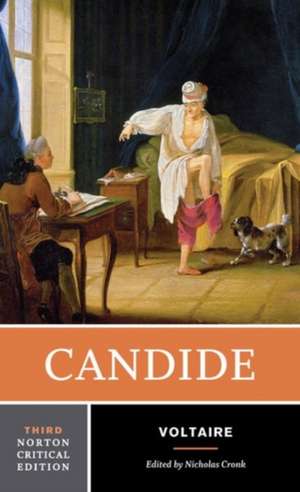
Voltaire: Candide
en Limba Engleză Paperback – 15 apr 2016
The Norton Critical Edition also includes:
- A full introduction by Nicholas Cronk.
- Six background studies of Enlightenment ideas and themes (by Richard Holmes, Adam Gopnik, W. H. Barber, Dennis Fletcher, Haydn Mason, and Nicholas Cronk), five of these new to the Third Edition.
- Seven critical essays--five of them new to this edition--representing a wide range of approaches to Candide. Contributors include J. G. Weightman, Robin Howells, James J. Lynch, Philip Stewart, Erich Auerbach, and Jean Starobinski.
- A revised and expanded Selected Bibliography.
Preț: 129.26 lei
Carte disponibilă
Livrare economică 07-21 octombrie
Livrare express 23-29 septembrie pentru 20.32 lei
Specificații
ISBN-10: 0393932524
Pagini: 280
Dimensiuni: 132 x 210 x 17 mm
Greutate: 0.24 kg
Ediția:Critică
Editura: W. W. Norton & Company
V-ar putea interesa
-
 FrankensteinMary ShelleyPreț: 28.01 lei
 -
 DublinersJames JoycePreț: 28.01 lei
 -
 The TempestWilliam ShakespearePreț: 28.93 lei
 -
 XINVISIBLE MAN_CLASSICS PBH. G. WellsPreț: 28.01 lei
 -
 BeautyRobin MckinleyPreț: 57.36 lei
 -
 Kafka on the ShoreHaruki Murakami-24%Preț: 60.01 lei79.22 lei
 -
 Lords of the HorizonsJason Goodwin-19%Preț: 74.49 lei92.03 lei
 -
 Rameaus Nephew / Dalemberts DreamDenis DiderotPreț: 91.53 lei
 -
 Black MassJohn Gray-19%Preț: 63.80 lei78.47 lei
 -
 NauseaJean-Paul SartrePreț: 77.31 lei
 -
 The Woman in the DunesKobo AbePreț: 77.41 lei
 -
 Beautifull CassandraJane Austen-39%Preț: 17.06 lei27.98 lei
 -
 Waking, Dreaming, BeingEvan ThompsonPreț: 162.97 lei
 -
 The Legend of the SleepersDanilo Kiš-21%Preț: 16.08 lei20.40 lei
 -
 LanceVladimir Nabokov-39%Preț: 16.86 lei27.86 lei
 -
 Of Dogs and WallsYuko Tsushima-39%Preț: 16.86 lei27.86 lei
 -
 -17%Preț: 172.42 lei207.33 lei
 -
 Of Mice and MenJohn Steinbeck-29%Preț: 49.08 lei69.09 lei
 -
 -5%Preț: 330.68 lei348.08 lei
 -
 What I BelieveBertrand RussellPreț: 129.87 lei
 -
 The Baklava ClubJason GoodwinPreț: 71.24 lei
 -
 The Wheel of Time Premium Boxed Set IIIRobert JordanPreț: 251.75 lei
 -
 OedipusVoltairePreț: 98.35 lei
 -
 Candide and L'IngénuVoltaire Voltaire-32%Preț: 56.70 lei83.19 lei
 -
 Stoicism TodayPatrick UssherPreț: 78.70 lei
 -
 2,100 Asanas: The Complete Yoga PosesDaniel Lacerda-21%Preț: 248.50 lei312.70 lei
 -
 The Telomere Effect: A Revolutionary Approach to Living Younger, Healthier, LongerDr Elizabeth Blackburn-26%Preț: 73.20 lei99.41 lei
 -
 The Divine ComedyDante AlighieriPreț: 45.74 lei
 -
 In the Dust of This Planet - Horror of Philosophy vol. 1Eugene ThackerPreț: 90.62 lei
 -
 HamletWilliam ShakespearePreț: 29.85 lei
Descriere
"Candide" is the story of a gentle man who, though pummeled and slapped in every direction by fate, clings desperately to the belief that he lives in "the best of all possible worlds." On the surface a witty, bantering tale, this eighteenth-century classic is actually a savage, satiric thrust at the philosophical optimism that proclaims that all disaster and human suffering is part of a benevolent cosmic plan. Fast, funny, often outrageous, the French philosopher's immortal narrative takes Candide around the world to discover that -- contrary to the teachings of his distringuished tutor Dr. Pangloss -- all is not always for the best. Alive with wit, brilliance, and graceful storytelling, "Candide" has become Voltaire's most celebrated work.
Notă biografică
By his mid-thirties his literary activities precipitated a four-year exile in England where he won the praise of Swift and Pope for his political tracts. His publication, three years later in France, of Lettres philosophiques sur les Anglais (1733)—an attack on French Church and State—forced him to flee again. For twenty years Voltaire lived chiefly away from Paris. In this, his most prolific period, he wrote such satirical tales as “Zadig” (1747) and “Candide” (1759). His old age at Ferney, outside Geneva, was made bright by his adopted daughter, “Belle et Bonne,” and marked by his intercessions in behalf of victims of political injustice. Sharp-witted and lean in his white wig, impatient with all appropriate rituals, he died in Paris in 1778—the foremost French author of his day.