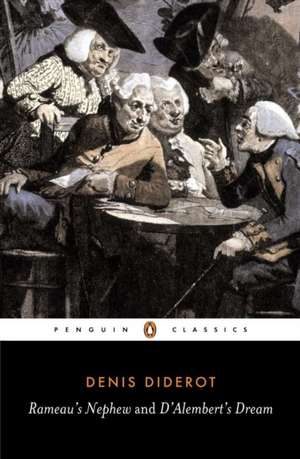
Rameaus Nephew / Dalemberts Dream
Autor Denis Dideroten Limba Engleză Paperback – 30 sep 2004
Preț: 93.16 lei
Puncte Express: 140
Carte disponibilă
Livrare economică 13-27 noiembrie
Livrare express 30 octombrie-05 noiembrie pentru 20.81 lei
Livrare prin curier în România Termenul estimat este afișat lângă disponibilitate.
Transport gratuit de la 400.00 lei Plată online sau ramburs, în funcție de opțiunile comenzii.
Retur gratuit în 14 zile Comandă securizată și suport în română.
Specificații
ISBN-13: 9780140441734
ISBN-10: 0140441735
Pagini: 242
Ilustrații: illustrations
Dimensiuni: 111 x 181 x 15 mm
Greutate: 0.23 kg
Editura: Penguin Classics
Locul publicării:London, United Kingdom
ISBN-10: 0140441735
Pagini: 242
Ilustrații: illustrations
Dimensiuni: 111 x 181 x 15 mm
Greutate: 0.23 kg
Editura: Penguin Classics
Locul publicării:London, United Kingdom
V-ar putea interesa
-
 Preț: 35.82 lei
 -
 ReflectionsSunny FransonPreț: 78.11 lei
 -
 MourningtideDiana M WilderPreț: 118.29 lei
 -
 ...And On The 7th Day, She Rests...Elizabeth Hope BrownPreț: 102.64 lei
 -
 OedipusVoltairePreț: 98.35 lei
 -
 When the Yule Log BurnsLeona DalrymplePreț: 34.13 lei
 -
 A Christmas Story. a Man in His ElementDr Samuel W. FrancisPreț: 64.74 lei
 -
 EudemiaIani Nicii ErythraeiPreț: 75.38 lei
 -
 Mundus Alter Et IdemJoseph HallPreț: 80.85 lei
 -
 Ruth SawyerRuth SawyerPreț: 64.64 lei
 -
 A Man of the WorldAnnie Payson CallPreț: 64.17 lei
 -
 George Manville FennGeorge Manville FennPreț: 83.37 lei
 -
 Saint Paul Trois ChateauxC. Joybell CPreț: 76.39 lei
 -
 Last of the StrawberriesJune PettittPreț: 122.59 lei
 -
 Lettres a FalconetDenis DiderotPreț: 99.31 lei
 -
 de La Suffisance de La Religion NaturelleDenis DiderotPreț: 60.28 lei
 -
 Correspondance GeneraleDenis DiderotPreț: 91.39 lei
 -
 Madame de La CarliereDenis DiderotPreț: 54.78 lei
 -
 Magnolia ParkKate MccabePreț: 111.37 lei
 -
 Flying Without a NetE. M. Ben ShaulPreț: 96.14 lei
 -
 The Shape of the AtmospshereJessica DaintyPreț: 89.07 lei
Notă biografică
Denis Diderot was born at Langres in eastern France in 1713, the son of a master cutler. He was originally destined for the Church but rebelled and persuaded his father to allow him to complete his education in Paris, where he graduated in 1732. For ten years Diderot was nominally a law student, but actually led a precarious bohemian but studious existence, eked out with tutoring, hack-writing and translating. His original writing began in 1746 with a number of scientific works setting out the materialist philosophy which he was to hold throughout his life. Along with his editorship of the Encyclopédie (1747-73), he wrote works on mathematics, medicine, the life sciences, economics, drama and painting, two plays and a novel, as well as his Salons (1759-81). His political writings were mainly composed around 1774 for Catherine II, at whose invitation he went to St. Petersburg. Diderot's astonishingly wide range of interests, together with his growing prediliction for the dialogue form, led to the production of his most famous works: D'Alembert's Dream, The Paradox of the Actor, Jacques the Fatalist and Rameau's Nephew. During the latter part of his life Diderot received a generous pension from Catherine II, in return for which he bequeathed her his library and manuscripts. He died in 1784.