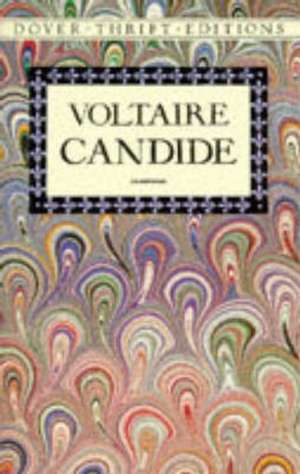
Voltaire: Candide
en Limba Engleză Paperback – feb 2000
Caustic and hilarious, "Candide" has ranked as one of the world's great satires since its first publication in 1759. It concerns the adventures of the youthful Candide, disciple of Dr. Pangloss, who was himself a disciple of Leibniz. In the course of his travels and adventures in Europe and South America, Candide saw and suffered such misfortune that it was difficult for him to believe this was "the best of all possible worlds" as Dr. Pangloss had assured him. Indeed, it seemed to be quite the opposite. In brilliantly skewering such naivete, Voltaire mercilessly exposes and satirizes romance, science, philosophy, religion, and government the ideas and forces that permeate and control the lives of men.
After many trials and travails, Candide is reunited with Cunegonde, his sweetheart. He then buys a little farm in Turkey where he and Cunegonde, Dr. Pangloss and others all retire. In the end, Candide decides that the best thing in the world is to cultivate one's own garden. A selection of the Common Core State Standards Initiative."
Preț: 35.82 lei
Carte disponibilă
Livrare economică 10-24 noiembrie
Livrare express 27-31 octombrie pentru 14.25 lei
Specificații
ISBN-10: 0486266893
Pagini: 112
Dimensiuni: 133 x 209 x 8 mm
Greutate: 0.09 kg
Ediția:Dover.
Editura: Dover Publications Inc.
Locul publicării:United States
V-ar putea interesa
-
 FrankensteinMary ShelleyPreț: 28.01 lei
 -
 DublinersJames JoycePreț: 28.01 lei
 -
 The TempestWilliam ShakespearePreț: 29.03 lei
 -
 XINVISIBLE MAN_CLASSICS PBH. G. WellsPreț: 28.01 lei
 -
 BeautyRobin MckinleyPreț: 59.61 lei
 -
 Kafka on the ShoreHaruki Murakami-24%Preț: 61.49 lei80.62 lei
 -
 Lords of the HorizonsJason Goodwin-19%Preț: 75.72 lei93.52 lei
 -
 Rameaus Nephew / Dalemberts DreamDenis DiderotPreț: 93.16 lei
 -
 Black MassJohn Gray-18%Preț: 65.33 lei79.72 lei
 -
 NauseaJean-Paul SartrePreț: 78.69 lei
 -
 The Woman in the DunesKobo AbePreț: 78.79 lei
 -
 Beautifull CassandraJane Austen-39%Preț: 17.49 lei28.48 lei
 -
 Waking, Dreaming, BeingEvan ThompsonPreț: 168.56 lei
 -
 The Legend of the SleepersDanilo Kiš-21%Preț: 16.08 lei20.40 lei
 -
 LanceVladimir Nabokov-39%Preț: 17.27 lei28.37 lei
 -
 Of Dogs and WallsYuko Tsushima-39%Preț: 17.26 lei28.37 lei
 -
 -16%Preț: 176.65 lei211.03 lei
 -
 Of Mice and MenJohn Steinbeck-29%Preț: 49.89 lei70.16 lei
 -
 -5%Preț: 331.90 lei349.37 lei
 -
 What I BelieveBertrand RussellPreț: 133.78 lei
 -
 The Baklava ClubJason GoodwinPreț: 71.24 lei
 -
 The Wheel of Time Premium Boxed Set IIIRobert JordanPreț: 260.38 lei
 -
 OedipusVoltairePreț: 98.35 lei
 -
 Candide and L'IngénuVoltaire Voltaire-32%Preț: 56.82 lei83.52 lei
 -
 Stoicism TodayPatrick UssherPreț: 78.70 lei
 -
 2,100 Asanas: The Complete Yoga PosesDaniel Lacerda-20%Preț: 254.87 lei318.17 lei
 -
 The Telomere Effect: A Revolutionary Approach to Living Younger, Healthier, LongerDr Elizabeth Blackburn-26%Preț: 74.98 lei101.10 lei
 -
 The Divine ComedyDante AlighieriPreț: 46.55 lei
 -
 In the Dust of This PlanetEugene ThackerPreț: 92.35 lei
 -
 HamletWilliam ShakespearePreț: 30.47 lei
Descriere
"Candide" is the story of a gentle man who, though pummeled and slapped in every direction by fate, clings desperately to the belief that he lives in "the best of all possible worlds." On the surface a witty, bantering tale, this eighteenth-century classic is actually a savage, satiric thrust at the philosophical optimism that proclaims that all disaster and human suffering is part of a benevolent cosmic plan. Fast, funny, often outrageous, the French philosopher's immortal narrative takes Candide around the world to discover that -- contrary to the teachings of his distringuished tutor Dr. Pangloss -- all is not always for the best. Alive with wit, brilliance, and graceful storytelling, "Candide" has become Voltaire's most celebrated work.