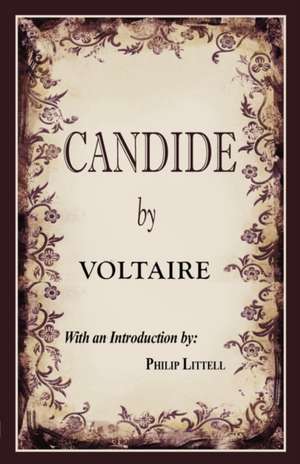
Voltaire: Candide
en Limba Engleză Paperback – 2 feb 2009
Whether Candide and optimism itself emerges unscathed in the end, hinges upon his own deceptively simple words: "let us cultivate our garden."
Preț: 85.09 lei
Puncte Express: 128
Cartea nu mai face parte din oferta noastră
Livrare prin curier în România Termenul estimat este afișat lângă disponibilitate.
Transport gratuit de la 400.00 lei Plată online sau ramburs, în funcție de opțiunile comenzii.
Retur gratuit în 14 zile Comandă securizată și suport în română.
Specificații
ISBN-13: 9781604503524
ISBN-10: 1604503521
Pagini: 132
Dimensiuni: 140 x 216 x 7 mm
Greutate: 0.18 kg
Editura: Tark Classic Fiction
Locul publicării:United States
ISBN-10: 1604503521
Pagini: 132
Dimensiuni: 140 x 216 x 7 mm
Greutate: 0.18 kg
Editura: Tark Classic Fiction
Locul publicării:United States
V-ar putea interesa
-
 Robinson CrusoeDaniel DefoePreț: 28.01 lei
 -
 Miracles and IdolatryVoltaire-30%Preț: 39.97 lei56.70 lei
 -
 Candide and Other StoriesVoltairePreț: 47.32 lei
 -
 A Pocket Philosophical DictionaryVoltaire-20%Preț: 68.09 lei85.17 lei
 -
 Preț: 61.37 lei
 -
 Voltaire: A Very Short IntroductionNicholas Cronk-20%Preț: 57.15 lei71.12 lei
 -
 The World as Will and Representation, Vol. 2Arthur Schopenhauer-34%Preț: 153.40 lei233.34 lei
 -
 Candide: A Dual-Language BookVoltaire-20%Preț: 81.34 lei101.57 lei
 -
 MeditationsMarcus AureliusPreț: 34.00 lei
 -
 -17%Preț: 80.93 lei97.84 lei
 -
 The Great Philosophers: VoltaireJohn Gray-29%Preț: 29.65 lei41.51 lei
 -
 Candide and L'IngénuVoltaire Voltaire-32%Preț: 56.82 lei83.52 lei
 -
 Candide, or The OptimistVoltaire-36%Preț: 49.20 lei76.56 lei
 -
 -17%Preț: 130.05 lei157.10 lei
 -
 CandideVoltairePreț: 49.86 lei
 -
 The Best of All Possible WorldsMichael KempePreț: 93.61 lei
 -
 Candide and Other WorksVoltairePreț: 28.01 lei
 -
 Gulliver's TravelsJonathan SwiftPreț: 36.47 lei
 -
 Preț: 68.90 lei
 -
 UtopiaThomas MorePreț: 33.19 lei
Notă biografică
François-Marie Arouet, writing under the pseudonym Voltaire, was born in 1694 into a Parisian bourgeois family. Educated by Jesuits, he was an excellent pupil but one quickly enraged by dogma. An early rift with his father—who wished him to study law—led to his choice of letters as a career. Insinuating himself into court circles, he became notorious for lampoons on leading notables and was twice imprisoned in the Bastille.
By his mid-thirties his literary activities precipitated a four-year exile in England where he won the praise of Swift and Pope for his political tracts. His publication, three years later in France, of Lettres philosophiques sur les Anglais (1733)—an attack on French Church and State—forced him to flee again. For twenty years Voltaire lived chiefly away from Paris. In this, his most prolific period, he wrote such satirical tales as “Zadig” (1747) and “Candide” (1759). His old age at Ferney, outside Geneva, was made bright by his adopted daughter, “Belle et Bonne,” and marked by his intercessions in behalf of victims of political injustice. Sharp-witted and lean in his white wig, impatient with all appropriate rituals, he died in Paris in 1778—the foremost French author of his day.
By his mid-thirties his literary activities precipitated a four-year exile in England where he won the praise of Swift and Pope for his political tracts. His publication, three years later in France, of Lettres philosophiques sur les Anglais (1733)—an attack on French Church and State—forced him to flee again. For twenty years Voltaire lived chiefly away from Paris. In this, his most prolific period, he wrote such satirical tales as “Zadig” (1747) and “Candide” (1759). His old age at Ferney, outside Geneva, was made bright by his adopted daughter, “Belle et Bonne,” and marked by his intercessions in behalf of victims of political injustice. Sharp-witted and lean in his white wig, impatient with all appropriate rituals, he died in Paris in 1778—the foremost French author of his day.