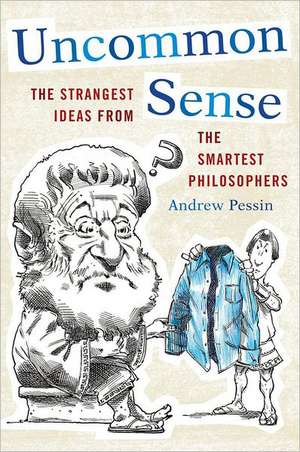
Uncommon Sense: The Strangest Ideas from the Smartest Philosophers
Autor Andrew Pessinen Limba Engleză Paperback – 3 feb 2015
You neither will, nor won't, do certain things in the future, like wear your blue shirt tomorrow. But your blue shirt isn't really blue, because colors don't exist in physical objects; they're only in your mind. Time is an illusion.Your thoughts are not inside your head.Everything you believe about morality is false.Animals don't have minds. There is no physical world at all.In eighteen lively, intelligent chapters, spanning the ancient Greeks and contemporary thinkers, Pessin examines the most unusual ideas, how they have influenced the course of Western thought, and why, despite being so odd, they just might be correct. Here is popular philosophy at its finest, sure to entertain as it enlightens.
Preț: 179.72 lei
Preț vechi: 239.28 lei
-25%
Puncte Express: 270
Carte tipărită la comandă
Livrare economică 12-26 noiembrie
Livrare prin curier în România Termenul estimat este afișat lângă disponibilitate.
Transport gratuit de la 400.00 lei Plată online sau ramburs, în funcție de opțiunile comenzii.
Retur gratuit în 14 zile Comandă securizată și suport în română.
Specificații
ISBN-13: 9781442216099
ISBN-10: 1442216093
Pagini: 228
Dimensiuni: 148 x 226 x 18 mm
Greutate: 0.32 kg
Editura: Bloomsbury Publishing
Colecția Rowman & Littlefield
Locul publicării:New York, United States
ISBN-10: 1442216093
Pagini: 228
Dimensiuni: 148 x 226 x 18 mm
Greutate: 0.32 kg
Editura: Bloomsbury Publishing
Colecția Rowman & Littlefield
Locul publicării:New York, United States
V-ar putea interesa
-
 -14%Preț: 131.37 lei153.26 lei
 -
 -18%Preț: 180.86 lei219.39 lei
 -
 Go-Givers Sell MoreBob Burg-21%Preț: 60.55 lei77.00 lei
 -
 High Performance Sales StrategiesRussell WardPreț: 145.93 lei
 -
 Selling The Invisible: A Field Guide to Modern MarketingHarry Beckwith-28%Preț: 80.43 lei112.02 lei
 -
 Eat What You Kill: Becoming a Sales CarnivoreSam Taggart-25%Preț: 161.68 lei216.94 lei
 -
 The Challenger SaleMatthew Dixon-20%Preț: 96.36 lei120.17 lei
 -
 The New Strategic SellingRobert B. MillerPreț: 306.47 lei
 -
 Insight SellingJohn E. DoerrPreț: 148.34 lei
 -
 The Sales Bible, New EditionJeffrey GitomerPreț: 130.68 lei
 -
 Fanatical ProspectingJeb BlountPreț: 155.79 lei
 -
 Preț: 105.39 lei
 -
 -28%Preț: 74.64 lei104.28 lei
 -
 The Work Smarter Guide to Sales: The 5-week Shortcut to Superb Sales PerformanceMaria Morozova-Duthoit-28%Preț: 74.40 lei104.02 lei
 -
 Preț: 182.98 lei
 -
 The 25 Sales Habits of Highly Successful SalespeopleStephan SchiffmanPreț: 58.74 lei
 -
 Customer Improvement SellingKatarina CoppéPreț: 126.57 lei
 -
 Preț: 90.94 lei
 -
 -20%Preț: 67.45 lei84.16 lei
 -
 Sales PsycheChris Hatfield-10%Preț: 97.82 lei108.94 lei
Cuprins
Introduction: "Stop Making Sense"
Chapter 1: Plato / More Than What Meets the Eye
Chapter 2: Aristotle / Neither You Will Nor You Won't
Chapter 3: Augustine / Forced to Be Free
Chapter 4: Anselm / God is Not Just a Good Idea
Chapter 5: Maimonides / Keeps Going, and Going, and Going . Or Not?
Chapter 6: Thomas Aquinas / God Has Not Been on Vacation Since the Original Creation
Chapter 7: René Descartes / "A Monstrous Thesis"
Chapter 8: John Locke / True Colors
Chapter 9: Nicolas Malebranche / On Honoring Leeks and Vegetables
Chapter 10: G. W. Leibniz / Synchronicity
Chapter 11: George Berkeley / To Be Is to Perceive, or Be Perceived
Chapter 12: David Hume / Stercus Accidit
Chapter 13: Friedrich Nietzsche / Philosopher, Psychologist-Antichrist?
Chapter 14: John McTaggart / Time Does Not Fly Even When You're Having Fun
Chapter 15: Ludwig Wittgenstein / The Voice In My Head is Speaking Nonsense
Chapter 16: Hilary Putnam / Thinking Outside the (Cranial) Box
Chapter 17: David Lewis / The Incredulous Stare
Chapter 18: Thomas Nagel, David Chalmers / Mind and Matter, Together Again at Last (Sort of)!
Chapter 1: Plato / More Than What Meets the Eye
Chapter 2: Aristotle / Neither You Will Nor You Won't
Chapter 3: Augustine / Forced to Be Free
Chapter 4: Anselm / God is Not Just a Good Idea
Chapter 5: Maimonides / Keeps Going, and Going, and Going . Or Not?
Chapter 6: Thomas Aquinas / God Has Not Been on Vacation Since the Original Creation
Chapter 7: René Descartes / "A Monstrous Thesis"
Chapter 8: John Locke / True Colors
Chapter 9: Nicolas Malebranche / On Honoring Leeks and Vegetables
Chapter 10: G. W. Leibniz / Synchronicity
Chapter 11: George Berkeley / To Be Is to Perceive, or Be Perceived
Chapter 12: David Hume / Stercus Accidit
Chapter 13: Friedrich Nietzsche / Philosopher, Psychologist-Antichrist?
Chapter 14: John McTaggart / Time Does Not Fly Even When You're Having Fun
Chapter 15: Ludwig Wittgenstein / The Voice In My Head is Speaking Nonsense
Chapter 16: Hilary Putnam / Thinking Outside the (Cranial) Box
Chapter 17: David Lewis / The Incredulous Stare
Chapter 18: Thomas Nagel, David Chalmers / Mind and Matter, Together Again at Last (Sort of)!
Recenzii
Andrew Pessin's Uncommon Sense is an uncommonly good introduction to philosophy, unpretentious in its style, and unerring in its sense of humor. It will provide both entertainment and insight to those seeking wisdom from philosophy's most incredible theories. As a philosophical tour guide for the uninitiated, Pessin is unbeatable.
Uncommon Sense is the fruit of a brilliant idea carried out with panache. The ideas explored are esoteric in the extreme, but Andrew Pessin's explanations are clear, down to earth, entertaining, and accessible. This book is an absolute goldmine for general readers curious about philosophy.
A key to understanding this book is furnished by the author's claim that 'common sense is what we believe about things when we haven't given them much thought.' So Pessin (Connecticut College) turns to what he calls strange claims of philosophers to introduce such topics as free will, God, morality, minds, and reality. The usual names appear--Plato, Aristotle, Augustine, Anselm, Maimonides, Aquinas, Descartes, Locke, and Hume. Also featured are Malebranche and Leibniz on the question of mind-body interaction, Berkeley on the nature of the external world, and Nietzsche's program for rewriting the grounds of morality. Pessin also includes contemporary philosophers John McTaggart on time, Wittgenstein on private language, Hilary Putnam on the nature of thinking, and David Lewis on possible worlds theory. The last of 18 chapters considers the view of Thomas Nagel and David Chalmers that something like mind permeates all reality. The chapters are short, the writing clear, and the tone entertaining. Each chapter contains primary and secondary sources, and the book has a good index. Looking for a book to give to someone to create interest in philosophy? This is it. Summing Up: Highly recommended. Lower- and upper-level undergraduates; general readers.
Uncommon Sense is the fruit of a brilliant idea carried out with panache. The ideas explored are esoteric in the extreme, but Andrew Pessin's explanations are clear, down to earth, entertaining, and accessible. This book is an absolute goldmine for general readers curious about philosophy.
A key to understanding this book is furnished by the author's claim that 'common sense is what we believe about things when we haven't given them much thought.' So Pessin (Connecticut College) turns to what he calls strange claims of philosophers to introduce such topics as free will, God, morality, minds, and reality. The usual names appear--Plato, Aristotle, Augustine, Anselm, Maimonides, Aquinas, Descartes, Locke, and Hume. Also featured are Malebranche and Leibniz on the question of mind-body interaction, Berkeley on the nature of the external world, and Nietzsche's program for rewriting the grounds of morality. Pessin also includes contemporary philosophers John McTaggart on time, Wittgenstein on private language, Hilary Putnam on the nature of thinking, and David Lewis on possible worlds theory. The last of 18 chapters considers the view of Thomas Nagel and David Chalmers that something like mind permeates all reality. The chapters are short, the writing clear, and the tone entertaining. Each chapter contains primary and secondary sources, and the book has a good index. Looking for a book to give to someone to create interest in philosophy? This is it. Summing Up: Highly recommended. Lower- and upper-level undergraduates; general readers.
Notă biografică
Jill Harrington slid into a sales career when she arrived in North America from the UK. A hunger to learn, the obsessive stalking of successful sales professionals, and a sincere interest in people and business took her from front line to executive suite. As president of salesSHIFT, she helps sales teams from diverse industries shift the way they think and act, enabling them to drive bigger results in highly competitive markets. Her brand of fresh thinking and "tell it as it is" communication style have garnered stellar reviews from conference audiences on four continents. She has contributed to business and trade publications in North America, and her salesSHIFT blog was voted one of the top 50 sales blogs worldwide by Top Sales World.