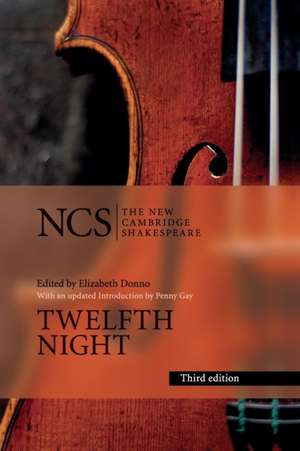
Twelfth Night: Or What You Will: The New Cambridge Shakespeare
Autor William Shakespeare Editat de Elizabeth Story Donno Introducere de Penny Gayen Limba Engleză Paperback – 16 aug 2017
Din seria The New Cambridge Shakespeare
-
 Preț: 78.08 lei
 -
 Preț: 72.13 lei
 - 15%
 Preț: 65.21 lei
 -
 Preț: 75.09 lei
 -
 Preț: 80.03 lei
 -
 Preț: 77.46 lei
 - 19%
 Preț: 490.86 lei
 -
 Preț: 79.84 lei
 -
 Preț: 81.20 lei
 -
 Preț: 75.87 lei
 -
 Preț: 73.13 lei
 -
 Preț: 72.13 lei
 - 19%
 Preț: 493.84 lei
 -
 Preț: 70.11 lei
 -
 Preț: 77.06 lei
 -
 Preț: 73.13 lei
 - 19%
 Preț: 493.12 lei
 -
 Preț: 76.75 lei
 - 8%
 Preț: 481.57 lei
 -
 Preț: 82.99 lei
 - 19%
 Preț: 469.31 lei
 -
 Preț: 75.09 lei
 -
 Preț: 81.03 lei
 - 19%
 Preț: 492.82 lei
 -
 Preț: 78.08 lei
 -
 Preț: 82.99 lei
 - 19%
 Preț: 489.35 lei
 -
 Preț: 76.67 lei
 -
 Preț: 78.08 lei
 -
 Preț: 76.10 lei
Preț: 73.13 lei
Puncte Express: 110
Preț estimativ în valută:
12.92€ • 14.98$ • 11.27£
12.92€ • 14.98$ • 11.27£
Carte disponibilă
Livrare economică 24 aprilie-08 mai
Livrare express 10-16 aprilie pentru 36.78 lei
Specificații
ISBN-13: 9781107565463
ISBN-10: 1107565464
Pagini: 194
Ilustrații: 20 b/w illus.
Dimensiuni: 152 x 228 x 9 mm
Greutate: 0.32 kg
Ediția:3Revizuită
Editura: Cambridge University Press
Colecția Cambridge University Press
Seria The New Cambridge Shakespeare
Locul publicării:New York, United States
ISBN-10: 1107565464
Pagini: 194
Ilustrații: 20 b/w illus.
Dimensiuni: 152 x 228 x 9 mm
Greutate: 0.32 kg
Ediția:3Revizuită
Editura: Cambridge University Press
Colecția Cambridge University Press
Seria The New Cambridge Shakespeare
Locul publicării:New York, United States
V-ar putea interesa
-
 Pride and PrejudiceJane AustenPreț: 24.60 lei
 -
 MacbethWilliam ShakespearePreț: 28.47 lei
 -
 The Secret GardenFrances Hodgson BurnettPreț: 24.60 lei
 -
 The TempestWilliam ShakespearePreț: 27.81 lei
 -
 A Midsummer Night's DreamWilliam ShakespearePreț: 28.01 lei
 -
 The MartianAndy Weir-15%Preț: 42.16 lei49.59 lei
 -
 Death of a SalesmanArthur Miller-29%Preț: 47.63 lei67.31 lei
 -
 AmadeusPeter Shaffer-22%Preț: 52.48 lei67.17 lei
 -
 A Streetcar Named DesireTennessee WilliamsPreț: 67.33 lei
 -
 Oxford School Shakespeare: Twelfth NightWilliam ShakespearePreț: 53.34 lei
 -
 AvengerFrederick Forsyth-31%Preț: 65.61 lei94.65 lei
 -
 Complete Dramatic WorksSamuel BeckettPreț: 137.27 lei
 -
 -36%Preț: 56.22 lei87.77 lei
 -
 BurnPatrick NessPreț: 56.90 lei
 -
 The Seven Deaths of Evelyn HardcastleStuart Turton-31%Preț: 53.29 lei77.33 lei
 -
 The NightingaleKristin HannahPreț: 46.92 lei
 -
 Apt Pupil: An iconic story from the No. 1 bestsellerStephen King-28%Preț: 53.88 lei74.94 lei
 -
 The Fall of the House of Usher (Special Edition)Edgar Allan PoePreț: 42.00 lei
 -
 A Midsummer Night's DreamWilliam ShakespearePreț: 34.22 lei
 -
 Pocket Tutor NeuroimagingRory Piper-5%Preț: 129.71 lei136.54 lei
 -
 The Old Man and the SeaHans-Christian OeserPreț: 48.61 lei
 -
 Preț: 131.72 lei
Cuprins
Preface to the first edition; Preface; Abbreviations and conventions; Introduction Penny Gay; Note on the text; List of characters; The play; Textual analysis; Reading list.
Notă biografică
Keir Elam is a Professor of English Literature at the University of Bologna, where he is Head of the Department of Modern Languages.
Descriere
The third New Cambridge edition of Shakespeare's Twelfth Night, updated by Penny Gay for the contemporary student reader.
Textul de pe ultima copertă
Twelfth Night has seldom been off the stage since Shakespeare's day. It has been performed for its romantic high comedy and its boisterous low comedy; with an emphasis on farce or on autumnal melancholy; as straightforward celebration of heterosexual love and marriage or as exploration of the complexity of gender. David Carnegie and Mark Houlahan's introduction to the play provides a lively discussion of the play's performance history, and encourages readers to think about stagecraft and the play as a performance text, while the historical appendices provide materials that illuminate different thematic elements of the play. Extended notes interleaved throughout the play present relevant illustrations and expand on mythological, historical, and religious references in the play. The accompanying online text will offer additional commentary on staging alternatives and more extensive visual materials.
Recenzii
Gayle Gaskill offers appropriate tribute to G.L. Kittredge by updating his classic edition with a mastery, thoroughness, and verve worthy of the original. This excellent edition is marked by impeccable scholarship that everywhere displays careful attention to detail and keen sensitivity to the needs of modern readers.
—John W. Mahon, Co-Editor, The Shakespeare Newsletter, and Professor of English, Iona College.
—John W. Mahon, Co-Editor, The Shakespeare Newsletter, and Professor of English, Iona College.
Even as the New Kittredge Shakespeare series glances back to George Lyman Kittredge's student editions of the plays, it is very much of our current moment: the slim editions are targeted largely at high school and first-year college students who are more versed in visual than in print culture. Not only are the texts of the plays accompanied by photographs or stills from various stage and cinema performances: the editorial contributions are performance-oriented, offering surveys of contemporary film interpretations, essays on the plays as performance pieces, and an annotated filmography. Traditional editorial issues (competing versions of the text, cruxes, editorial emendation history) are for the most part excluded; the editions focus instead on clarifying the text with an eye to performing it. There is no disputing the pedagogic usefulness of the New Kittredge Shakespeare's performance-oriented approach. At times, however, it can run the risk of treating textual issues as impediments, rather than partners, to issues of performance. This is particularly the case with a textually vexed play such as Pericles: Prince of Tyre. In the introduction to the latter, Jeffrey Kahan notes the frequent unintelligibility of the play as originally published: "the chances of a reconstructed text matching what Shakespeare actually wrote are about 'nil'" (p. xiii) But his solution — to use a "traditional text" rather than one corrected as are the Oxford and Norton Pericles — obscures how this "traditional text," including its act and scene division, is itself a palimpsest produced through three centuries of editorial intervention. Nevertheless, the series does a service to its target audience with its emphasis on performance and dramaturgy. Kahan's own essay about his experiences as dramaturge for a college production of Pericles is very good indeed, particularly on the play's inability to purge the trace of incestuous desire that Pericles first encounters in Antioch. Other plays' cinematic histories: Annalisa Castaldo's edition of Henry V contrasts Laurence Oliver's and Branagh's film productions; Samuel Crowl's and James Wells's edition of (respectively) I and 2 Henry IV concentrate on Welle's Chimes at Midnight and Gus Van Sant's My Own Private Idaho; Patricia Lennox's edition of As You Like It offers an overview of four Hollywood and British film adaptations; and John R. Ford's edition of A Midsummer Night's Dream provides a spirited survey of the play's rich film history.
The differences between, and comparative merits of, various editorial series are suggested by the three editions of The Taming of the Shrew published this year. Laury Magnus's New Kittredge Shakespeare edition is, like the other New Kittredge volumes, a workable text for high school and first year college students interested in film and theater. The introduction elaborates on one theme — Elizabethan constructions of gender — and offers a very broad performance history, focusing on Sam Taylor's and Zeffirelli's film versions as well as adaptations such as Kiss Me Kate and Ten Things I Hate About You (accompanied by a still of ten hearthtrobs Heath Ledger and Julia Stiles). The volume is determined to eradicate any confusion that a first time reader of the play might experience: the dramatis personae page explains that "Bianca Minola" is "younger daughter to Baptista, wooed by Lucentio-in-disguise (as Cambio) and then wife to him, also wooed by the elderly Gremio and Hortensio-in-disguise (as Licio)" (p.1). Other editorial notes, based on Kittredge's own, are confined mostly to explaining individual words and phrases: additional footnotes discuss interpretive choices made by film and stage productions. Throughout, the editorial emphasis is on the play less as text than as performance piece, culminating in fifteen largely performance-oriented "study questions" on topics such as disguise, misogyny, and violence.
Studies in English Literature, Tudor and Stuart Drama, Volume 51, Spring 2011, Number 2, pages 497-499.
The differences between, and comparative merits of, various editorial series are suggested by the three editions of The Taming of the Shrew published this year. Laury Magnus's New Kittredge Shakespeare edition is, like the other New Kittredge volumes, a workable text for high school and first year college students interested in film and theater. The introduction elaborates on one theme — Elizabethan constructions of gender — and offers a very broad performance history, focusing on Sam Taylor's and Zeffirelli's film versions as well as adaptations such as Kiss Me Kate and Ten Things I Hate About You (accompanied by a still of ten hearthtrobs Heath Ledger and Julia Stiles). The volume is determined to eradicate any confusion that a first time reader of the play might experience: the dramatis personae page explains that "Bianca Minola" is "younger daughter to Baptista, wooed by Lucentio-in-disguise (as Cambio) and then wife to him, also wooed by the elderly Gremio and Hortensio-in-disguise (as Licio)" (p.1). Other editorial notes, based on Kittredge's own, are confined mostly to explaining individual words and phrases: additional footnotes discuss interpretive choices made by film and stage productions. Throughout, the editorial emphasis is on the play less as text than as performance piece, culminating in fifteen largely performance-oriented "study questions" on topics such as disguise, misogyny, and violence.
Studies in English Literature, Tudor and Stuart Drama, Volume 51, Spring 2011, Number 2, pages 497-499.
“Gayle Gaskill offers appropriate tribute to G.L. Kittredge by updating his classic tradition with a mastery, thoroughness, and verve worthy of the original. This excellent edition is marked by impeccable scholarship that everywhere displays careful attention to detail and keen sensitivity to the needs of modern readers.” —John W. Mahon, Co-Editor, The Shakespearean Newsletter and Professor of English, Iona College
George Lyman Kittredge’s insightful editions of Shakespeare have endured in part because of this eclecticism, his diversity of interests, and his wide-ranging accomplishments—all of which are reflected in the valuable notes in each volume. The plays in the New Kittredge Shakespeare series retain the original Kittredge notes and introductions, changed or augmented only when some modernization seems necessary. These new editions also include introductory essays by contemporary editors, notes on the plays as they have been performed on stage and film, and additional student materials.
These plays are being made available by Focus Publishing with the permission of the Kittredge heirs.
Gayle Gaskill is professor of English at St. Catherine University in St. Paul, Minnesota. She has contributed articles to Who Hears in Shakespeare?: Auditory Worlds on Stage and Screen (Fairleigh Dickinson 2012), The Merchant of Venice: Critical Essays (Routledge 2002), The Shakespeare Newsletter, and the Greenwood Companion to Shakespeare. Her reviews have appeared in Renaissance Quarterly and Cahiers Élisabéthains.
George Lyman Kittredge’s insightful editions of Shakespeare have endured in part because of this eclecticism, his diversity of interests, and his wide-ranging accomplishments—all of which are reflected in the valuable notes in each volume. The plays in the New Kittredge Shakespeare series retain the original Kittredge notes and introductions, changed or augmented only when some modernization seems necessary. These new editions also include introductory essays by contemporary editors, notes on the plays as they have been performed on stage and film, and additional student materials.
These plays are being made available by Focus Publishing with the permission of the Kittredge heirs.
Gayle Gaskill is professor of English at St. Catherine University in St. Paul, Minnesota. She has contributed articles to Who Hears in Shakespeare?: Auditory Worlds on Stage and Screen (Fairleigh Dickinson 2012), The Merchant of Venice: Critical Essays (Routledge 2002), The Shakespeare Newsletter, and the Greenwood Companion to Shakespeare. Her reviews have appeared in Renaissance Quarterly and Cahiers Élisabéthains.