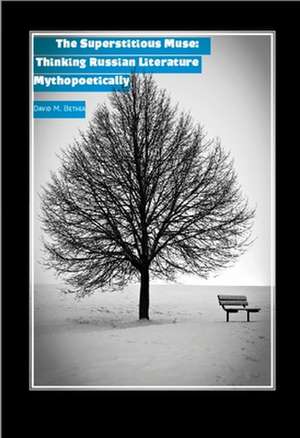
The Superstitious Muse: Thinking Russian Literature Mythopoetically
Autor David Betheaen Limba Engleză Hardback – noi 2009
Preț: 844.21 lei
Preț vechi: 1096.38 lei
-23%
Puncte Express: 1266
Carte tipărită la comandă
Livrare economică 07-21 decembrie
Livrare prin curier în România Termenul estimat este afișat lângă disponibilitate.
Transport gratuit pentru acest produs Plată online sau ramburs, în funcție de opțiunile comenzii.
Retur gratuit în 14 zile Comandă securizată și suport în română.
Specificații
ISBN-13: 9781934843178
ISBN-10: 1934843172
Pagini: 432
Dimensiuni: 159 x 238 x 28 mm
Greutate: 0.76 kg
Ediția:New.
Editura: Academic Studies Press
Colecția Academic Studies Press
Locul publicării:Boston, MA, United States
ISBN-10: 1934843172
Pagini: 432
Dimensiuni: 159 x 238 x 28 mm
Greutate: 0.76 kg
Ediția:New.
Editura: Academic Studies Press
Colecția Academic Studies Press
Locul publicării:Boston, MA, United States
V-ar putea interesa
-
 Critical Studies: The Great GatsbyKathleen ParkinsonPreț: 32.57 lei
 -
 Literature and the Great War 1914-1918Randall Stevenson-12%Preț: 296.08 lei334.99 lei
 -
 Irish Dramatic MovementM. FitzgeraldPreț: 458.59 lei
 -
 A Handbook to the Reception of Greek DramaBetine van Zyl Smit-23%Preț: 1182.97 lei1536.33 lei
 -
 Gay and Lesbian Literary HeritageClaude J. Summers-15%Preț: 454.92 lei535.21 lei
 -
 Ovid on Cosmetics: Medicamina Faciei Femineae and Related TextsMarguerite Johnson-25%Preț: 192.15 lei256.52 lei
 -
 -25%Preț: 650.34 lei864.16 lei
 -
 Teaching Nineteenth-Century Russian Literature: Essays in Honor of Robert L. BelknapDeborah A. Martinsen-25%Preț: 648.43 lei862.89 lei
 -
 -24%Preț: 524.10 lei685.21 lei
 -
 First Words (ENG): On Dostoevsky's IntroductionsLewis Bagby-15%Preț: 577.56 lei679.48 lei
 -
 Translation and the Making of Modern Russian LiteratureProfessor Brian James BaerPreț: 296.18 lei
 -
 Jacob's Ladder: Kabbalistic Allegory in Russian LiteratureMarina Aptekman-23%Preț: 745.48 lei968.15 lei
 -
 -23%Preț: 833.39 lei1082.33 lei
 -
 -23%Preț: 916.03 lei1189.64 lei
 -
 Close Encounters: Essays on Russian LiteratureRobert Louis Jackson-26%Preț: 587.61 lei790.72 lei
 -
 Preț: 316.36 lei
Cuprins
Preface: David Bethea. Introduction: Caryl Emerson. Part One: Russian Literature: Background, Foreground, Creative Cognition. 1. The Mythopoetic "Vectors" of Russian Literature. 2. Mythopoesis Writ Large: The Apocalyptic Plot in Russian Literature. 3. Mythopoesis and Biography: Pushkin, Jakobson, and the Secret Life of Statues. 4. The Evolution of Evolution: Genes, Memes, Intelligent Design and Nabokov. 5. Relativity and Reality: Dante, Florensky, Lotman, and Metaphorical Time-Travel. 6. Whose Mind is this Anyway? Influence, Intertextuality, and the Legitimate Boundaries of Scholarship. Part 2: Pushkin the Poet, Pushkin the Thinker. 7. Of Pushkin and Pushkinists. 8. Biography (with Sergei Davydov). 9. Pushkin's Mythopoetic Consciousness: Apuleius, Psyche and Cupid, and the Theme of Metamorphosis in Eugene Onegin. 10. "A Higher Audacity": How to Read Pushkin's Dialogue with Shakespeare in The Stone Guest. 11. Stabat Pater: Revisiting the "Monumental" in Peter, Petersburg, and Pushkin. 12. Slavic Gift Giving, the Poet in History, and Pushkin's The Captain's Daughter. 13. Pushkin's The History of Pugachev: Where Fact Meets the Zero-Degree of Fiction. Part 3: Reading Russian Writers Reading Themselves and Others. 14. Sorrento Photographs: Khodasevich's Memory Speaks. 15. Nabokov's Style. 16. Sologub, Nabokov, and the Limits of Decadent Aesthetics. 17. Exile, Elegy, and Auden in Brodsky's "Verses on the Death of T.S. Eliot". 18. Joseph Brodsky and the American Seashore Poem: Lowell, Mandelstam, and Cape Cod. 19. Joseph Brodsky's "To My Dauther" (A Reading). 20. Brodsky, Frost and the Pygmalion Myth. Index.
Recenzii
"Bethea (Slavic languages and literatures, U. of Wisconsin-Madison and Russian studies, Oxford U.) explores how the poetic impulse creates and is created by story, looking at Russian literature primarily as transmission and modification of large cultural patterns, though also recognizing the individuality of the authors. A central section on Pushkin as poet and thinker is preceded by a section on general themes and followed by one surveying how other Russian authors viewed their own work and that of others. Specific topics include the apocalyptic plot in Russian literature, how to read Pushkin's dialogue with Shakespeare in The Stone Guest, and Nabokov's style, and Joseph Brodsky's "To My Daughter." The ultra-contemporary typeface is for readers with a short attention span."
“Few American Slavists have been as prolific as David M. Bethea; hence this ample collection represents only a small sampling of his work. Nonetheless, it gives a good sense of his scholarly preoccupations over the past three decades. The book is wide-ranging in both its theoretical concerns and its choice of primary texts. . . . Bethea’s approach opens up obscure passages in unprecedented ways, often with admirable clarity.”
“Few American Slavists have been as prolific as David M. Bethea; hence this ample collection represents only a small sampling of his work. Nonetheless, it gives a good sense of his scholarly preoccupations over the past three decades. The book is wide-ranging in both its theoretical concerns and its choice of primary texts. . . . Bethea’s approach opens up obscure passages in unprecedented ways, often with admirable clarity.”
Notă biografică
David Bethea (Ph.D. University of Kansas, 1977) is a Vilas Professor of Slavic Languages, University of Wisconsin-Madison. Research interests include: Pushkin and his era, modern Russian poetry (esp. Khodasevich and Brodsky), Russian religious thought and cultural mythology, Russian émigré literature, Anglo-American vs. Russian modernism, 20th century Russian/Slavic literary theory (esp. influence studies), biography. Among his books are: Joseph Brodsky and the Creation of Exile (Princeton: Princeton University Press, 1994), and Realizing Metaphors: Alexander Pushkin and the Life of the Poet (Madison: University of Wisconsin Press, 1998).