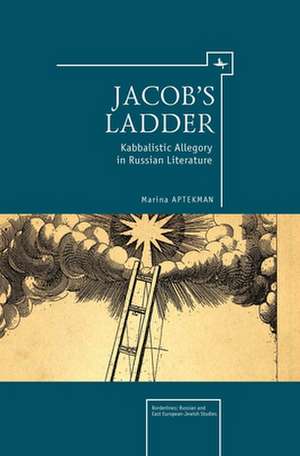
Jacob's Ladder: Kabbalistic Allegory in Russian Literature: Borderlines: Russian and East European-Jewish Studies
Autor Marina Aptekmanen Limba Engleză Hardback – iun 2011


Preț: 745.48 lei
Preț vechi: 968.15 lei
-23%
Puncte Express: 1118
Carte tipărită la comandă
Livrare economică 05-19 decembrie
Livrare prin curier în România Termenul estimat este afișat lângă disponibilitate.
Transport gratuit pentru acest produs Plată online sau ramburs, în funcție de opțiunile comenzii.
Retur gratuit în 14 zile Comandă securizată și suport în română.
Specificații
ISBN-13: 9781934843383
ISBN-10: 1934843385
Pagini: 250
Dimensiuni: 159 x 238 x 16 mm
Greutate: 0.53 kg
Ediția:New.
Editura: Academic Studies Press
Colecția Academic Studies Press
Seria Borderlines: Russian and East European-Jewish Studies
Locul publicării:Boston, MA, United States
ISBN-10: 1934843385
Pagini: 250
Dimensiuni: 159 x 238 x 16 mm
Greutate: 0.53 kg
Ediția:New.
Editura: Academic Studies Press
Colecția Academic Studies Press
Seria Borderlines: Russian and East European-Jewish Studies
Locul publicării:Boston, MA, United States
V-ar putea interesa
-
 Critical Studies: The Great GatsbyKathleen ParkinsonPreț: 32.57 lei
 -
 Literature and the Great War 1914-1918Randall Stevenson-12%Preț: 296.08 lei334.99 lei
 -
 Irish Dramatic MovementM. FitzgeraldPreț: 458.59 lei
 -
 A Handbook to the Reception of Greek DramaBetine van Zyl Smit-23%Preț: 1182.97 lei1536.33 lei
 -
 Gay and Lesbian Literary HeritageClaude J. Summers-15%Preț: 454.92 lei535.21 lei
 -
 Ovid on Cosmetics: Medicamina Faciei Femineae and Related TextsMarguerite Johnson-25%Preț: 192.15 lei256.52 lei
 -
 -25%Preț: 650.34 lei864.16 lei
 -
 Teaching Nineteenth-Century Russian Literature: Essays in Honor of Robert L. BelknapDeborah A. Martinsen-25%Preț: 648.43 lei862.89 lei
 -
 -24%Preț: 524.10 lei685.21 lei
 -
 First Words (ENG): On Dostoevsky's IntroductionsLewis Bagby-15%Preț: 577.56 lei679.48 lei
 -
 Translation and the Making of Modern Russian LiteratureProfessor Brian James BaerPreț: 296.18 lei
 -
 -23%Preț: 833.39 lei1082.33 lei
 -
 -23%Preț: 916.03 lei1189.64 lei
 -
 Close Encounters: Essays on Russian LiteratureRobert Louis Jackson-26%Preț: 587.61 lei790.72 lei
 -
 Preț: 316.36 lei
Recenzii
"Marina Aptekman makes skillful use of rich and diverse source materials, some new and others interpreted in an original and innovative way. This is an important and thought-provoking contribution to the field of Russian-Jewish cultural relations."—Mikhail Krutikov, associate professor of Slavic Languages and Literature, University of Michigan
“This book is a fascinating study of a largely unexplored subject--the role of Kabbalah in Russian literature from the mid 17th to the 20th century and the larger context in which literature developed. Focusing on images and allegories that derive, directly and indirectly, from Kabbalah, Aptekman shows how and why lt became an important element in mystical freemasonry, romanticism, and modernism. In addition, she limns the alternation between mystical and magical (or occult) interpretations of kabbalah and reveals how the occult interpretation came to be associated with black magic and, eventually, with the myth of a Judaeo-Masonic conspiracy.”
"Aptekman’s study is a valuable work that offers much to a reader interested in Russian literary culture and the role played by Freemasonry in Russian literature. More specifically, in Chapter 1 Aptekman provides a fascinating overview of how Kabbalah played a significant role in the literary works of a triumvirate of late eighteenth-century Russian writers (Mikhail Kheraskov, Fyodor Kliucharev and Semyon Bobov). The author’s analysis of the kabbalistic elements utilized by the Silver Age poet Vasilii Rozanov is also stimulating, especially in regard to the cultural backdrop of anti-Semitism rife in Russia at the turn of the twentieth century."
“Those who are looking for names, sources, and themes related to the aspects of Kabbalah at the periods around the turns of the two centuries will find this book a useful tool."
“Marina Aptekman’s thoroughly researched book Jacob’s Ladder makes a valuable contribution to both Russian and Jewish Studies by exploring the evolution of kabbalistic themes and allegories in literature and philosophy from pre-Romanticism to the Silver Age. This study opens up new ways of decoding and interpreting literary works by tracing the evolution of mystical kabbalistic allegories during three centuries of Russian literature."
“This book is a fascinating study of a largely unexplored subject--the role of Kabbalah in Russian literature from the mid 17th to the 20th century and the larger context in which literature developed. Focusing on images and allegories that derive, directly and indirectly, from Kabbalah, Aptekman shows how and why lt became an important element in mystical freemasonry, romanticism, and modernism. In addition, she limns the alternation between mystical and magical (or occult) interpretations of kabbalah and reveals how the occult interpretation came to be associated with black magic and, eventually, with the myth of a Judaeo-Masonic conspiracy.”
"Aptekman’s study is a valuable work that offers much to a reader interested in Russian literary culture and the role played by Freemasonry in Russian literature. More specifically, in Chapter 1 Aptekman provides a fascinating overview of how Kabbalah played a significant role in the literary works of a triumvirate of late eighteenth-century Russian writers (Mikhail Kheraskov, Fyodor Kliucharev and Semyon Bobov). The author’s analysis of the kabbalistic elements utilized by the Silver Age poet Vasilii Rozanov is also stimulating, especially in regard to the cultural backdrop of anti-Semitism rife in Russia at the turn of the twentieth century."
“Those who are looking for names, sources, and themes related to the aspects of Kabbalah at the periods around the turns of the two centuries will find this book a useful tool."
“Marina Aptekman’s thoroughly researched book Jacob’s Ladder makes a valuable contribution to both Russian and Jewish Studies by exploring the evolution of kabbalistic themes and allegories in literature and philosophy from pre-Romanticism to the Silver Age. This study opens up new ways of decoding and interpreting literary works by tracing the evolution of mystical kabbalistic allegories during three centuries of Russian literature."
Notă biografică
Marina Aptekman is an assistant professor of Russian Language and Literature at Hobart and William Smith Colleges. She received her Ph.D. in Slavic Languages and Literatures at Brown University in 2003. Her recent publications include articles "Forward to the Past or Two Radical Views on Russian Nationalist Future: Pyotr Krasnov's Behind the Thistle and Vladimir Sorokin's Day of Oprichnik" (SEEJ), and "Kabbalah, Judeo-Masonic Conspiracy and Post-Soviet Literary Discourse: from Political Tool to Virtual Reality."(Russian Review).