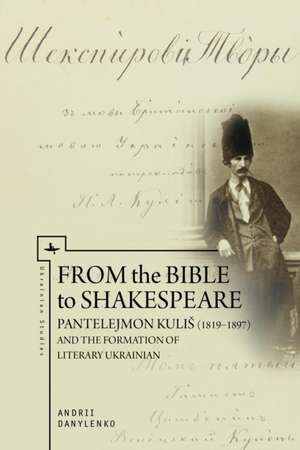
From the Bible to Shakespeare: Pantelejmon Kuliš (1819–1897) and the Formation of Literary Ukrainian: Ukrainian Studies
Autor Andrii Danylenkoen Limba Engleză Hardback – 13 sep 2016


Preț: 517.03 lei
Preț vechi: 684.20 lei
-24%
Puncte Express: 776
Carte disponibilă
Livrare economică 02-16 noiembrie
Livrare express 16-22 octombrie pentru 114.64 lei
Livrare prin curier în România Termenul estimat este afișat lângă disponibilitate.
Transport gratuit pentru acest produs Plată online sau ramburs, în funcție de opțiunile comenzii.
Retur gratuit în 14 zile Comandă securizată și suport în română.
Specificații
ISBN-13: 9781618114709
ISBN-10: 1618114700
Pagini: 472
Dimensiuni: 156 x 234 x 30 mm
Greutate: 0.84 kg
Editura: Academic Studies Press
Colecția Academic Studies Press
Seria Ukrainian Studies
Locul publicării:Boston, MA, United States
ISBN-10: 1618114700
Pagini: 472
Dimensiuni: 156 x 234 x 30 mm
Greutate: 0.84 kg
Editura: Academic Studies Press
Colecția Academic Studies Press
Seria Ukrainian Studies
Locul publicării:Boston, MA, United States
V-ar putea interesa
-
 Being ShelleyAnn WroePreț: 119.05 lei
 -
 Victorian Glassworlds: Glass Culture and the Imagination 1830-1880Isobel Armstrong-23%Preț: 587.98 lei767.60 lei
 -
 Thomas Hardy's 'Poetical Matter' NotebookPamela Dalziel-21%Preț: 371.03 lei472.42 lei
 -
 -31%Preț: 773.74 lei1123.52 lei
 -
 Selected PoetryGerard Manley HopkinsPreț: 47.75 lei
 -
 A Memoir of Jane Austen: and Other Family RecollectionsJames Edward Austen-Leigh-17%Preț: 54.35 lei65.83 lei
 -
 -23%Preț: 658.73 lei851.80 lei
 -
 On Form: Poetry, Aestheticism, and the Legacy of a WordAngela Leighton-13%Preț: 303.21 lei347.20 lei
 -
 The AntiquaryWalter Scott-17%Preț: 78.81 lei95.16 lei
 -
 Charlotte Bronte - Jane EyreSara LodgePreț: 170.22 lei
 -
 RomanticismAidan DayPreț: 217.15 lei
 -
 Preț: 59.26 lei
 -
 Preț: 61.11 lei
 -
 Preț: 64.05 lei
 -
 Dostoevsky: Language, Faith and FictionThe Rt Hon Rowan Williams-42%Preț: 100.79 lei172.79 lei
Cuprins
Acknowledgements
Abbreviations
Introduction: Writing a Linguistic Biography of a Ukrainian Maverick
Part I: The Bible
Chapter 1: Exploring Psalmody
The Book of Psalms
Alexandrine Verse or Trochaic Foot?
Invoking Gavrila Deržavin
Church Slavonicisms
“Kulišisms”
Xarkiv Chimes In
The 1897 Poetic Crowning
Chapter 2: The Makings of the Rusian Bible
A Pentateuch Prolusion
Gearing Up for New Challenges
“Poison and Ruin for the Rusian People”
“The Labor Pangs of a Unified Ukrainian Literary Language”
Reception of the Translation
The Sloboda Bulwark
The Archangel Havrylo
Who Else Bears a Grudge?
The Creation of the New Biblical Style
Means of Archaization
Means of Vernacularization
Chapter 3: Galicia “Writes Back”
The West or the East?
Fostering “Rusian Church Vernacular”
Any Palliative Solution?
Lost in Diacritics
To “Secularize” or “Synthesize”?
Chapter 4: Here Comes the Bible!
The Holy Writ Doesn’t Burn
Tobit and Job
At the Crossroads of Poetry and Prose
Ivan Nečuj-Levyc´kyj Takes It Personally
The Pranks of Ivan Franko
Ivan Puljuj Makes His Riposte
How Should It Sound?
How to String Words?
How to Choose Words?
How to Spell Words?
Ivan Nečuj-Levyc´kyj Is Shuffled Backstage
Interpreting Hebrew Poetry
The Book of Job
Lamentations
The Song of Songs
The Versified Bible
Summary
Part II: Shakespeare
Chapter 5: “Oh, Shakespeare, Our Father, Native to All Peoples”
Ethics Avant la Lettre!
Bringing Forth the “Ukrainian Shakespeare”
The First (Over)Reaction
The Language of the “Ukrainian Shakespeare”
On the Threshold of a New Secular High Style
Chapter 6: Expanding the Literary Canon of the “Ukrainian Shakespeare”
The First Step Is the Hardest?
“Huculia Did Not Appear; Rather Shakespeare Was Merely Hidden”
Hamlet or Hamljet? That Is the Question
Hamlet in Peasant Leather Shoes
The Younger Generation Steps to the Fore
“We Are All Peasants Today”
One or Multiple Homesteads?
Conclusion: Detours Offered But Never Taken
Bibliography
Indices
Geographical and Personal Names
Subjects and Titles of Literary Works and Translations
Word-forms
Introduction: Writing a Linguistic Biography of a Ukrainian Maverick
Part I: The Bible
Chapter 1: Exploring Psalmody
The Book of Psalms
Alexandrine Verse or Trochaic Foot?
Invoking Gavrila Deržavin
Church Slavonicisms
“Kulišisms”
Xarkiv Chimes In
The 1897 Poetic Crowning
Chapter 2: The Makings of the Rusian Bible
A Pentateuch Prolusion
Gearing Up for New Challenges
“Poison and Ruin for the Rusian People”
“The Labor Pangs of a Unified Ukrainian Literary Language”
Reception of the Translation
The Sloboda Bulwark
The Archangel Havrylo
Who Else Bears a Grudge?
The Creation of the New Biblical Style
Means of Archaization
Means of Vernacularization
Chapter 3: Galicia “Writes Back”
The West or the East?
Fostering “Rusian Church Vernacular”
Any Palliative Solution?
Lost in Diacritics
To “Secularize” or “Synthesize”?
Chapter 4: Here Comes the Bible!
The Holy Writ Doesn’t Burn
Tobit and Job
At the Crossroads of Poetry and Prose
Ivan Nečuj-Levyc´kyj Takes It Personally
The Pranks of Ivan Franko
Ivan Puljuj Makes His Riposte
How Should It Sound?
How to String Words?
How to Choose Words?
How to Spell Words?
Ivan Nečuj-Levyc´kyj Is Shuffled Backstage
Interpreting Hebrew Poetry
The Book of Job
Lamentations
The Song of Songs
The Versified Bible
Summary
Part II: Shakespeare
Chapter 5: “Oh, Shakespeare, Our Father, Native to All Peoples”
Ethics Avant la Lettre!
Bringing Forth the “Ukrainian Shakespeare”
The First (Over)Reaction
The Language of the “Ukrainian Shakespeare”
On the Threshold of a New Secular High Style
Chapter 6: Expanding the Literary Canon of the “Ukrainian Shakespeare”
The First Step Is the Hardest?
“Huculia Did Not Appear; Rather Shakespeare Was Merely Hidden”
Hamlet or Hamljet? That Is the Question
Hamlet in Peasant Leather Shoes
The Younger Generation Steps to the Fore
“We Are All Peasants Today”
One or Multiple Homesteads?
Conclusion: Detours Offered But Never Taken
Bibliography
Indices
Geographical and Personal Names
Subjects and Titles of Literary Works and Translations
Word-forms
Recenzii
"There is no figure more important for the development and standardization of literary Ukrainian in the nineteenth century than Pantelejmon Kuliš. As an author, as a scholar, and as an activist, he worked tirelessly for the rejuvenation of Ukrainian culture and particularly its language. Among his most important contributions were his translations of the Bible and of Shakespeare’s plays. With painstaking diligence, exhaustive research, and uncompromising analysis, Andrii Danylenko examines the language of these translations at great depth and compares them to the efforts of other translators in similar genres. The result is a masterful study of Kuliš’s language and a major contribution to the history of the Ukrainian language."
"The monograph, about the language of Pantelejmon Kuliš’s seminal Bible and Shakespeare translations from the 1860s until his death in 1897, is a major contribution to our understanding of the formation of modern literary and standard Ukrainian and a long-due appraisal of Kuliš’s contribution. It is based on an impressive wealth of unpublished sources and an extensive range of secondary literature. The principal merit lies in numerous detailed analyses of Kuliš’s and his contemporaries’ language and the assessment of the forms and words found with respect to their provenance. This is a notoriously difficult undertaking, which very few scholars in Ukrainian philology are able to carry out with the same care, expertise and balanced approach."
"The learning and industry [of this book] are deep and wide. Modern technology has enable Danylenko to display and discuss different systems of transliteration and fonts accomodating variations in Cyrillic spelling, including Church Slavonic. Documentation occurs internal to the text in streamlined form ... well worth the price as a reference tool."
“From the Bible to Shakespeare represents a truly innovative and fundamental study of an important contribution to the Ukrainian linguistic culture, made by the famous Ukrainian writer and cultural figure Pantelejmon Kuliš. . . . the volume also appears to be a very useful text for university studies. It provides a great deal of facts and theoretical concepts for reconstruction of the history of biblical studies on the Ukrainian terrain in the nineteenth and early twentieth centuries.”
This is a well-researched, meticulous and erudite analysis that offers a wealth of information on the development of literary Ukrainian and Kulish’s lasting contribution to the effort. It is a remarkable achievement and a welcome contribution to Ukrainian studies.
Andrii Danylenko’s From the Bible to Shakespeare: Pantelejmon Kuliš (1819-1897) and the Formation of Literary Ukrainian is a profound study that offers an insight into a complex process of the development of language, embracing the formation of the literary and the national. Kuliš’s translations represent an intriguing study case not only for the exploration of linguistic synthesis, but also for investigation of identity fluidity that stems from openness towards linguistic and cultural dialogism.
“This book could be rightly considered as a further steptowards the realization of an ‘integral history of the new Ukrainian literary language’which Danylenko is striving for. … Overall, the book can be read with theutmost curiosity and recommended to those scholars with a keen interest in theformation process of modern literary Ukrainian. Danylenko’s detailed analysisof the language used in the exemplified translation fragments by Kuliš and the comparison withthe translations made by his, more or less famous, contemporaries, inserted in broadersocio-historic and cultural-literary context, adds a fundamental milestone inthe history of the Ukrainian language.” —Salvatore Del Gaudio, Richerche Slavistiche Vol. 1 (LXI)
"The monograph, about the language of Pantelejmon Kuliš’s seminal Bible and Shakespeare translations from the 1860s until his death in 1897, is a major contribution to our understanding of the formation of modern literary and standard Ukrainian and a long-due appraisal of Kuliš’s contribution. It is based on an impressive wealth of unpublished sources and an extensive range of secondary literature. The principal merit lies in numerous detailed analyses of Kuliš’s and his contemporaries’ language and the assessment of the forms and words found with respect to their provenance. This is a notoriously difficult undertaking, which very few scholars in Ukrainian philology are able to carry out with the same care, expertise and balanced approach."
"The learning and industry [of this book] are deep and wide. Modern technology has enable Danylenko to display and discuss different systems of transliteration and fonts accomodating variations in Cyrillic spelling, including Church Slavonic. Documentation occurs internal to the text in streamlined form ... well worth the price as a reference tool."
“From the Bible to Shakespeare represents a truly innovative and fundamental study of an important contribution to the Ukrainian linguistic culture, made by the famous Ukrainian writer and cultural figure Pantelejmon Kuliš. . . . the volume also appears to be a very useful text for university studies. It provides a great deal of facts and theoretical concepts for reconstruction of the history of biblical studies on the Ukrainian terrain in the nineteenth and early twentieth centuries.”
This is a well-researched, meticulous and erudite analysis that offers a wealth of information on the development of literary Ukrainian and Kulish’s lasting contribution to the effort. It is a remarkable achievement and a welcome contribution to Ukrainian studies.
Andrii Danylenko’s From the Bible to Shakespeare: Pantelejmon Kuliš (1819-1897) and the Formation of Literary Ukrainian is a profound study that offers an insight into a complex process of the development of language, embracing the formation of the literary and the national. Kuliš’s translations represent an intriguing study case not only for the exploration of linguistic synthesis, but also for investigation of identity fluidity that stems from openness towards linguistic and cultural dialogism.
“This book could be rightly considered as a further steptowards the realization of an ‘integral history of the new Ukrainian literary language’which Danylenko is striving for. … Overall, the book can be read with theutmost curiosity and recommended to those scholars with a keen interest in theformation process of modern literary Ukrainian. Danylenko’s detailed analysisof the language used in the exemplified translation fragments by Kuliš and the comparison withthe translations made by his, more or less famous, contemporaries, inserted in broadersocio-historic and cultural-literary context, adds a fundamental milestone inthe history of the Ukrainian language.” —Salvatore Del Gaudio, Richerche Slavistiche Vol. 1 (LXI)
Notă biografică
Andrii Danylenko is a well-known Slavists who edited and authored several books on Slavic linguistics and philology as well as dozens of studies on a wide array of topics ranging from Indo-European to literary Ukrainian. He is an editorial Board member of several publications and a reviewer for numerous publications and programs in North America, Europe, and Japan.