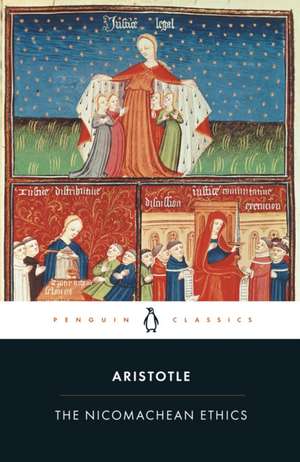
The Nicomachean Ethics
Autor Aristotle Editat de Hugh Tredennick Traducere de J A K Thomsonen Limba Engleză Paperback – 30 mar 2004
Observăm în această ediție a lucrării Nicomachean Ethics o structură metodologică riguroasă, menită să ghideze cititorul prin sistemul etic complex al lui Aristotle. Materialul este organizat în zece secțiuni distincte, pornind de la premisa că binele suprem este fericirea, definită nu ca stare pasivă, ci ca activitate a sufletului. Găsim o progresie logică clară: de la definirea virtuților morale și a conceptului de „cale de mijloc” în primele cărți, către analize specifice despre dreptate, raționament practic și importanța prieteniei în viața cetății. Această ediție tradusă de Christopher Byrne se distinge prin efortul de a clarifica lexicul intelectual moștenit de la Stagira, făcând textul mai fluid pentru studenții contemporani fără a sacrifica precizia tehnică.
Suntem de părere că această lucrare trebuie citită în strânsă legătură cu celelalte contribuții majore ale lui Aristotle. Dacă în The Art of Rhetoric autorul explorează mecanismele persuasiunii, iar în De Anima (sau On the Soul) analizează natura funcțiilor vitale, în Nicomachean Ethics el sintetizează aceste direcții pentru a răspunde la întrebarea fundamentală: cum trebuie să trăiască un om pentru a fi împlinit? Prezența anexelor care includ selecții din Politics subliniază viziunea autorului conform căreia virtutea individuală este inseparabilă de contextul social și de stat.
Metodologia editorială a acestui volum este una comparativă. Prin includerea fragmentelor din Republica lui Platon și a comentariilor lui Toma d'Aquino despre legea naturală, ediția oferă o perspectivă asupra modului în care gândirea aristotelică a modelat filosofia occidentală. Este un instrument de lucru esențial pentru curriculumul de filosofie, oferind atât textul primar, cât și contextul istoric necesar pentru a înțelege evoluția conceptelor de etică și moralitate.
Preț: 66.03 lei
Preț vechi: 93.99 lei
-30%
Carte disponibilă
Livrare economică 12-18 noiembrie
Livrare express 23-29 octombrie pentru 51.75 lei
Specificații
ISBN-10: 0140449493
Pagini: 400
Dimensiuni: 129 x 196 x 25 mm
Greutate: 0.3 kg
Ediția:Further Rev.
Editura: Penguin Books
Locul publicării:London, United Kingdom
V-ar putea interesa
-
 The Wisdom of No EscapePema ChodronPreț: 71.20 lei
 -
 The Subtle Art of Not Giving a F*ckMark MansonPreț: 135.88 lei
 -
 Murphy's LawArthur Bloch-20%Preț: 56.11 lei70.29 lei
 -
 Brave New World RevisitedAldous Huxley-20%Preț: 57.13 lei71.13 lei
 -
 Letters from a StoicSeneca-18%Preț: 59.76 lei72.66 lei
 -
 Thinking, Fast and SlowDaniel Kahneman-27%Preț: 90.79 lei123.57 leiRecomandat
 -
 The Art of HappinessEpicurusPreț: 92.93 lei
 -
 William Blake: Selected PoemsWilliam Blake-17%Preț: 67.19 lei80.79 lei
 -
 The Consolation of PhilosophyBoethius-19%Preț: 58.13 lei71.69 lei
 -
 Discourses, Fragments, HandbookEpictetus-18%Preț: 65.70 lei79.90 lei
 -
 Aristotle's "Politics": Second EditionAristotlePreț: 142.26 lei
 -
 Daring GreatlyBrené Brown-25%Preț: 64.25 lei86.01 lei
 -
 The Things You Can See Only When You Slow DownHaemin Sunim-16%Preț: 68.59 lei81.62 lei
 -
 An Introduction to the Principles of Morals and LegislationJeremy Bentham-26%Preț: 113.29 lei153.49 lei
 -
 Good to GreatJim Collins-24%Preț: 146.96 lei192.27 lei
 -
 -20%Preț: 73.96 lei92.24 lei
 -
 -19%Preț: 133.34 lei164.74 lei
 -
 A Practical EducationRandall StrossPreț: 106.30 lei
 -
 -26%Preț: 88.64 lei120.35 lei
 -
 On LoveJose Ortega y. GassetPreț: 63.19 lei
 -
 The Courage To Be DislikedIchiro KishimiPreț: 91.63 leiRecomandat
 -
 -20%Preț: 55.61 lei69.90 lei
 -
 When the Body Says NoGabor Mate-19%Preț: 75.30 lei93.07 lei
 -
 The Kant DictionaryDr Lucas Thorpe-25%Preț: 206.34 lei274.80 lei
 -
 Sex and PunishmentEric BerkowitzPreț: 84.86 lei
 -
 Beyond Good & EvilFriedrich Wilhelm NietzschePreț: 72.68 lei
De ce să citești această carte
Această ediție a Nicomachean Ethics este recomandată studenților și cercetătorilor care caută o traducere modernă, fidelă dar accesibilă. Cititorul câștigă o înțelegere clară a eticii virtuții și a modului în care rațiunea practică influențează deciziile zilnice. Este un volum esențial pentru oricine dorește să exploreze fundamentele moralității occidentale printr-un aparat critic ce facilitează comparația directă cu Platon sau Toma d'Aquino.
Despre autor
Aristotle (384–322 î.Hr.), discipol al lui Platon și educator al lui Alexandru cel Mare, rămâne una dintre cele mai influente figuri ale istoriei intelectuale. Fondator al Liceului din Atena și al școlii peripatetice, el a sistematizat cunoașterea umană într-o gamă vastă de discipline, de la logică și metafizică până la biologie și etică. În Nicomachean Ethics, numită probabil după fiul său, Nicomah, el pune bazele eticii teleologice. Deși doar o treime din opera sa a supraviețuit, scrierile sale rămân piloni centrali în studiul filozofiei, oferind lexicul și metodele de investigație folosite de gândirea occidentală până în prezent.
Notă biografică
Descriere scurtă
Previously published as Ethics, Aristotle's The Nicomachean Ethics addresses the question of how to live well and originates the concept of cultivating a virtuous character as the basis of his ethical system. Here Aristotle sets out to examine the nature of happiness, and argues that happiness consists in 'activity of the soul in accordance with virtue', including moral virtues, such as courage, generosity and justice, and intellectual virtues, such as knowledge, wisdom and insight. The Ethics also discusses the nature of practical reasoning, the value and the objects of pleasure, the different forms of friendship, and the relationship between individual virtue, society and the State. Aristotle's work has had a profound and lasting influence on all subsequent Western thought about ethical matters.
This Penguin Classics edition is translated from the Greek by J.A.K. Thomson with revisions and notes by Hugh Tredennick, and an introduction and bibliography by Jonathan Barnes.
For more than seventy years, Penguin has been the leading publisher of classic literature in the English-speaking world. With more than 1,700 titles, Penguin Classics represents a global bookshelf of the best works throughout history and across genres and disciplines. Readers trust the series to provide authoritative texts enhanced by introductions and notes by distinguished scholars and contemporary authors, as well as up-to-date translations by award-winning translators.
Cuprins
Chronology
Introduction
Further Reading
A Note on the Text
Synopsis
The Nicomachean Ethics
Book I: The Object of Life
Book II: Moral Goodness
Book III: Moral Responsibility: Two Virtues
Book IV: Other Moral Virtues
Book V: Justice
Book VI: Intellectual Virtues
Book VII: Continence and Incontinence: THe Nature of Pleasure
Book VIII: The Kinds of Friendship
Book IX: The Grounds of Friendship
Book X: Pleasure and the Life of Happiness
Appendix 1: Table of Virtues and Vices
Appendix 2: Pythagoreanism
Appendix 3: The Sophists and Socrates
Appendix 4: Plato's Theory of Forms
Appendix 5: The Catagories
Appendix 6: Substance and Change
Appendix 7: Nature and Theology
Appendix 8: The Practical Syllogism
Appendix 9: Pleasure and Process
Appendix 10: Liturgies
Appendix 11: Aristotle in the Middle Ages
Glossary of Greek Words
Index of Names
Subject Index
Descriere
'Happiness, then, is the best, noblest, and most pleasant thing in the world.'In the Nicomachean Ethics Aristotle's guiding question is: what is the best thing for a human being? His answer is happiness, but he means, not something we feel, but rather a specially good kind of life. Happiness is made up of activities in which we use the best human capacities, both ones that contribute to our flourishing as members of a community, and ones that allow us to engage in god-like contemplation. Contemporary ethical writings on the role and importance of the moral virtues such as courage and justice have drawn inspiration from this work, which also contains important discussions on responsibility for actions, on the nature of practical reasoning, and on friendship and its role in the best life. This new edition retains and lightly revises David Ross's justly admired translation. It also includes a valuable introduction to this seminal work, and notes designed to elucidate Aristotle's arguments. ABOUT THE SERIES: For over 100 years Oxford World's Classics has made available the widest range of literature from around the globe. Each affordable volume reflects Oxford's commitment to scholarship, providing the most accurate text plus a wealth of other valuable features, including expert introductions by leading authorities, helpful notes to clarify the text, up-to-date bibliographies for further study, and much more.
Recenzii
—Burt Hopkins, Seattle University
—Alan White, Williams College
Renowned philosophy professor Joe Sachs presents an accessible and faithful translation; an inspirational addition to the Focus Philosophical Library. Other Joe Sachs titles available from Focus Publishing:
Plato: Republic
Plato: Gorgias and Aristotle: Rhetoric
Aristotle: Poetics
Plato: Theaetetus
Socrates and The Sophists
"Sachs’s translations of Aristotle are truly exemplary. They combine a rare sensitivity to Aristotle’s use of the Greek language with an English style that is straightforward and imaginative. But what makes Sachs’s translations even more noteworthy is their attunement to the thought that is indicated by Aristotle’s words, an attunement born of a profound awareness of the untranslatability of this thought into modern philosophical concepts. For anyone seriously interested in Aristotle’s philosophy, Sachs’s translations are indispensable."
—Burt Hopkins, Seattle University
"Sachs’s translations are unequaled in making accessible to Greekless readers an Aristotle undistorted by the influence of Latin. In addition, his helpful glossaries not only explain his own translational choices, but also inform readers of common alternatives, thereby enabling them to cope with the secondary literature. His are my translations of choice, for both introductory and advanced courses."
—Alan White, Williams College