Cantitate/Preț
Produs

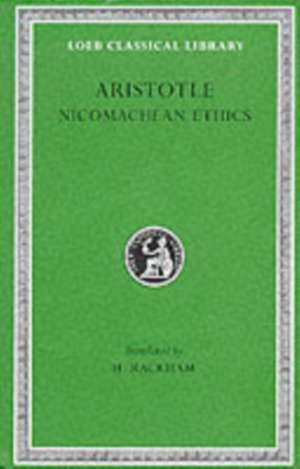
Nicomachean Ethics

Autor Aristotle Traducere de H. Rackham
en Limba Engleză Hardback – 1926
Aristotle, great Greek philosopher, researcher, reasoner, and writer, born at Stagirus in 384 BC, was the son of Nicomachus, a physician, and Phaestis. He studied under Plato at Athens and taught there (367- 347); subsequently he spent three years at the court of a former pupil, Hermeias, in Asia Minor and at this time married Pythias, one of Hermeias' relations. After some time at Mitylene, in 343- 2 he was appointed by King Philip of Macedon to be tutor of his teen-aged son Alexander. After Philip's death in 336, Aristotle became head of his own school (of 'Peripatetics'), the Lyceum at Athens. Because of anti-Macedonian feeling there after Alexander's death in 323, he withdrew to Chalcis in Euboea, where he died in 322. Nearly all the works Aristotle prepared for publication are lost; the priceless ones extant are lecture-materials, notes, and memoranda (some are spurious). They can be categorized as follows: I "Practical": Nicomachean Ethics; Great Ethics (Magna Moralia); Eudemian Ethics; Politics; Economics (on the good of the family); On Virtues and Vices. II "Logical": Categories; Analytics (Prior and Posterior); Interpretation; Refutations used by Sophists; Topica. III "Physical": Twenty-six works (some suspect) including astronomy, generation and destruction, the senses, memory, sleep, dreams, life, facts about animals, etc. IV "Metaphysics": on being as being. V "Art": Rhetoric and Poetics. VI Other works including the Constitution of Athens; more works also of doubtful authorship. VII Fragments of various works such as dialogues on philosophy and literature; and of treatises on rhetoric, politics and metaphysics. The Loeb Classical Library edition ofAristotle is in twenty-three volumes.
Citește tot Restrânge

Toate formatele și edițiile

Toate formatele și edițiile Preț Express
Paperback (20) 4202 lei  3-5 săpt. +892 lei  6-10 zile
  WORDSWORTH EDITIONS LTD – 5 sep 1996 4202 lei  3-5 săpt. +892 lei  6-10 zile
  Oxford University Press – 11 iun 2009 5017 lei  22-28 zile +2215 lei  6-10 zile
  Penguin Books – 30 mar 2004 6178 lei  23-34 zile +4107 lei  6-10 zile
  Penguin Books – 30 apr 2020 6315 lei  23-34 zile +3029 lei  6-10 zile
  Bryn Mawr Commentaries, Inc. – 30 iun 2004 8682 lei  3-5 săpt.
  BROADVIEW PR – 10 apr 2025 12319 lei  3-5 săpt. +3264 lei  6-10 zile
  Hackett Publishing Company,Inc – 30 aug 2019 13522 lei  3-5 săpt. +3818 lei  6-10 zile
  Hackett Publishing Company,Inc – 2002 13836 lei  3-5 săpt. +3304 lei  6-10 zile
  Hackett Publishing Company,Inc – 20 dec 2023 16304 lei  3-5 săpt.
  4460 lei  3-5 săpt.
  4735 lei  3-5 săpt.
  CREATESPACE – 5601 lei  3-5 săpt.
  NuVision Publications – 9 aug 2007 6676 lei  3-5 săpt.
  A & D Publishing – 8 feb 2009 9090 lei  6-8 săpt.
  COSIMO CLASSICS – 31 oct 2008 10470 lei  6-8 săpt.
  Lulu.Com – 26 ian 2017 11267 lei  6-8 săpt.
  Start Classics – 26 mar 2024 14046 lei  38-44 zile
  CREATESPACE – 14474 lei  3-5 săpt.
  Martino Fine Books – 9 noi 2016 16644 lei  38-44 zile
  Pearson – 31 dec 1961 41496 lei  6-8 săpt.
Hardback (4) 18348 lei  6-8 săpt. +2173 lei  6-10 zile
  Harvard University Press – 1926 22404 lei  3-5 săpt. +2173 lei  6-10 zile
  Hackett Publishing Company,Inc – 30 aug 2019 35761 lei  3-5 săpt. +6589 lei  6-10 zile
  18348 lei  6-8 săpt.
  Start Classics – 26 mar 2024 23107 lei  38-44 zile

Preț: 22404 lei

Puncte Express: 336

Preț estimativ în valută:
3961 4700$ 3444£

Carte disponibilă

Livrare economică 11-25 martie
Livrare express 24-28 februarie pentru 3172 lei


Specificații

ISBN-13: 9780674990814
ISBN-10: 0674990811
Pagini: 688
Dimensiuni: 118 x 168 x 40 mm
Greutate: 0.46 kg
Ediția:Revised edition
Editura: Harvard University Press
Locul publicării:United States

Public țintă

Academic/professional/technical: Undergraduate. Academic/professional/technical: Postgraduate. Academic/professional/technical: Research and professional

Notă biografică

Aristotle

Descriere

Descriere de la o altă ediție sau format:

'Happiness, then, is the best, noblest, and most pleasant thing in the world.'In the Nicomachean Ethics Aristotle's guiding question is: what is the best thing for a human being? His answer is happiness, but he means, not something we feel, but rather a specially good kind of life. Happiness is made up of activities in which we use the best human capacities, both ones that contribute to our flourishing as members of a community, and ones that allow us to engage in god-like contemplation. Contemporary ethical writings on the role and importance of the moral virtues such as courage and justice have drawn inspiration from this work, which also contains important discussions on responsibility for actions, on the nature of practical reasoning, and on friendship and its role in the best life. This new edition retains and lightly revises David Ross's justly admired translation. It also includes a valuable introduction to this seminal work, and notes designed to elucidate Aristotle's arguments. ABOUT THE SERIES: For over 100 years Oxford World's Classics has made available the widest range of literature from around the globe. Each affordable volume reflects Oxford's commitment to scholarship, providing the most accurate text plus a wealth of other valuable features, including expert introductions by leading authorities, helpful notes to clarify the text, up-to-date bibliographies for further study, and much more.


Cuprins

Acknowledgements
Introduction
Aristotle: A Brief Chronology
Aristotle in the History of Philosophy: A Brief Chronology
A Note on the Translation

Nicomachean Ethics
  • Book I: Human Happiness and Virtuous Action
  • Book II: Moral Virtue and the Mean
  • Book III: Choice, Deliberation, and Moral Virtue
  • Book IV: The Moral Virtues as Social Virtues
  • Book V: Justice
  • Book VI: The Intellectual Virtues
  • Book VII: Self-Control and Lack of Self-Control
  • Book VIII: Friendship
  • Book IX: Friendship and Our Duties to Others
  • Book X: Pleasure and the Pursuit of Knowledge
Appendix A: The Main Argument of the Nicomachean Ethics
Appendix B: The Functions of a Human Being and the Virtues They Require
Appendix C: Selections from Aristotle’s Politics, Book I
Appendix D: Selections from Plato’s Republic, Book I
  • 1. Thrasymachus’ Speech on the Nature of Justice (338d–344d)
  • 2. Plato on Function and Virtue (352d–354a)
Appendix E: Selections from Thomas Aquinas on Natural Law
  • 1. From Article 2: Does Natural Law Contain Many Precepts or Just One?
  • 2. From Article 4: Is There One Natural Law for All People?
  • 3. Article 5: Can the Natural Law Be Changed?
Glossary of Key Terms
Select Bibliography
Index

Recenzii

"Sachs’s translations of Aristotle are truly exemplary. They combine a rare sensitivity to Aristotle’s use of the Greek language with an English style that is straightforward and imaginative. But what makes Sachs’s translations even more noteworthy is their attunement to the thought that is indicated by Aristotle’s words, an attunement born of a profound awareness of the untranslatability of this thought into modern philosophical concepts. For anyone seriously interested in Aristotle’s philosophy, Sachs’s translations are indispensable."
—Burt Hopkins, Seattle University

"Sachs’s translations are unequaled in making accessible to Greekless readers an Aristotle undistorted by the influence of Latin. In addition, his helpful glossaries not only explain his own translational choices, but also inform readers of common alternatives, thereby enabling them to cope with the secondary literature. His are my translations of choice, for both introductory and advanced courses."
—Alan White, Williams College

The Focus Philosophical Library publishes clear, faithful editions by renowned scholars and teachers enabling access for modern students to essential ideas and wisdom of the world’s greatest thinkers.
Renowned philosophy professor Joe Sachs presents an accessible and faithful translation; an inspirational addition to the Focus Philosophical Library. Other Joe Sachs titles available from Focus Publishing:
Plato: Republic
Plato: Gorgias and Aristotle: Rhetoric
Aristotle: Poetics
Plato: Theaetetus
Socrates and The Sophists


"Sachs’s translations of Aristotle are truly exemplary. They combine a rare sensitivity to Aristotle’s use of the Greek language with an English style that is straightforward and imaginative. But what makes Sachs’s translations even more noteworthy is their attunement to the thought that is indicated by Aristotle’s words, an attunement born of a profound awareness of the untranslatability of this thought into modern philosophical concepts. For anyone seriously interested in Aristotle’s philosophy, Sachs’s translations are indispensable."
 —Burt Hopkins, Seattle University

"Sachs’s translations are unequaled in making accessible to Greekless readers an Aristotle undistorted by the influence of Latin. In addition, his helpful glossaries not only explain his own translational choices, but also inform readers of common alternatives, thereby enabling them to cope with the secondary literature. His are my translations of choice, for both introductory and advanced courses."
—Alan White, Williams College