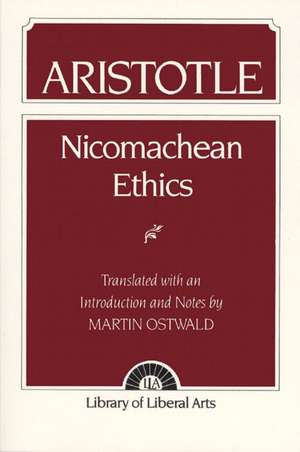
Nicomachean Ethics
Autor Aristotle Editat de Martin Ostwalden Limba Engleză Paperback – 31 dec 1961
Preț: 432.92 lei
Preț vechi: 534.47 lei
-19%
Puncte Express: 649
Carte tipărită la comandă
Livrare economică 19 noiembrie-03 decembrie
Livrare prin curier în România Termenul estimat este afișat lângă disponibilitate.
Transport gratuit pentru acest produs Plată online sau ramburs, în funcție de opțiunile comenzii.
Retur gratuit în 14 zile Comandă securizată și suport în română.
Specificații
ISBN-13: 9780023895302
ISBN-10: 0023895306
Pagini: 316
Dimensiuni: 135 x 201 x 18 mm
Greutate: 0.32 kg
Ediția:1
Editura: Pearson
Locul publicării:Upper Saddle River, United States
ISBN-10: 0023895306
Pagini: 316
Dimensiuni: 135 x 201 x 18 mm
Greutate: 0.32 kg
Ediția:1
Editura: Pearson
Locul publicării:Upper Saddle River, United States
V-ar putea interesa
-
 The Wisdom of No EscapePema ChodronPreț: 71.20 lei
 -
 The Subtle Art of Not Giving a F*ckMark MansonPreț: 135.88 lei
 -
 Murphy's LawArthur Bloch-20%Preț: 56.11 lei70.29 lei
 -
 Brave New World RevisitedAldous Huxley-20%Preț: 56.95 lei71.13 lei
 -
 Letters from a StoicSeneca-18%Preț: 59.37 lei72.56 lei
 -
 Thinking, Fast and SlowDaniel Kahneman-27%Preț: 90.45 lei123.57 leiRecomandat
 -
 The Art of HappinessEpicurusPreț: 92.93 lei
 -
 William Blake: Selected PoemsWilliam BlakePreț: 66.92 lei
 -
 The Consolation of PhilosophyBoethius-19%Preț: 57.91 lei71.69 lei
 -
 Discourses, Fragments, HandbookEpictetus-18%Preț: 65.28 lei79.80 lei
 -
 Aristotle's "Politics": Second EditionAristotlePreț: 142.04 lei
 -
 Daring GreatlyBrené Brown-26%Preț: 64.05 lei86.01 lei
 -
 The Things You Can See Only When You Slow DownHaemin Sunim-16%Preț: 68.32 lei81.62 lei
 -
 An Introduction to the Principles of Morals and LegislationJeremy Bentham-26%Preț: 113.29 lei153.49 lei
 -
 Good to GreatJim Collins-24%Preț: 146.08 lei191.99 lei
 -
 -20%Preț: 73.36 lei92.11 lei
 -
 -19%Preț: 132.53 lei164.49 lei
 -
 A Practical EducationRandall StrossPreț: 106.30 lei
 -
 -27%Preț: 88.31 lei120.35 lei
 -
 On LoveJose Ortega y. GassetPreț: 63.19 lei
 -
 The Courage To Be DislikedIchiro KishimiPreț: 90.38 leiRecomandat
 -
 -20%Preț: 55.61 lei69.90 lei
 -
 When the Body Says NoGabor Mate-20%Preț: 74.75 lei92.94 lei
 -
 The Kant DictionaryDr Lucas Thorpe-25%Preț: 206.34 lei274.80 lei
 -
 Sex and PunishmentEric BerkowitzPreț: 83.46 lei
 -
 Beyond Good & EvilFriedrich Wilhelm NietzschePreț: 72.68 lei
Notă biografică
Aristotle (Greek: ¿¿¿¿¿¿¿¿¿¿¿ Aristotél¿s, pronounced [aristotél¿¿s]; 384-322 BC)[A] was a Greek philosopher and polymath during the Classical period in Ancient Greece. Taught by Plato, he was the founder of the Lyceum, the Peripatetic school of philosophy, and the Aristotelian tradition. His writings cover many subjects. including physics, biology, zoology, metaphysics, logic, ethics, estheticspoetry, theatre, music, rhetoric, psychology, linguistics, economics, politics, and government. Aristotle provided a complex synthesis of the various philosophies existing prior to him. It was above all from his teachings that the West inherited its intellectual lexicon, as well as problems and methods of inquiry. As a result, his philosophy has exerted a unique influence on almost every form of knowledge in the West and it continues to be a subject of contemporary philosophical discussion. Little is known about his life. Aristotle was born in the city of Stagira in Northern Greece. His father, Nicomachus, died when Aristotle was a child, and he was brought up by a guardian. At seventeen or eighteen years of age he joined Plato's Academy in Athens and remained there until the age of thirty-seven (c. 347 BC).[4] Shortly after Plato died, Aristotle left Athens and, at the request of Philip II of Macedon, tutored Alexander the Great beginning in 343 BC.[5] He established a library in the Lyceum which helped him to produce many of his hundreds of books on papyrus scrolls. Though Aristotle wrote many elegant treatises and dialogues for publication, only around a third of his original output has survived, none of it intended for publication.[6] Aristotle's views on physical science profoundly shaped medieval scholarship. Their influence extended from Late Antiquity and the Early Middle Ages into the Renaissance, and were not replaced systematically until the Enlightenment and theories such as classical mechanics. Some of Aristotle's zoological observations found in his biology, such as on the hectocotyl (reproductive) arm of the octopus, were disbelieved until the 19th century. His works contain the earliest known formal study of logic, studied by medieval scholars such as Peter Abelard and John Buridan. Aristotle's influence on logic also continued well into the 19th century.
Cuprins
Acknowledgements
Introduction
Aristotle: A Brief Chronology
Aristotle in the History of Philosophy: A Brief Chronology
A Note on the Translation
Nicomachean Ethics
Appendix B: The Functions of a Human Being and the Virtues They Require
Appendix C: Selections from Aristotle’s Politics, Book I
Appendix D: Selections from Plato’s Republic, Book I
Select Bibliography
Index
Introduction
Aristotle: A Brief Chronology
Aristotle in the History of Philosophy: A Brief Chronology
A Note on the Translation
Nicomachean Ethics
- Book I: Human Happiness and Virtuous Action
- Book II: Moral Virtue and the Mean
- Book III: Choice, Deliberation, and Moral Virtue
- Book IV: The Moral Virtues as Social Virtues
- Book V: Justice
- Book VI: The Intellectual Virtues
- Book VII: Self-Control and Lack of Self-Control
- Book VIII: Friendship
- Book IX: Friendship and Our Duties to Others
- Book X: Pleasure and the Pursuit of Knowledge
Appendix B: The Functions of a Human Being and the Virtues They Require
Appendix C: Selections from Aristotle’s Politics, Book I
Appendix D: Selections from Plato’s Republic, Book I
- 1. Thrasymachus’ Speech on the Nature of Justice (338d–344d)
- 2. Plato on Function and Virtue (352d–354a)
- 1. From Article 2: Does Natural Law Contain Many Precepts or Just One?
- 2. From Article 4: Is There One Natural Law for All People?
- 3. Article 5: Can the Natural Law Be Changed?
Select Bibliography
Index
Recenzii
"Sachs’s translations of Aristotle are truly exemplary. They combine a rare sensitivity to Aristotle’s use of the Greek language with an English style that is straightforward and imaginative. But what makes Sachs’s translations even more noteworthy is their attunement to the thought that is indicated by Aristotle’s words, an attunement born of a profound awareness of the untranslatability of this thought into modern philosophical concepts. For anyone seriously interested in Aristotle’s philosophy, Sachs’s translations are indispensable."
—Burt Hopkins, Seattle University
—Burt Hopkins, Seattle University
"Sachs’s translations are unequaled in making accessible to Greekless readers an Aristotle undistorted by the influence of Latin. In addition, his helpful glossaries not only explain his own translational choices, but also inform readers of common alternatives, thereby enabling them to cope with the secondary literature. His are my translations of choice, for both introductory and advanced courses."
—Alan White, Williams College
—Alan White, Williams College
The Focus Philosophical Library publishes clear, faithful editions by renowned scholars and teachers enabling access for modern students to essential ideas and wisdom of the world’s greatest thinkers.
Renowned philosophy professor Joe Sachs presents an accessible and faithful translation; an inspirational addition to the Focus Philosophical Library. Other Joe Sachs titles available from Focus Publishing:
Plato: Republic
Plato: Gorgias and Aristotle: Rhetoric
Aristotle: Poetics
Plato: Theaetetus
Socrates and The Sophists
"Sachs’s translations of Aristotle are truly exemplary. They combine a rare sensitivity to Aristotle’s use of the Greek language with an English style that is straightforward and imaginative. But what makes Sachs’s translations even more noteworthy is their attunement to the thought that is indicated by Aristotle’s words, an attunement born of a profound awareness of the untranslatability of this thought into modern philosophical concepts. For anyone seriously interested in Aristotle’s philosophy, Sachs’s translations are indispensable."
—Burt Hopkins, Seattle University
"Sachs’s translations are unequaled in making accessible to Greekless readers an Aristotle undistorted by the influence of Latin. In addition, his helpful glossaries not only explain his own translational choices, but also inform readers of common alternatives, thereby enabling them to cope with the secondary literature. His are my translations of choice, for both introductory and advanced courses."
—Alan White, Williams College
Renowned philosophy professor Joe Sachs presents an accessible and faithful translation; an inspirational addition to the Focus Philosophical Library. Other Joe Sachs titles available from Focus Publishing:
Plato: Republic
Plato: Gorgias and Aristotle: Rhetoric
Aristotle: Poetics
Plato: Theaetetus
Socrates and The Sophists
"Sachs’s translations of Aristotle are truly exemplary. They combine a rare sensitivity to Aristotle’s use of the Greek language with an English style that is straightforward and imaginative. But what makes Sachs’s translations even more noteworthy is their attunement to the thought that is indicated by Aristotle’s words, an attunement born of a profound awareness of the untranslatability of this thought into modern philosophical concepts. For anyone seriously interested in Aristotle’s philosophy, Sachs’s translations are indispensable."
—Burt Hopkins, Seattle University
"Sachs’s translations are unequaled in making accessible to Greekless readers an Aristotle undistorted by the influence of Latin. In addition, his helpful glossaries not only explain his own translational choices, but also inform readers of common alternatives, thereby enabling them to cope with the secondary literature. His are my translations of choice, for both introductory and advanced courses."
—Alan White, Williams College