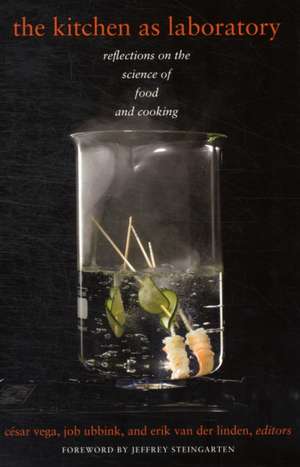
The Kitchen as Laboratory
Editat de César Vega, Job Ubbink, Erik van der Lindenen Limba Engleză Hardback – 31 ian 2012
Adresăm această lucrare profesioniștilor din industria alimentară, pasionaților de chimie gastronomică și bucătarilor care doresc să treacă de la execuția bazată pe intuiție la cea fundamentată pe dovezi. The Kitchen as Laboratory nu este o simplă carte de rețete, ci un compendiu tehnic ce deconstruiește experiența multisenzorială a mâncării prin prisma proprietăților fizice și chimice ale ingredientelor. Subliniem rigoarea celor 336 de pagini, unde editorii César Vega, Job Ubbink și Erik van der Linden coordonează o echipă internațională de experți pentru a testa ipoteze culinare concrete. Pe linia practică a volumului Culinary Reactions, dar cu un focus mult mai accentuat pe cercetarea academică și pe aplicații industriale, această carte explorează fenomene precum sferificarea, texturile elastice ale înghețatei Konjac sau chimia din spatele stratului de grăsime al baconului. Structura este organizată tematic, progresând de la analize asupra unor preparate aparent banale, precum sandvișul cu brânză, către tehnici complexe de laborator utilizate în restaurantele de tip fine-dining. Suntem de părere că includerea celor 11 tabele și a numeroaselor ilustrații transformă textul într-un instrument de referință pentru înțelegerea proceselor de cristalizare, emulsie și denaturare a proteinelor. Spre deosebire de The Science of Cooking, care oferă o introducere generală, volumul de față aprofundează studii de caz specifice, oferind cititorului o perspectivă rară asupra modului în care un experiment controlat poate redefini textura și gustul unui preparat tradițional.
Preț: 221.92 lei
Carte tipărită la comandă
Livrare economică 20 noiembrie-04 decembrie
Specificații
ISBN-10: 0231153449
Pagini: 336
Ilustrații: 67 halftones, 11 tables
Dimensiuni: 164 x 249 x 28 mm
Greutate: 0.66 kg
Ediția:New.
Editura: Columbia University Press
V-ar putea interesa
-
 Coffee in Health and Disease PreventionVictor R. Preedy-20%Preț: 984.38 lei1230.87 lei
 -
 -16%Preț: 137.67 lei164.04 lei
 -
 The Making of a ChefMichael RuhlmanPreț: 131.69 lei
 -
 Indian Cookery CourseMonisha Bharadwaj-23%Preț: 224.80 lei290.55 lei
 -
 Advanced Bread and PastryMichel Suas-11%Preț: 589.62 lei662.49 lei
 -
 Analyzing Sensory Data with RSebastien Le-18%Preț: 935.39 lei1140.71 lei
 -
 Food Additive User’s HandbookJ. Smith-15%Preț: 615.35 lei723.94 lei
 -
 Edible Oil Processing from a Patent PerspectiveAlbert J. Dijkstra-15%Preț: 673.50 lei792.35 lei
 -
 Mycotoxins and Their Metabolites in Humans and AnimalsMartin Weidenbörner-18%Preț: 1085.87 lei1324.23 lei
 -
 -18%Preț: 925.20 lei1128.28 lei
 -
 The Physical Processes of DigestionRoger G. Lentle-15%Preț: 645.75 lei759.71 lei
 -
 -18%Preț: 1226.42 lei1495.63 lei
 -
 Colour Additives for Foods and BeveragesMichael J. Scotter-31%Preț: 1106.15 lei1601.41 lei
 -
 Handbook of Food Allergen Detection and ControlSimon Flanagan-27%Preț: 1370.81 lei1890.59 lei
 -
 Dietary Supplements: Safety, Efficacy and QualityKatja Berginc-28%Preț: 1218.84 lei1683.33 lei
 -
 Metabolomics as a Tool in Nutrition ResearchJ-L Sebedio-33%Preț: 1020.40 lei1530.73 lei
 -
 Handbook of Antioxidants for Food PreservationFereidoon Shahidi-31%Preț: 1258.22 lei1829.00 lei
 -
 -27%Preț: 1163.87 lei1604.33 lei
 -
 Unelaborated ProductsElbullifoundation-20%Preț: 659.58 lei827.38 lei
 -
 Chemistry of Foods: EU Legal and Regulatory ApproachesDaniele PisanelloPreț: 363.87 lei
 -
 Berichte zur Resistenzmonitoringstudie 2011/2012: Resistenzsituation bei klinisch wichtigen tierpathogenen BakterienBundesamt für Verbraucherschutz und LebePreț: 254.42 lei
 -
 Biochemistry of Beer FermentationEduardo PiresPreț: 444.42 lei
 -
 Preț: 167.22 lei
 -
 Safety Protocols in the Food Industry and Emerging ConcernsGiovanni GurnariPreț: 365.06 lei
 -
 Preț: 408.31 lei
 -
 Die chemische Untersuchung und Beurtheilung des WeinesKarl WindischPreț: 406.91 lei
 -
 Spezialitäten und Geheimmittel: Ihre Herkunft und ZusammensetzungHahn Holfert Arends-15%Preț: 462.38 lei543.98 lei
 -
 Die Mikroskopische Untersuchung der Tee- und TabakersatzstoffeConstantin GriebelPreț: 393.27 lei
 -
 Das Kasein: Chemie und technische VerwertungEdwin Sutermeister-15%Preț: 425.71 lei500.83 lei
De ce să citești această carte
Recomandăm această carte oricărui specialist care dorește să stăpânească mecanismele moleculare din spatele gătitului. Veți câștiga o înțelegere profundă a modului în care instrumentele de laborator și tehnicile chimice pot fi aplicate pentru a îmbunătăți consistența și savoarea preparatelor. Este resursa ideală pentru a transforma bucătăria într-un spațiu de inovare tehnologică, oferind argumente științifice pentru fiecare decizie culinară luată la focul aragazului.
Cuprins
Introduction: The Case for Science Inspired by the Kitchen, by César Vega, Job Ubbink, and Erik van der Linden
1. The Science of a Grilled Cheese Sandwich, by Jennifer Kimmel
2. Sound Appeal, by Malcolm Povey
3. Mediterranean Sponge Cake, by Cristina de Lorenzo and Sergio Laguarda
4. Spherification: Faux Caviar and Skinless Ravioli, by César Vega and Pere Castells
5. Konjac Dondurma: Designing a Sustainable and Stretchable "Fox Testicle" Ice Cream, by Arielle Johnson, Kent Kirshenbaum, and Anne E. McBride
6. Stretchy Textures in the Kitchen: Insights from Salep Dondurma, by Tim J. Foster
7. Moussaka as an Introduction to Food Chemistry, by Christos Ritzoulis
8. The Sticky Science of Malaysian Dodol, by Alias A. Karim and Rajeev Bhat
9. The Perfect Cookie Dough, by Aki Kamozawa and H. Alexander Talbot
10. To Bloom or Not to Bloom, by Amelia Frazier and Richard Hartel
11. Bacon: The Slice of Life, by Timothy Knight
12. Scandinavian "Sushi": The Raw Story, by Pia Snitkjær and Louise M. Mortensen
13. Maximizing Food Flavor by Speeding Up the Maillard Reaction, by Martin Lersch
14. Lighten Up! The Role of Gases in the Culinary Experience, by Matt Golding
15. The Meringue Concept and Its Variations, by Peter Wierenga, Helen Hofstede, Erik van der Linden, Sidney Schutte, and Jonnie Boer
16. Why Does Cold Milk Foam Better? Into the Nature of Milk Foam, by Julia Maldonado-Valderrama, Peter J. Wilde, and María J. Gálvez-Ruiz
17. Ice Cream Unlimited: The Possibilities of Ingredient Pairing, by Elke Scholten and Miriam Peters
18. Egg Yolk: A Library of Textures, by César Vega
19. Ketchup as Tasty Soft Matter: The Case of Xanthan Gum, by Thomas Vilgis
20. Taste and Mouthfeel of Soups and Sauces, by John R. Mitchell
21. Playing with Sound: Crispy Crusts, by Paula Varela and Susana Fiszman
22. Baked Alaska and Frozen Florida: On the Physics of Heat Transfer, by Adam Burbidge
23. On Superb Crackling Duck Skin: An Homage to Nicholas Kurti, by Christopher Young and Nathan Myhrvold
24. Sweet Physics: Sugar, Sugar Blends, and Sugar Glasses, by Natalie Russ and Thomas Vilgis
25. Coffee, Please, but No Bitters, by Jan Groenewold and Eke Mariën
26. Turning Waste into Wealth: On Bones, Stocks, and Sauce Reductions, by Job Ubbink
27. Restructuring Pig Trotters: Fine Chemistry Supporting the Creative Culinary Process, by Jorge Ruiz and Julia Calvarro
28. Innovate: Old World Pizza Crust with New World Ingredients, by Thomas M. Tongue Jr.
29. Eating Is Believing, by Line Holler Mielby and Michael Bom Frøst
30. Molecular Gastronomy Is a Scientific Activity, by Hervé This
31. The Pleasure of Eating: The Integration of Multiple Senses, by Juan-Carlos Arboleya, Daniel Lasa, Oswaldo Oliva, Javier Vergara, and Andoni Luis-Aduriz
32. On the Fallacy of Cooking from Scratch, by César Vega and David J. McClements
33. Science and Cooking: Looking Beyond the Trends a Personal, Practical Approach, by Michael Laiskonis
Contributors
Index