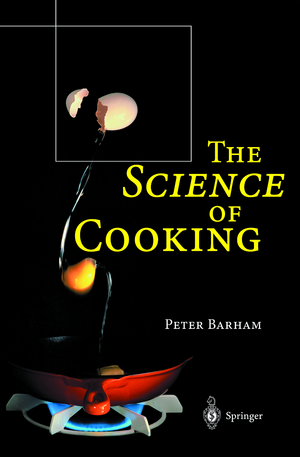
The Science of Cooking
Autor Peter Barhamen Limba Engleză Hardback – 4 oct 2000
Notăm cu interes faptul că The Science of Cooking abordează bucătăria nu ca pe o artă abstractă, ci ca pe un laborator experimental unde legile termodinamicii și ale chimiei organice dictează succesul oricărui preparat. Publicat de Springer, acest volum se concentrează pe mecanismele fizico-chimice fundamentale care guvernează transformarea alimentelor, oferind o bază teoretică solidă pentru procese precum caramelizarea, emulsificarea sau denaturarea proteinelor. Suntem de părere că rigoarea științifică a lui Peter Barham, fizician de formație, transformă lectura dintr-o simplă parcurgere de rețete într-o sesiune de instruire tehnică aplicată.
Structura cărții este riguros logică, progresând de la analiza moleculelor senzoriale și a aromelor către metode specifice de gătit și ustensile necesare. Fiecare capitol dedicat unei categorii de alimente — de la Meat and Poultry la complexitatea unui Soufflés — începe cu o expunere teoretică a problemelor științifice relevante (cum ar fi elasticitatea glutenului în pâine sau stabilitatea spumelor de ou), urmată de rețete „fără eșec”. Un element distinctiv îl reprezintă tabelele de soluționare a problemelor, care diagnostichează erorile comune prin prisma cauzelor fizice. Complementar lui The Science of Cooking: A Quick Immersion, care oferă o perspectivă rapidă și sintetică, volumul lui Barham plonjează mult mai adânc în zona experimentală, incluzând secțiuni de experimente casnice menite să demonstreze principiile discutate.
În contextul operei autorului, această lucrare reprezintă puntea de legătură între cercetarea sa academică și viața cotidiană. Deși Peter Barham este cunoscut pentru studii complexe precum Forgotten Lunatics of the Great War sau Outrageous Reason, unde explorează istoria socială și psihologia, în The Science of Cooking (publicată și sub titlul german Die letzten Geheimnisse der Kochkunst), el își folosește expertiza analitică pentru a demitifica procesele culinare. Putem afirma că volumul reușește să echilibreze tonul unui manual universitar cu aplicabilitatea practică a unei cărți de bucătărie de înalt nivel.
Preț: 561.38 lei
Preț vechi: 660.45 lei
-15%
Carte tipărită la comandă
Livrare economică 16-30 noiembrie
Livrare express 09-15 octombrie pentru 73.13 lei
Specificații
ISBN-10: 3540674667
Pagini: 258
Ilustrații: VII, 244 p.
Dimensiuni: 155 x 235 x 25 mm
Greutate: 0.51 kg
Ediția:2001
Editura: Springer Berlin, Heidelberg
Colecția Springer
Locul publicării:Berlin, Heidelberg, Germany
V-ar putea interesa
-
 Eating Up ItalyMatthew FortPreț: 110.81 lei
 -
 Cooking Under Pressure (Anniversary)Lorna J SassPreț: 132.66 lei
 -
 CookedMichael Pollan-18%Preț: 65.20 lei79.15 lei
 -
 Food RulesMichael Pollan-21%Preț: 43.93 lei55.67 lei
 -
 Food RulesMichael PollanPreț: 88.42 lei
 -
 CookedMichael PollanPreț: 108.13 lei
 -
 The Science of Cooking: Every Question Answered to Perfect your CookingDr. Stuart Farrimond-28%Preț: 146.82 lei202.91 leiRecomandat
 -
 -24%Preț: 270.01 lei355.53 lei
 -
 The New Book of Middle Eastern FoodClaudia RodenPreț: 358.86 lei
 -
 Science and CookingMichael BrennerPreț: 225.63 lei
 -
 Top Secret Restaurant Recipes 2Todd WilburPreț: 150.86 lei
 -
 The Fannie Farmer CookbookMarion CunninghamPreț: 84.57 lei
 -
 Preț: 333.21 lei
 -
 The Omnivore's DilemmaMichael PollanPreț: 72.72 lei
 -
 Preț: 78.45 lei
 -
 Look Inside CarsRob Lloyd JonesPreț: 81.17 lei
 -
 First Sticker Book SpaceSam SmithPreț: 46.85 lei
 -
 Ratio: The Simple Codes Behind the Craft of Everyday CookingMichael Ruhlman-19%Preț: 75.07 lei93.14 lei
 -
 Chemistry in Your KitchenMatthew HartingsPreț: 187.27 lei
 -
 First Sticker Book SpaceSam SmithPreț: 46.80 lei
 -
 Pressure Cooker PerfectionAmerica'S Test KitchenPreț: 132.20 lei
Public țintă
Professional/practitionerDe ce să citești această carte
Recomandăm această carte profesioniștilor și amatorilor pasionați de gastronomie moleculară care doresc să înțeleagă mecanismele din spatele fiecărui ingredient. Cititorul câștigă capacitatea de a corecta rețete defectuoase și de a inova controlat, trecând de la copierea mecanică a unor pași la stăpânirea proceselor fizice. Este un instrument esențial pentru oricine dorește să transforme gătitul într-o știință predictibilă și precisă.
Despre autor
Peter Barham este un cercetător polivalent, cunoscut atât pentru contribuțiile sale în fizica polimerilor, cât și pentru lucrările de istorie socială și psihologie a sănătății mintale. Profesor la Universitatea din Bristol, Barham a devenit o figură centrală în promovarea gastronomiei moleculare, colaborând frecvent cu bucătari de renume pentru a aplica rigoarea laboratorului în spațiul culinar. Opera sa vastă include titluri precum At the Heart of a Mad Movement, demonstrând o capacitate rară de a naviga între discipline tehnice riguroase și analize umaniste profunde, adaptând întotdeauna discursul științific pentru a fi relevant și aplicabil.
Cuprins
1 Introduction.- 2 Sensuous Molecules — Molecular Gastronomy.- 3 Taste and Flavour.- 4 Heating and Eating — Physical Gastronomy.- 5 Cooking methods and utensils.- 6 Meat and Poultry.- 7 Fish.- 8 Breads.- 9 Sauces.- 10 Sponge Cakes.- 11 Pastry.- 12 Soufflés.- 13 Cooking with Chocolate.- Weights and Measurements.- Glossary of Terms.
Recenzii
“The Science of Cooking is organized into two distinct sections, with an introduction and ancillary material. … The helpful Glossary provides basic definitions of chemical terms that many cooks may not have encountered. … ‘Foodies’, chemists who are interested in food, and serious cooks will enjoy the spirit of this book.” (Cheryl Baldwin Frech, Journal of Chemical Education, Vol. 81 (4), April, 2004)
"This year, at last, we have a book which shows how a practical understanding of physics and chemistry can improve culinary performance… [Barham] first explains, in a lucid non-textbooky way, the principles behind taste, flavour and the main methods of food preparation, and then gives fool-proof basic recipes for dishes from roast leg of lab to chocolate soufflé."
- FINANCIAL TIMES WEEKEND
"This book is full of interesting and relevant facts that clarify the techniques of cooking that lead to the texture, taste and aroma of good cuisine. As a physicist the author introduces the importance of models in preparing food, and their modification as a result of testing (tasting)."
-THE PHYSICIST
"Focuses quite specifically on the physics and food chemistry of practical domestic cooking in terms of real recipes. Industrial food technologists and process engineers will not find design equations or process flowsheets. Instead they, and those with more immediate home cooking interests, will find a clear, fascinating, informative and serviceable description of the scientific phenomena occurring during domestic cooking, and how to exploit an understanding thereof to achieve results consistently, adapt recipes confidently and adeptly rescue catastrophes. Each chapter starts with an overview of the scientific issues relevant to that food group, e.g. toughness of meat, thickening of sauces, collapse of sponge cakes and soufflés. This is followed by actual recipes, with the purpose behind each ingredient and technique explained, and each recipe followed by a table describing some common problems, causes and solutions. Each chapter then ends with suggested experiments to illustrate some of the scientific principles exploited in the chapter."
-FOOD & DRINK NEWSLETTER
"Will be stimulating for amateur cooks with an interest in following recipes and understanding how they work. They will find anecdotes and, sprinkled throughout the book, scientific points of information... The book is a pleasant read and is an invitation to become better acquainted with the science of cooking."
-NATURE
"You do not have to be a chemist or a physicist to cook a meal, any more than you need a qualification in engineering to drive a car; but in both cases, a little technical knowledge can help when things go wrong. That is the reasoning behind this odd volume that combines an explanation of the scientific principles of cooking with a down-to-earth guide to kitchen utensils, ... some experiments to try at home, and a random collection of around 40 recipes."
-THE ECONOMIST
"I believe that cooking is a bit like this: it is natural ability, not scientific knowledge that makes a good cook. Not withstanding, as physicists who are always asking "why is it so?," this book is full of interesting and relevant facts that clarify the techniques of cooking that lead to the texture, taste and aroma of good cuisine. As a physicist the author introduces the importance of models in preparing food, and their modification as a result of testing (tasting)"
- THE PHYSICIST
"…At last, we have a book which shows how a practical understanding of physics and chemistry can improve culinary performance … [Barham] first explains, in a lucid non-textbooky way, the principles behind taste, flavour and the main methods of food preparation, and then gives fool-proof basic recipes for dishes from roast leg of lab to chocolate soufflé."
–Financial Times Weekend
"Will be stimulating for amateur cooks with an interest in following recipes and understanding how they work. They will find anecdotes and, sprinkled throughout the book, scientific points of information...The book is a pleasant read and is an invitation to become better acquainted with the science of cooking."
–Nature
Caracteristici
Descriere
A kitchen is no different from most science laboratories and cookery may properly be regarded as an experimental science. Food preparation and cookery involve many processes which are well described by the physical sciences. Understanding the chemistry and physics of cooking should lead to improvements in performance in the kitchen. For those of us who wish to know why certain recipes work and perhaps more importantly why others fail, appreciating the underlying physical processes will inevitably help in unravelling the mysteries of the "art" of good cooking.
Strong praise from the reviewers -
"Will be stimulating for amateur cooks with an interest in following recipes and understanding how they work. They will find anecdotes and, sprinkled throughout the book, scientific points of information... The book is a pleasant read and is an invitation to become better acquainted with the science of cooking." - NATURE
"This year, at last, we have a book which shows how a practical understanding of physics and chemistry can improve culinary performance… [Barham] first explains, in a lucid non-textbooky way, the principles behind taste, flavour and the main methods of food preparation, and then gives fool-proof basic recipes for dishes from roast leg of lab to chocolate soufflé." - FINANCIAL TIMES WEEKEND
"This book is full of interesting and relevant facts that clarify the techniques of cooking that lead to the texture, taste and aroma of good cuisine. As a physicist the author introduces the importance of models in preparing food, and their modification as a result of testing (tasting)."- THE PHYSICIST
"Focuses quite specifically on the physics and food chemistry of practical domestic cooking in terms of real recipes... Each chapter starts with an overview of the scientific issues relevant to that food group, e.g. toughness of meat, thickening of sauces, collapse of sponge cakes and soufflés. This is followed by actual recipes, with the purpose behind each ingredient and technique explained, and each recipe followed by a table describing some common problems, causes and solutions. Each chapter then ends with suggested experiments to illustrate some of the scientific principles exploited in the chapter." - FOOD & DRINK NEWSLETTER