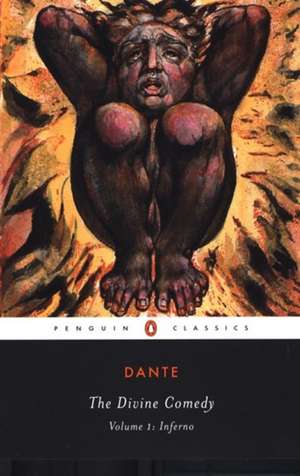
The Divine Comedy
Autor Dante Alighieri Comentarii de Mark Musaen Limba Engleză Paperback – 31 dec 2002
This vigorous translation of Inferno preserves Dante's simple, natural style, and captures the swift movement of the original Italian verse. Mark Musa's blank verse rendition of the poet's journey through the circles of hell recreates for the modern reader the rich meanings that Dante's poem had for his contemporaries. Musa's introduction and commentaries on each of the cantos brilliantly illuminate the text.
Dante Alighieri (1265-1321), scion of a Florentine family, mastered in the art of lyric poetry at an early age. His first major work is La Vita Nuova (1292) an exercise in sonnet form constructed as a tribute to Beatrice Portinari, the great love of his life. It is believed that The Divine Comedy - comprised of three canticles, Inferno, Purgatorio, and Paradiso - was written between 1308 and 1320.
If you enjoyed the Inferno you might like Giovanni Boccaccio's Decameron, also available in Penguin Classics.
'Musa operates on the principle that a translator's first duty is to render the original text as exactly as possible without compromising the literary quality of the work ... [This is] the best English-language version of the Inferno currently available'
Library Journal
Preț: 94.32 lei
Puncte Express: 141
Preț estimativ în valută:
16.67€ • 19.21$ • 14.55£
16.67€ • 19.21$ • 14.55£
Carte disponibilă
Livrare economică 25 aprilie-09 mai
Livrare express 11-17 aprilie pentru 31.27 lei
Specificații
ISBN-13: 9780142437223
ISBN-10: 0142437220
Pagini: 432
Dimensiuni: 129 x 196 x 20 mm
Greutate: 0.29 kg
Editura: Penguin Publishing Group
Locul publicării:London, United Kingdom
ISBN-10: 0142437220
Pagini: 432
Dimensiuni: 129 x 196 x 20 mm
Greutate: 0.29 kg
Editura: Penguin Publishing Group
Locul publicării:London, United Kingdom
V-ar putea interesa
-
 Wuthering HeightsEmily BrontëPreț: 24.60 lei
 -
 The LeopardJo Nesbo-28%Preț: 42.32 lei58.46 leiRecomandat
 -
 CockroachesJo Nesbo-15%Preț: 47.94 lei56.40 leiRecomandat
 -
 The Gods Will Have BloodAnatole France-20%Preț: 54.43 lei68.34 lei
 -
 The Master and MargaritaMikhail Bulgakov-26%Preț: 52.03 lei69.97 lei
 -
 -18%Preț: 63.85 lei77.60 lei
 -
 Mystical Poems of RumiJalal al-Din RumiPreț: 130.95 lei
 -
 A Christmas Carol and Other Christmas StoriesCharles DickensPreț: 31.85 lei
 -
 Complete Dramatic WorksSamuel BeckettPreț: 137.27 lei
 -
 The Selected Poems of Emily DickinsonEmily DickinsonPreț: 80.57 lei
 -
 -28%Preț: 54.42 lei75.26 lei
 -
 MolloySamuel BeckettPreț: 91.55 lei
 -
 Five Nights at Freddy's The Silver Eyes 1Kira Breed-WrisleyPreț: 57.98 lei
 -
 Five Nights at Freddy's: The Twisted OnesScott CawthonPreț: 55.44 lei
 -
 Five Nights at Freddy's The Fourth Closet 3Scott CawthonPreț: 56.84 lei
 -
 The Silk Roads: A New History of the WorldProfessor Peter Frankopan-25%Preț: 89.64 lei119.69 lei
 -
 The Romanovs: The Story of Russia and its Empire 1613-1918Simon Sebag Montefiore-24%Preț: 80.29 lei106.32 lei
 -
 Of The NightDavid BlairPreț: 35.19 lei
 -
 The Whisperer in Darkness, Volume One: Collected StoriesHoward Philips LovecraftPreț: 36.02 lei
 -
 Wuthering HeightsEmily BrontePreț: 35.15 lei
 -
 The InfernoDante AlighieriPreț: 41.41 lei
 -
 AmoriscoKhaled MattawaPreț: 70.75 lei
 -
 FaustJohann Wolfgang GoethePreț: 64.82 lei
Recenzii de la cititorii Books Express
Ioana Andreia Sandru a dat nota:
It was rather hard to understand it and so I read it twice. The second time reading it was more enjoyable because I understood the poem better, and that helped me appreciate the power of imagination and creativity. Inferno is undoubtedly one of the masterpieces in epic poetry.
Notă biografică
Dante Alighieri was born in Florence in 1265 and belonged to a noble but impoverished family. His life was divided by political duties and poetry, the most of famous of which was inspired by his meeting with Bice Portinari, whom he called Beatrice,including La Vita Nuova and The Divine Comedy. He died in Ravenna in 1321.
Mark Musa is Distinguished Professor of French and Italian at the Center for Italian Studies, Indiana University.
Mark Musa is Distinguished Professor of French and Italian at the Center for Italian Studies, Indiana University.
Descriere
Descriere de la o altă ediție sau format:
Described variously as the greatest poem of the European Middle Ages and, because of the author's evangelical purpose, the `fifth Gospel', the Divine Comedy is central to the culture of the west. The poem is a spiritual autobiography in the form of a journey - the poet travels from the dark circles of the Inferno, up the mountain of Purgatory, where Virgil, his guide leaves him to encounter Beatrice in the Earthly Paradise. Dante conceived the poem as the new epic of Christendom, and he creates a world in which reason and faith have transformed moral and social chaos into order.Charles Sisson's blank verse translation is remarkable for its lucidity and vigour, and the Introduction, diagrams, maps, and notes by David Higgins provide the reader with invaluable guidance. ABOUT THE SERIES: For over 100 years Oxford World's Classics has made available the widest range of literature from around the globe. Each affordable volume reflects Oxford's commitment to scholarship, providing the most accurate text plus a wealth of other valuable features, including expert introductions by leading authorities, helpful notes to clarify the text, up-to-date bibliographies for further study, and much more.
Described variously as the greatest poem of the European Middle Ages and, because of the author's evangelical purpose, the `fifth Gospel', the Divine Comedy is central to the culture of the west. The poem is a spiritual autobiography in the form of a journey - the poet travels from the dark circles of the Inferno, up the mountain of Purgatory, where Virgil, his guide leaves him to encounter Beatrice in the Earthly Paradise. Dante conceived the poem as the new epic of Christendom, and he creates a world in which reason and faith have transformed moral and social chaos into order.Charles Sisson's blank verse translation is remarkable for its lucidity and vigour, and the Introduction, diagrams, maps, and notes by David Higgins provide the reader with invaluable guidance. ABOUT THE SERIES: For over 100 years Oxford World's Classics has made available the widest range of literature from around the globe. Each affordable volume reflects Oxford's commitment to scholarship, providing the most accurate text plus a wealth of other valuable features, including expert introductions by leading authorities, helpful notes to clarify the text, up-to-date bibliographies for further study, and much more.
Recenzii
"The perfect balance of tightness and colloquialism . . . Likely to be the best modern version of Dante."
"Kirkpatrick brings a more nuanced sense of the Italian and a more mediated appreciation of the poem's construction than nearly all of his competitors."
"We gain much from Kirkpatrick's fidelity to syntax and nuance. . . . His introduction . . . tells you, very readable indeed, pretty much all you need for a heightened appreciation of the work."
Cuprins
The Divine Comedy How to Read Dante
Translator's Note
The Inferno
Introduction
Cantos
The Purgatorio
Introduction
Cantos
The Paradiso
Introduction
Cantos
Translator's Note
The Inferno
Introduction
Cantos
The Purgatorio
Introduction
Cantos
The Paradiso
Introduction
Cantos
Textul de pe ultima copertă
This story begins in a shadowed forest on Good Friday in the year of our Lord 1300. It proceeds on a journey that, in its intense re-creation of the depths and the heights of human experience, has become the key with which Western civilization has sought to unlock the mystery of its own identity.