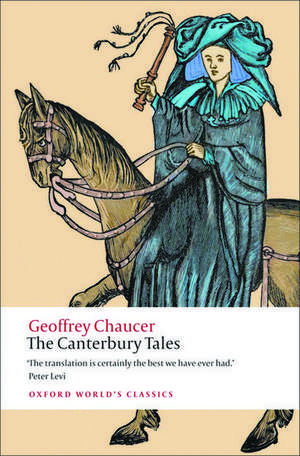
The Canterbury Tales
Autor Geoffrey Chaucer Traducere de David Wright Introducere și note de Christopher Cannonen Limba Engleză Paperback – 11 aug 2011
Preț: 53.40 lei
Preț vechi: 64.19 lei
-17%
Puncte Express: 80
Carte disponibilă
Livrare economică 21-26 mai
Livrare express 02-08 mai pentru 38.00 lei
Specificații
ISBN-13: 9780199599028
ISBN-10: 0199599025
Pagini: 560
Dimensiuni: 130 x 191 x 27 mm
Greutate: 0.39 kg
Ediția:New edition
Editura: Oxford University Press
Colecția OUP Oxford
Locul publicării:Oxford, United Kingdom
ISBN-10: 0199599025
Pagini: 560
Dimensiuni: 130 x 191 x 27 mm
Greutate: 0.39 kg
Ediția:New edition
Editura: Oxford University Press
Colecția OUP Oxford
Locul publicării:Oxford, United Kingdom
V-ar putea interesa
-
 BeowulfJ. R. R. TolkienPreț: 76.50 lei
 -
 HamletCollins GcsePreț: 27.82 lei
 -
 The TempestWilliam ShakespearePreț: 28.05 lei
 -
 As You Like itWilliam ShakespearePreț: 27.64 lei
 -
 Preț: 20.97 lei
 -
 The SonnetsWilliam ShakespearePreț: 27.77 lei
 -
 The Winter Berry HouseCaroline FlynnPreț: 61.88 lei
 -
 Everyone's a Aliebn When Ur a Aliebn TooJomny SunPreț: 101.74 lei
 -
 Sir Gawain and the Green KnightAnonymous-29%Preț: 47.81 lei67.39 lei
 -
 Le Morte D'Arthur Volume 1Thomas Malory-30%Preț: 72.21 lei102.97 lei
 -
 Le Morte d'ArthurThomas Malory-16%Preț: 78.38 lei93.47 lei
 -
 Princess in PracticeConnie Glynn-19%Preț: 45.23 lei55.80 lei
 -
 Shakespeare's SonnetsWilliam Shakespeare-21%Preț: 37.41 lei47.41 lei
 -
 Titus AndronicusWilliam Shakespeare-19%Preț: 44.90 lei55.52 lei
 -
 -19%Preț: 67.68 lei83.47 lei
 -
 Romeo & JulietWilliam Shakespeare-19%Preț: 19.45 lei24.12 lei
 -
 The Merchant of VeniceWilliam Shakespeare-26%Preț: 21.66 lei29.27 lei
 -
 OthelloWilliam ShakespearePreț: 36.10 lei
 -
 BeowulfSeamus HeaneyPreț: 88.01 lei
 -
 Embassy Row: All Fall Down: Book 1Ally Carter-26%Preț: 51.26 lei69.51 lei
 -
 Not If I Save You FirstAlly Carter-26%Preț: 46.34 lei62.76 lei
 -
 The Tragedy of MacbethWilliam ShakespearePreț: 34.79 lei
 -
 Richard IIIWilliam ShakespearePreț: 34.61 lei
 -
 HamletWilliam ShakespearePreț: 34.75 lei
 -
 Twelfth NightWilliam ShakespearePreț: 34.11 lei
 -
 Preț: 34.24 lei
 -
 OthelloWilliam Shakespeare-42%Preț: 43.41 lei74.43 lei
Recenzii
David Wright is a fine poet, and he has translated the Tales with crisp brilliance and fidelity into classic verse...On every page he offers at least a few lines that make one smile with pleasure. This version ought to be on every school syllabus. The translation is certainly the best we have ever had.
David Wright's new verse translation of The Canterbury Tales is done with great skill, literary tact, and polish....it is caring and resourceful. It both stands up well in its own right, and is likely to send the reader back to Chaucer.
David Wright's new verse translation of The Canterbury Tales is done with great skill, literary tact, and polish....it is caring and resourceful. It both stands up well in its own right, and is likely to send the reader back to Chaucer.
Notă biografică
David Wright (1920-94) was a poet, author, and translator. Born in South Africa, he was deafened by scarlet fever at the age of 7 and emigrated to England when he was 14. He co-founded the literary review X which he co-edited from 1959-62, and published several books of verse, a translation of Beowulf, and edited anthologies of verse for Penguin and Faber.Christopher Cannon has taught at UCLA, Oxford, and Cambridge. His publications include The Making of Chaucer's English: A Study of Words (2001;2005). The Grounds of English Literature (2004; 2007), and Middle English Literature: A Cultural History (2008). He has written the Foreword to the Riverside Chaucer.
Extras
The Knight’s Tale
1
Introduction
1 The Knight’s Tale, which mostly takes place in ancient Athens, is the conflicted love story of two royal Theban cousins who love the same woman. Because “The Knight’s Tale” is by far the longest and most complex of the Canterbury Tales presented in this volume, a quick summary of the action of the four parts of the tale may help readers encountering it for the first time:
Part I. On his way back to Athens with his bride, Hypolita, and his sister-in-law, Emily, Duke Theseus responds to the pleas of some grieving widows by defeating Creon, the tyrant of Thebes. Among the bodies of the defeated army, he finds near death the royal cousins Palamon and Arcite. Rather than kill them, Theseus takes them back to Athens and places them in prison. From their barred prison window, the two young men see the lovely Emily and both fall in love with her. Arcite after a time is released but banished from Athens on pain of death, while Palamon remains in prison. The two are envious of each other’s condition.
Part II. Arcite disguises himself as a common laborer and comes back to Athens, where he gets a job working in Emily’s household. Meanwhile, Palamon escapes from prison, and the rival cousins chance to meet in a grove near Athens. While Palamon and Arcite are fighting a bloody duel, Theseus, Hypolita, and Emily, out hunting, by chance come upon them in a grove. At first angry, Theseus soon relents, sets both of his enemies free, and invites them to return in a year, each with a hundred knights, to take part in a glorious tournament, with Emily’s hand going to the winner.
Part III. Theseus builds a splendid amphitheater in preparation for the tournament and places on its west, east, and north borders elaborately decorated temples to Mars, Venus, and Diana. When the two troops of warriors come back for the tournament, the three principals each pray to one of the planetary deities. Palamon prays to Venus, not for victory but for the hand of Emily. Emily prays to Diana to be spared marriage to either Palamon or Arcite, praying instead to remain a maiden always. Arcite prays to Mars for victory in the tournament.
Part IV. Just before the tournament begins Theseus declares that he wants no lives to be lost and restricts the kinds of weapons that may be used. He sets out the rules of the game, the primary one being that the winning side will be the one that takes the loser to a stake at the end of the field. After vigorous fighting, Arcite’s men drag the wounded Palamon to the stake. No sooner is Arcite declared the winner than Saturn commands Pluto, god of the underworld, to send a diabolical fury to frighten Arcite’s horse. Arcite is thrown and crushed by his own saddle bow. After an elaborate funeral and the passage of some years, Theseus tells Palamon and Emily to marry, and they happily do so.
Arching over the story of the warriors and lovers down on the earth below is a heavenly conflict among the gods or, more precisely, among the planetary or astrological influences that were thought to control the affairs of men. Indeed, a key feature of “The Knight’s Tale” is the prayers of the three principal characters to these influences. Closely tied up with the question of whether Palamon or Arcite will get the young woman they both love is the question of how the powerful Saturn will settle the conflicting demands on him of Mars, Venus, and Diana.
Chaucer’s main source for “The Knight’s Tale” is Giovanni Boccaccio’s several-hundred-page-long Teseida. Readers who are upset at having to read Chaucer’s long and leisurely story of Palamon, Arcite, and Emily should thank Chaucer for streamlining a story that is less than a quarter the length of Boccaccio’s Italian story of Palemone, Arcita, and Emilia. Chaucer reduced the story in lots of ways, particularly by staying focused on the love story. He cut out, for example, Boccaccio’s long opening description of Theseus’s journey to the land of the Amazons, his defeat of them, and his acquiring as his bride the Amazonian queen Hypolita. But Chaucer did more than reduce the Teseida, which focuses on Arcite as the main character, who in Boccaccio is almost a tragic figure who makes the mistake of praying to the wrong deity. For Chaucer, Palamon is raised to equal importance, if not more importance, than his rival. And Chaucer transforms the vain and coquettish Emilia of his source into a more innocent object of the love of rival cousins.
One of Chaucer’s most important changes was to give the story a philosophical overlay by introducing into it the ideas of the ancient philosopher Boethius. One of Boethius’s key ideas was that there is a great God who designs a far better plan for human beings than they could possibly design for themselves. That design sometimes involves what looks like adversity, but the adversity is always (for Boethius) part of a design that leads to happiness. We should then, according to Boethius, not resist or fight against the troubles that come our way, but cheerfully accept them, trusting that in the end things will work out for the best. The ending of “The Knight’s Tale,” then, reflects this reassuring philosophy by showing that although the three principal characters all seem at first not to get what they want most, in the end all of them do get what they want, or perhaps something even better.
For this and the other tales in this volume, readers should reread the portrait of the teller given by Chaucer in the General Prologue. The portrait of the Knight (lines 43–78) shows him to be the idealized Christian soldier who fought with valor and honor at most of the important late-fourteenth-century battles against heathens. We know less of his marital than of his martial life, but he does have a son who is with him on this pilgrimage. The Knight seems, all in all, an ideal teller for the long tale of war, romance, honor, and philosophy that Chaucer assigns to him.
Notes
Part I
Femenye (line 8). A race of warlike women, led by Hypolita, who decided that they could live and protect themselves without the help of men. They are sometimes called Amazons, their land Scithia.
Saturne, Juno (470–71). Two forces that Palamon blames for the setbacks that Thebes has suffered. Saturn is the powerful planet. Juno is the jealous wife of Jupiter, who had made love to two Theban women.
Part II
Hereos (516). Eros, a sickness associated with the intense emotion of falling in love.
manye (516). A kind of melancholy madness or mania brought on by the frustration of his love for an inaccessible woman.
Argus (532). In classical mythology, the jealous Juno had set the hundred-eyed Argus as guard to Io, who was a lover of her husband, Jupiter. Argus was killed by Mercury (see line 527), who first sang all of Argus’s hundred eyes to sleep.
Cadme and Amphioun (688). Cadmus and Amphion are the legendary founders of the city of Thebes, home to Palamon and Arcite.
regne of Trace (780). The reference in this and the next lines is to the Thracian kingdom in which a hunter prepares himself at a mountain pass to meet a charging lion or bear.
Part III
Citheroun (1078). Venus’s supposed mountainous island of Cytherea, though Chaucer may have confused the name with the name of a different location.
Ydelnesse, Salamon, Hercules, Medea, Circes, Turnus, Cresus (1082–88). Various literary, historical, and classical allusions, most of them demonstrating the follies and miseries associated with the snares of love.
qualm (1156). Probably a reference to the “pestilence” or bubonic plague that killed millions in Europe during Chaucer’s lifetime. See also line 1611 below, where Saturn claims to have the power to send the plague. The reference to the bubonic plague here is anachronistic, since “The Knight’s Tale” is set in the classical pre-Christian era.
Julius, Nero, Antonius (1173–74). Three famous rulers slaughtered in time of war—exemplary of the mayhem and death caused by mighty Mars. The last is Marcus Aurelius Antoninus Caracalla, a Roman emperor murdered in AD 217.
Puella, Rubeus (1187). Two astrological references to Mars as cast by a complicated process called geomancy, a pseudoscience involving dots and lines.
Calistopee, Dane, Attheon, Atthalante, Meleagre (1198– 1213). Various classical and legendary allusions to hunters or the hunted whose unfortunate tales are depicted on the walls of the temple of Diana, goddess of the hunt.
griffon (1275). A griffin was in Greek mythology a fearsome beast with the head and wings of an eagle on the body of a lion.
in hir houre (1359). Palamon picks his hour of prayer carefully. The various planets were supposed to have special powers on certain hours of the day, hours in which it was particularly propitious to make prayers for their astrological influence. Venus would have had special strength on the twenty-third hour of Sunday night (see line 1351), when it was not yet two hours before dawn on Monday morning (line 1352).
the thridde houre inequal (1413). The medieval astrological day was divided into twenty-four “inequal” or planetary hours. In this system the time between dawn and dusk was divided equally into twelve hours, the time between dusk and the following dawn into twelve more. Except at the two equinoxes, when the daylight hours would have been exactly equal in length to the nighttime hours (that is, sixty minutes), the daylight hours would have been longer or shorter than the hours of darkness, depending on the time of the year—thus the inequality. Emily prays to Diana on the third inequal hour after Palamon prayed to Venus. That would have been the first hour of Monday (“moon day”), or the dawn hour, the hour at which Diana’s power would have been the greatest. Like Palamon, Emily picks her prayer time very carefully.
Stace of Thebes (1436). The Thebaid of Statius, though Chaucer’s more direct source was actually Boccaccio’s Teseida, which he does not mention by name here or elsewhere. Chaucer was often eager to claim an ancient source, not a contemporary one.
Attheon (1445). While hunting, Acteon accidentally saw Diana while she was bathing. In her anger she changed him into a stag, which Acteon’s hunting dogs then killed, not realizing that they were killing their master. See lines 1207–10 above, where Acteon’s unhappy story is artistically summarized on the walls of Diana’s temple.
thre formes (1455). As suggested in lines 1439–42 above, the goddess was imagined to have appeared in various forms. The three referred to here are probably Luna, the moon (in the heavens), the chaste Diana, the huntress (on earth), and Proserpina, the reluctant wife of Pluto (in the underworld).
the nexte houre of Mars (1509). Mars’s next hour, the hour that Arcite would have selected for his prayer to Mars, would have been the fourth hour of that Monday.
Part IV
al that Monday (1628). Monday is given over to partying and celebrations so that the tournament itself takes place the next day, on a Tuesday, or Mars’s day (“Mardi” in French). Since Tuesday is the day when the influence of Mars is strongest, it would not have surprised a medieval audience that Arcite, who had prayed to Mars, wins the tournament.
Galgopheye (1768). Probably a valley in another part of Greece, perhaps Gargaphia.
Belmarye (1772). Probably Benmarin in Morocco but, like the previous name, perhaps just meant to be an exotic place where wild animals were rampant and dangerous.
furie infernal (1826). A fury was an avenging spirit usually confined to the underworld but released from time to time to influence the affairs of men, sometimes to see that justice was done.
vertu expulsif (1891). This “virtue” involved the ability to expel certain harmful poisons from the body. This complex account of the mechanics of Arcite’s dying, the technical details of which are not important here, shows Chaucer’s awareness of the medical terminology of his day.
Firste Moevere (2129). This First Mover who creates the links in the great “chain of love,” though later in the passage identified as Jupiter, may perhaps be read as an anachronistic stand-in for the Judeo-Christian godhead, the all- loving deity who stands above and beyond the planetary gods and goddesses that seem to control the fates of men. This prime mover determines the number of years indi- vidual men and women get to live on earth and arranges things better for them than they could arrange them for themselves.
1
Introduction
1 The Knight’s Tale, which mostly takes place in ancient Athens, is the conflicted love story of two royal Theban cousins who love the same woman. Because “The Knight’s Tale” is by far the longest and most complex of the Canterbury Tales presented in this volume, a quick summary of the action of the four parts of the tale may help readers encountering it for the first time:
Part I. On his way back to Athens with his bride, Hypolita, and his sister-in-law, Emily, Duke Theseus responds to the pleas of some grieving widows by defeating Creon, the tyrant of Thebes. Among the bodies of the defeated army, he finds near death the royal cousins Palamon and Arcite. Rather than kill them, Theseus takes them back to Athens and places them in prison. From their barred prison window, the two young men see the lovely Emily and both fall in love with her. Arcite after a time is released but banished from Athens on pain of death, while Palamon remains in prison. The two are envious of each other’s condition.
Part II. Arcite disguises himself as a common laborer and comes back to Athens, where he gets a job working in Emily’s household. Meanwhile, Palamon escapes from prison, and the rival cousins chance to meet in a grove near Athens. While Palamon and Arcite are fighting a bloody duel, Theseus, Hypolita, and Emily, out hunting, by chance come upon them in a grove. At first angry, Theseus soon relents, sets both of his enemies free, and invites them to return in a year, each with a hundred knights, to take part in a glorious tournament, with Emily’s hand going to the winner.
Part III. Theseus builds a splendid amphitheater in preparation for the tournament and places on its west, east, and north borders elaborately decorated temples to Mars, Venus, and Diana. When the two troops of warriors come back for the tournament, the three principals each pray to one of the planetary deities. Palamon prays to Venus, not for victory but for the hand of Emily. Emily prays to Diana to be spared marriage to either Palamon or Arcite, praying instead to remain a maiden always. Arcite prays to Mars for victory in the tournament.
Part IV. Just before the tournament begins Theseus declares that he wants no lives to be lost and restricts the kinds of weapons that may be used. He sets out the rules of the game, the primary one being that the winning side will be the one that takes the loser to a stake at the end of the field. After vigorous fighting, Arcite’s men drag the wounded Palamon to the stake. No sooner is Arcite declared the winner than Saturn commands Pluto, god of the underworld, to send a diabolical fury to frighten Arcite’s horse. Arcite is thrown and crushed by his own saddle bow. After an elaborate funeral and the passage of some years, Theseus tells Palamon and Emily to marry, and they happily do so.
Arching over the story of the warriors and lovers down on the earth below is a heavenly conflict among the gods or, more precisely, among the planetary or astrological influences that were thought to control the affairs of men. Indeed, a key feature of “The Knight’s Tale” is the prayers of the three principal characters to these influences. Closely tied up with the question of whether Palamon or Arcite will get the young woman they both love is the question of how the powerful Saturn will settle the conflicting demands on him of Mars, Venus, and Diana.
Chaucer’s main source for “The Knight’s Tale” is Giovanni Boccaccio’s several-hundred-page-long Teseida. Readers who are upset at having to read Chaucer’s long and leisurely story of Palamon, Arcite, and Emily should thank Chaucer for streamlining a story that is less than a quarter the length of Boccaccio’s Italian story of Palemone, Arcita, and Emilia. Chaucer reduced the story in lots of ways, particularly by staying focused on the love story. He cut out, for example, Boccaccio’s long opening description of Theseus’s journey to the land of the Amazons, his defeat of them, and his acquiring as his bride the Amazonian queen Hypolita. But Chaucer did more than reduce the Teseida, which focuses on Arcite as the main character, who in Boccaccio is almost a tragic figure who makes the mistake of praying to the wrong deity. For Chaucer, Palamon is raised to equal importance, if not more importance, than his rival. And Chaucer transforms the vain and coquettish Emilia of his source into a more innocent object of the love of rival cousins.
One of Chaucer’s most important changes was to give the story a philosophical overlay by introducing into it the ideas of the ancient philosopher Boethius. One of Boethius’s key ideas was that there is a great God who designs a far better plan for human beings than they could possibly design for themselves. That design sometimes involves what looks like adversity, but the adversity is always (for Boethius) part of a design that leads to happiness. We should then, according to Boethius, not resist or fight against the troubles that come our way, but cheerfully accept them, trusting that in the end things will work out for the best. The ending of “The Knight’s Tale,” then, reflects this reassuring philosophy by showing that although the three principal characters all seem at first not to get what they want most, in the end all of them do get what they want, or perhaps something even better.
For this and the other tales in this volume, readers should reread the portrait of the teller given by Chaucer in the General Prologue. The portrait of the Knight (lines 43–78) shows him to be the idealized Christian soldier who fought with valor and honor at most of the important late-fourteenth-century battles against heathens. We know less of his marital than of his martial life, but he does have a son who is with him on this pilgrimage. The Knight seems, all in all, an ideal teller for the long tale of war, romance, honor, and philosophy that Chaucer assigns to him.
Notes
Part I
Femenye (line 8). A race of warlike women, led by Hypolita, who decided that they could live and protect themselves without the help of men. They are sometimes called Amazons, their land Scithia.
Saturne, Juno (470–71). Two forces that Palamon blames for the setbacks that Thebes has suffered. Saturn is the powerful planet. Juno is the jealous wife of Jupiter, who had made love to two Theban women.
Part II
Hereos (516). Eros, a sickness associated with the intense emotion of falling in love.
manye (516). A kind of melancholy madness or mania brought on by the frustration of his love for an inaccessible woman.
Argus (532). In classical mythology, the jealous Juno had set the hundred-eyed Argus as guard to Io, who was a lover of her husband, Jupiter. Argus was killed by Mercury (see line 527), who first sang all of Argus’s hundred eyes to sleep.
Cadme and Amphioun (688). Cadmus and Amphion are the legendary founders of the city of Thebes, home to Palamon and Arcite.
regne of Trace (780). The reference in this and the next lines is to the Thracian kingdom in which a hunter prepares himself at a mountain pass to meet a charging lion or bear.
Part III
Citheroun (1078). Venus’s supposed mountainous island of Cytherea, though Chaucer may have confused the name with the name of a different location.
Ydelnesse, Salamon, Hercules, Medea, Circes, Turnus, Cresus (1082–88). Various literary, historical, and classical allusions, most of them demonstrating the follies and miseries associated with the snares of love.
qualm (1156). Probably a reference to the “pestilence” or bubonic plague that killed millions in Europe during Chaucer’s lifetime. See also line 1611 below, where Saturn claims to have the power to send the plague. The reference to the bubonic plague here is anachronistic, since “The Knight’s Tale” is set in the classical pre-Christian era.
Julius, Nero, Antonius (1173–74). Three famous rulers slaughtered in time of war—exemplary of the mayhem and death caused by mighty Mars. The last is Marcus Aurelius Antoninus Caracalla, a Roman emperor murdered in AD 217.
Puella, Rubeus (1187). Two astrological references to Mars as cast by a complicated process called geomancy, a pseudoscience involving dots and lines.
Calistopee, Dane, Attheon, Atthalante, Meleagre (1198– 1213). Various classical and legendary allusions to hunters or the hunted whose unfortunate tales are depicted on the walls of the temple of Diana, goddess of the hunt.
griffon (1275). A griffin was in Greek mythology a fearsome beast with the head and wings of an eagle on the body of a lion.
in hir houre (1359). Palamon picks his hour of prayer carefully. The various planets were supposed to have special powers on certain hours of the day, hours in which it was particularly propitious to make prayers for their astrological influence. Venus would have had special strength on the twenty-third hour of Sunday night (see line 1351), when it was not yet two hours before dawn on Monday morning (line 1352).
the thridde houre inequal (1413). The medieval astrological day was divided into twenty-four “inequal” or planetary hours. In this system the time between dawn and dusk was divided equally into twelve hours, the time between dusk and the following dawn into twelve more. Except at the two equinoxes, when the daylight hours would have been exactly equal in length to the nighttime hours (that is, sixty minutes), the daylight hours would have been longer or shorter than the hours of darkness, depending on the time of the year—thus the inequality. Emily prays to Diana on the third inequal hour after Palamon prayed to Venus. That would have been the first hour of Monday (“moon day”), or the dawn hour, the hour at which Diana’s power would have been the greatest. Like Palamon, Emily picks her prayer time very carefully.
Stace of Thebes (1436). The Thebaid of Statius, though Chaucer’s more direct source was actually Boccaccio’s Teseida, which he does not mention by name here or elsewhere. Chaucer was often eager to claim an ancient source, not a contemporary one.
Attheon (1445). While hunting, Acteon accidentally saw Diana while she was bathing. In her anger she changed him into a stag, which Acteon’s hunting dogs then killed, not realizing that they were killing their master. See lines 1207–10 above, where Acteon’s unhappy story is artistically summarized on the walls of Diana’s temple.
thre formes (1455). As suggested in lines 1439–42 above, the goddess was imagined to have appeared in various forms. The three referred to here are probably Luna, the moon (in the heavens), the chaste Diana, the huntress (on earth), and Proserpina, the reluctant wife of Pluto (in the underworld).
the nexte houre of Mars (1509). Mars’s next hour, the hour that Arcite would have selected for his prayer to Mars, would have been the fourth hour of that Monday.
Part IV
al that Monday (1628). Monday is given over to partying and celebrations so that the tournament itself takes place the next day, on a Tuesday, or Mars’s day (“Mardi” in French). Since Tuesday is the day when the influence of Mars is strongest, it would not have surprised a medieval audience that Arcite, who had prayed to Mars, wins the tournament.
Galgopheye (1768). Probably a valley in another part of Greece, perhaps Gargaphia.
Belmarye (1772). Probably Benmarin in Morocco but, like the previous name, perhaps just meant to be an exotic place where wild animals were rampant and dangerous.
furie infernal (1826). A fury was an avenging spirit usually confined to the underworld but released from time to time to influence the affairs of men, sometimes to see that justice was done.
vertu expulsif (1891). This “virtue” involved the ability to expel certain harmful poisons from the body. This complex account of the mechanics of Arcite’s dying, the technical details of which are not important here, shows Chaucer’s awareness of the medical terminology of his day.
Firste Moevere (2129). This First Mover who creates the links in the great “chain of love,” though later in the passage identified as Jupiter, may perhaps be read as an anachronistic stand-in for the Judeo-Christian godhead, the all- loving deity who stands above and beyond the planetary gods and goddesses that seem to control the fates of men. This prime mover determines the number of years indi- vidual men and women get to live on earth and arranges things better for them than they could arrange them for themselves.
Textul de pe ultima copertă
A group of pilgrims bound for Canterbury Cathedral agree to pass the weary miles by taking turns at storytelling. The travelers noble, coarse, jolly, and pious offer a vibrant portrait of fourteenth-century English life. Their narratives form English literature's greatest collection of chivalric romances, bawdy tales, fables, legends, and other stories.
The Canterbury Tales reflects a society in transition, as a middle class began to emerge from England's feudal system. Craftsmen and laborers ride side by side with the gentry on the road to the shrine of St. Thomas a Becket, and their discussions and arguments about ethical issues mirror their changing world. The pilgrims' conversations and stories also reveal their individual personalities, and Chaucer's vivid, realistic characterizations assured the Tales an instant and enduring success. Each pilgrim's story can be read separately and appreciated in its own right; all appear here in a lucid translation into modern English verse by J. U. Nicolson.
Dover (2015) republication of the modern English verse translation by J. U. Nicolson, originally published in 1934.
See every Dover book in print at
www.doverpublications.com
"
The Canterbury Tales reflects a society in transition, as a middle class began to emerge from England's feudal system. Craftsmen and laborers ride side by side with the gentry on the road to the shrine of St. Thomas a Becket, and their discussions and arguments about ethical issues mirror their changing world. The pilgrims' conversations and stories also reveal their individual personalities, and Chaucer's vivid, realistic characterizations assured the Tales an instant and enduring success. Each pilgrim's story can be read separately and appreciated in its own right; all appear here in a lucid translation into modern English verse by J. U. Nicolson.
Dover (2015) republication of the modern English verse translation by J. U. Nicolson, originally published in 1934.
See every Dover book in print at
www.doverpublications.com
"
Cuprins
The Canterbury Tales: A SelectionAcknowledgements
Chronology
Introduction
Further Reading
A Note on the Translation, Text and Illustrations
The Canterbury Tales
The General Prologue The Knight's Tale The Miller's Prologue and Tale The Reeve's Prologue and Tale The Wife of Bath's Prologue and Tale The Clerk's Prologue and Tale The Merchant's Prologue, Tale and Epilogue The Franklin's Prologue and Tale The Pardoner's Prologue and Tale The Nun's Priest's Tale