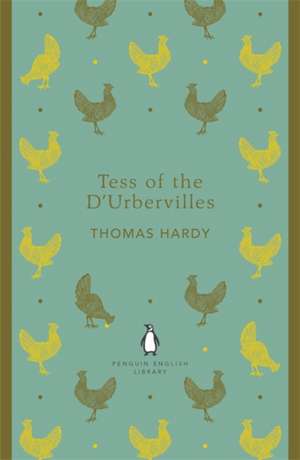
Tess of the D'Urbervilles: The Penguin English Library
Autor Thomas Hardyen Limba Engleză Paperback – 25 oct 2012
"I would be content, ay, glad, to live with you as your servant, if I may not as your wife; so that I could only be near you, and get glimpses of you, and think of you as mine ... I long for only one thing in heaven or earth or under the earth, to meet you, my own dear! Come to me - come to me, and save me from what threatens me!"
When Tess Durbeyfield is driven by family poverty to claim kinship with the wealthy D'Urbervilles and seek a portion of their family fortune, meeting her 'cousin' Alec proves to be her downfall. A very different man, Angel Clare, seems to offer her love and salvation, but Tess must choose whether to reveal her past or remain silent in the hope of a peaceful future. With its sensitive depiction of the wronged Tess and powerful criticism of social convention, Tess of the D'Urbervilles is one of the most moving and poetic of Hardy's novels.
The Penguin English Library - 100 editions of the best fiction in English, from the eighteenth century and the very first novels to the beginning of the First World War.
| Toate formatele și edițiile | Preț | Express |
|---|---|---|
| Paperback (48) | 24.60 lei 24 ore | |
| HarperCollins Publishers – apr 2010 | 24.60 lei 24 ore | |
| Random House – mai 1984 | 41.19 lei 3-5 săpt. | |
| Penguin Books – 25 oct 2012 | 47.18 lei 24-30 zile | +24.96 lei 4-10 zile |
| Oxford University Press – 14 aug 2008 | 47.27 lei 24-29 zile | +25.15 lei 4-10 zile |
| Vintage Publishing – 7 apr 2011 | 48.13 lei 24-30 zile | +26.67 lei 4-10 zile |
| Arcturus Publishing – 14 iun 2018 | 49.66 lei 3-5 săpt. | +12.52 lei 4-10 zile |
| HarperCollins Publishers – 25 oct 2022 | 51.49 lei 3-5 săpt. | +19.22 lei 4-10 zile |
| Penguin Books – 30 ian 2003 | 57.82 lei 3-5 săpt. | +18.18 lei 4-10 zile |
| FABER & FABER – mar 2018 | 58.29 lei 3-5 săpt. | +19.88 lei 4-10 zile |
| CreateSpace Independent Publishing Platform – | 60.98 lei 3-5 săpt. | |
| CREATESPACE – | 62.08 lei 3-5 săpt. | |
| CANTERBURY CLASSICS – 31 mar 2022 | 65.18 lei 25-37 zile | +42.23 lei 4-10 zile |
| Dover Publications – 14 iun 2001 | 65.78 lei 3-5 săpt. | |
| CreateSpace Independent Publishing Platform – | 88.70 lei 3-5 săpt. | |
| – | 98.53 lei 3-5 săpt. | |
| West Margin Press – 8 iul 2020 | 101.42 lei 3-5 săpt. | |
| CREATESPACE – | 102.04 lei 3-5 săpt. | |
| CREATESPACE – | 123.96 lei 3-5 săpt. | |
| BEDFORD BOOKS – feb 1998 | 127.33 lei 3-5 săpt. | |
| CREATESPACE – | 137.65 lei 3-5 săpt. | |
| CREATESPACE – | 138.28 lei 3-5 săpt. | |
| – | 150.02 lei 3-5 săpt. | |
| CREATESPACE – | 163.85 lei 3-5 săpt. | |
| CreateSpace Independent Publishing Platform – | 82.56 lei 6-8 săpt. | |
| CREATESPACE – | 86.81 lei 6-8 săpt. | |
| – | 92.32 lei 6-8 săpt. | |
| – | 101.49 lei 6-8 săpt. | |
| Lulu.Com – 11 iun 2018 | 112.11 lei 6-8 săpt. | |
| – | 117.48 lei 6-8 săpt. | |
| CreateSpace Independent Publishing Platform – 5 dec 2015 | 119.79 lei 6-8 săpt. | |
| – | 120.90 lei 6-8 săpt. | |
| – | 121.33 lei 6-8 săpt. | |
| SMK Books – 25 apr 2011 | 123.12 lei 6-8 săpt. | |
| CREATESPACE – | 126.10 lei 6-8 săpt. | |
| CREATESPACE – | 130.74 lei 6-8 săpt. | |
| KUPERARD (BRAVO LTD) – 22 mar 2001 | 142.50 lei 38-44 zile | |
| – | 149.39 lei 6-8 săpt. | |
| Bibliotech Press – 31 dec 2011 | 156.73 lei 6-8 săpt. | |
| SC Active Business Development SRL – 29 noi 2017 | 158.43 lei 38-44 zile | |
| Aegypan Press – 31 aug 2007 | 159.17 lei 38-44 zile | |
| BLURB INC – 22 mar 2019 | 177.50 lei 17-23 zile | |
| Alpha Editions – 4 aug 2020 | 178.69 lei 6-8 săpt. | |
| CreateSpace Independent Publishing Platform – | 182.88 lei 6-8 săpt. | |
| Delhi Open Books – 12 iun 2020 | 185.39 lei 6-8 săpt. | |
| TREDITION CLASSICS – 31 oct 2011 | 252.85 lei 6-8 săpt. | |
| Echo Library – 30 iun 2003 | 266.36 lei 38-44 zile | |
| Echo Library – 31 mar 2006 | 305.77 lei 38-44 zile | |
| Orion Publishing Group – 30 dec 2019 | 38.18 lei Precomandă | |
| Hardback (12) | 54.51 lei 3-5 săpt. | +41.97 lei 4-10 zile |
| Pan Macmillan – 3 mai 2018 | 54.51 lei 3-5 săpt. | +41.97 lei 4-10 zile |
| Flame Tree Publishing – 15 feb 2020 | 60.94 lei 3-5 săpt. | +20.56 lei 4-10 zile |
| WORDSWORTH EDITIONS LTD – 15 aug 2022 | 71.04 lei 3-5 săpt. | +18.18 lei 4-10 zile |
| Penguin Books – 5 noi 2008 | 90.29 lei 24-30 zile | +76.49 lei 4-10 zile |
| North Parade Publishing – 7 ian 2025 | 106.24 lei 3-5 săpt. | +25.85 lei 4-10 zile |
| chiltern publishing – 8 sep 2020 | 141.90 lei 3-5 săpt. | +35.40 lei 4-10 zile |
| Mint Editions – 23 iun 2020 | 153.10 lei 3-5 săpt. | |
| Alpha Editions – 26 aug 2020 | 242.76 lei 3-5 săpt. | |
| Lulu.Com – 11 iun 2018 | 219.40 lei 6-8 săpt. | |
| Bibliotech Press – 6 iul 2019 | 230.36 lei 6-8 săpt. | |
| SMK Books – 3 apr 2018 | 231.00 lei 6-8 săpt. | +45.09 lei 4-10 zile |
| OUP OXFORD – 31 mar 1983 | 759.07 lei 45-50 zile |
Din seria The Penguin English Library
-
 Preț: 42.46 lei
 - 28%
 Preț: 44.18 lei
 - 27%
 Preț: 46.07 lei
 - 30%
 Preț: 42.74 lei
 - 23%
 Preț: 55.66 lei
 - 28%
 Preț: 44.60 lei
 - 34%
 Preț: 46.24 lei
 - 25%
 Preț: 52.60 lei
 - 18%
 Preț: 45.97 lei
 - 27%
 Preț: 45.87 lei
 - 14%
 Preț: 63.59 lei
 - 30%
 Preț: 42.90 lei
 - 19%
 Preț: 50.21 lei
 -
 Preț: 60.56 lei
 - 29%
 Preț: 43.57 lei
 - 34%
 Preț: 45.87 lei
 - 29%
 Preț: 43.71 lei
 - 27%
 Preț: 46.18 lei
 - 17%
 Preț: 47.34 lei
 -
 Preț: 55.96 lei
 - 20%
 Preț: 43.71 lei
 - 29%
 Preț: 43.40 lei
 - 30%
 Preț: 55.23 lei
 - 29%
 Preț: 44.03 lei
 - 29%
 Preț: 43.94 lei
 - 25%
 Preț: 47.63 lei
 - 17%
 Preț: 59.42 lei
 - 25%
 Preț: 53.17 lei
 - 29%
 Preț: 44.14 lei
 - 17%
 Preț: 53.04 lei
 - 20%
 Preț: 43.91 lei
 - 26%
 Preț: 47.14 lei
 - 29%
 Preț: 43.07 lei
 - 27%
 Preț: 45.28 lei
 - 27%
 Preț: 45.47 lei
 - 19%
 Preț: 45.57 lei
 - 16%
 Preț: 60.18 lei
 - 20%
 Preț: 49.07 lei
 - 29%
 Preț: 43.43 lei
 - 22%
 Preț: 42.41 lei
 - 30%
 Preț: 42.70 lei
 - 27%
 Preț: 45.37 lei
 - 29%
 Preț: 43.78 lei
 - 19%
 Preț: 45.44 lei
 - 17%
 Preț: 59.16 lei
 - 22%
 Preț: 42.18 lei
 -
 Preț: 61.19 lei
 - 28%
 Preț: 44.50 lei
 - 19%
 Preț: 45.17 lei
 - 20%
 Preț: 44.43 lei
Preț: 47.18 lei
Preț vechi: 56.99 lei
-17% Nou
Puncte Express: 71
Preț estimativ în valută:
8.35€ • 9.79$ • 7.33£
8.35€ • 9.79$ • 7.33£
Carte disponibilă
Livrare economică 15-21 ianuarie 26
Livrare express 26 decembrie 25 - 01 ianuarie 26 pentru 34.95 lei
Preluare comenzi: 021 569.72.76
Specificații
ISBN-13: 9780141199948
ISBN-10: 0141199946
Pagini: 496
Dimensiuni: 127 x 196 x 23 mm
Greutate: 0.34 kg
Editura: Penguin Books
Colecția Penguin Classics
Seria The Penguin English Library
Locul publicării:London, United Kingdom
ISBN-10: 0141199946
Pagini: 496
Dimensiuni: 127 x 196 x 23 mm
Greutate: 0.34 kg
Editura: Penguin Books
Colecția Penguin Classics
Seria The Penguin English Library
Locul publicării:London, United Kingdom
V-ar putea interesa
-
 Pride and PrejudiceJane AustenPreț: 24.60 lei
 -
 Robinson CrusoeDaniel De FoePreț: 24.60 lei
 -
 Great ExpectationsCharles DickensPreț: 24.60 lei
 -
 Northanger AbbeyJane AustenPreț: 24.60 lei
 -
 Tales of Mystery and ImaginationEdgar Allan PoePreț: 24.60 lei
 -
 Plays of Oscar WildeOscar WildePreț: 24.60 lei
 -
 The Portrait of a Lady (Collins Classics)Henry JamesPreț: 34.77 lei
 -
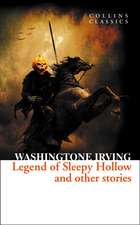 Irving, W: Legend of Sleepy Hollow and Other StoriesWashington IrvingPreț: 29.49 lei
 -
 UlyssesJames Joyce-20%Preț: 64.61 lei81.25 lei
 -
 The Adventures of Huckleberry FinnMark Twain-27%Preț: 45.37 lei62.49 lei
 -
 Vanity FairWilliam Makepeace Thackeray-21%Preț: 63.31 lei80.48 lei
 -
 Sense and SensibilityJane Austen-27%Preț: 46.18 lei62.98 lei
 -
 -28%Preț: 44.18 lei61.76 lei
 -
 MiddlemarchGeorge Eliot-14%Preț: 63.59 lei74.04 lei
 -
 AntigoneSophocles-40%Preț: 16.22 lei27.11 lei
 -
 The Complete Short Stories of Ernest HemingwayErnest HemingwayPreț: 126.60 lei
 -
 Classic Starts(r) Moby-DickHerman Melville-10%Preț: 45.20 lei50.12 lei
 -
 A Monster CallsPatrick NessPreț: 62.13 lei
 -
 The Hate U GiveAngie Thomas-7%Preț: 58.13 lei62.78 lei
 -
 Call Me By Your NameAndre Aciman-20%Preț: 54.99 lei68.82 lei
 -
 The Collected Short Stories of Katherine MansfieldKatherine MansfieldPreț: 31.66 lei
 -
 UlyssesJames JoycePreț: 32.21 lei
 -
 Vanity Fair(tr)William Makepeace ThackerayPreț: 32.78 lei
 -
 David CopperfieldCharles DickensPreț: 32.42 lei
 -
 Mansfield ParkJane AustenPreț: 29.26 lei
 -
 Lord JimJoseph ConradPreț: 24.60 lei
 -
 Far from the Madding CrowdNorman VancePreț: 24.60 lei
 -
 Hard TimesCharles DickensPreț: 24.60 lei
Notă biografică
Formerly a prize-winning architectural student, Thomas Hardy (1840-1928) went on to become a prolific novelist and poet. Tess of the D'Urbervilles, set in the 'partly real, partly dream-country' of Wessex, was at first refused publication and then published in censored form, shocking readers in the challenge it posed to social and sexual mores.
Hardy's novels Under the Greenwood Tree, Far From the Madding Crowd, The Return of the Native, Two on a Tower, The Mayor of Casterbridge and Jude the Obscure are also published in the Penguin English Library.
Hardy's novels Under the Greenwood Tree, Far From the Madding Crowd, The Return of the Native, Two on a Tower, The Mayor of Casterbridge and Jude the Obscure are also published in the Penguin English Library.
Extras
Phase the First
The Maiden
I
On an evening in the latter part of May a middle-aged man was walking homeward from Shaston1 to the village of Marlott, in the adjoining Vale of Blakemore or Blackmoor. The pair of legs that carried him were rickety, and there was a bias in his gait which inclined him somewhat to the left of a straight line. He occasionally gave a smart nod, as if in confirmation of some opinion, though he was not thinking of anything in particular. An empty egg-basket was slung upon his arm, the nap of his hat was ruffled, a patch being quite worn away at its brim where his thumb came in taking it off. Presently he was met by an elderly parson astride on a gray mare, who, as he rode, hummed a wandering tune.
"Good night t'ee," said the man with the basket.
"Good night, Sir John," said the parson.
The pedestrian, after another pace or two, halted, and turned round.
"Now, sir, begging your pardon; we met last market-day on this road about this time, and I zaid2 'Good night,' and you made reply 'Good night, Sir John,' as now."
"I did," said the parson.
"And once before that—near a month ago."
"I may have."
"Then what might your meaning be in calling me 'Sir John' these different times, when I be plain Jack Durbeyfield, the haggler?"3
The parson rode a step or two nearer.
"It was only my whim," he said; and, after a moment's hesitation: "It was on account of a discovery I made some little time ago, whilst I was hunting up pedigrees for the new county history. I am Parson Tringham, the antiquary, of Stagfoot Lane. Don't you really know, Durbeyfield, that you are the lineal representative of the ancient and knightly family of the d'Urbervilles, who derive their descent from Sir Pagan d'Urberville, that renowned knight who came from Normandy with William the Conqueror, as appears by Battle Abbey Roll?"4
"Never heard it before, sir!"
"Well, it's true. Throw up your chin a moment, so that I may catch the profile of your face better. Yes, that's the d'Urberville nose and chin—a little debased. Your ancestor was one of the twelve knights who assisted the Lord of Estremavilla in Normandy in his conquest of Glamorganshire. Branches of your family held manors over all this part of England; their names appear in the Pipe Rolls5 in the time of King Stephen. In the reign of King John one of them was rich enough to give a manor to the Knights Hospitallers; and in Edward the Second's time your forefather Brian was summoned to Westminster to attend the great Council there. You declined a little in Oliver Cromwell's time, but to no serious extent, and in Charles the Second's reign you were made Knights of the Royal Oak6 for your loyalty. Aye, there have been generations of Sir Johns among you, and if knighthood were hereditary, like a baronetcy, as it practically was in old times, when men were knighted from father to son, you would be Sir John now."
"Ye don't say so!"
"In short," concluded the parson, decisively smacking his leg with his switch, "there's hardly such another family in England."
"Daze7 my eyes, and isn't there?" said Durbeyfield. "And here have I been knocking about, year after year, from pillar to post, as if I was no more than the commonest feller in the parish. . . . And how long hev this news about me been knowed, Pa'son Tringham?"
The clergyman explained that, as far as he was aware, it had quite died out of knowledge, and could hardly be said to be known at all. His own investigations had begun on a day in the preceding spring when, having been engaged in tracing the vicissitudes of the d'Urberville family, he had observed Durbeyfield's name on his waggon, and had thereupon been led to make inquiries about his father and grandfather till he had no doubt on the subject.
"At first I resolved not to disturb you with such a useless piece of information," said he. "However, our impulses are too strong for our judgment sometimes. I thought you might perhaps know something of it all the while."
"Well, I have heard once or twice, 'tis true, that my family had seen better days afore they came to Blackmoor. But I took no notice o't, thinking it to mean that we had once kept two horses where we now keep only one. I've got a wold8 silver spoon, and a wold graven seal at home, too; but, Lord, what's a spoon and seal? . . . And to think that I and these noble d'Urbervilles were one flesh all the time. 'Twas said that my gr't-grandfer had secrets, and didn't care to talk of where he came from. . . . And where do we raise our smoke, now, parson, if I may make so bold; I mean, where do we d'Urbervilles live?"
"You don't live anywhere. You are extinct—as a county family."
"That's bad."
"Yes—what the mendacious family chronicles call extinct in the male line—that is, gone down—gone under."
"Then where do we lie?"
"At Kingsbere-sub-Greenhill: rows and rows of you in your vaults, with your effigies under Purbeck-marble9 canopies."
"And where be our family mansions and estates?"
"You haven't any."
"Oh? No lands neither?"
"None; though you once had 'em in abundance, as I said, for your family consisted of numerous branches. In this county there was a seat of yours at Kingsbere, and another at Sherton, and another at Millpond, and another at Lullstead, and another at Wellbridge."
"And shall we ever come into our own again?"
"Ah—that I can't tell!"
"And what had I better do about it, sir?" asked Durbeyfield, after a pause.
"Oh—nothing, nothing; except chasten yourself with the thought of 'how are the mighty fallen.'10 It is a fact of some interest to the local historian and genealogist, nothing more. There are several families among the cottagers of this county of almost equal lustre. Good night."
"But you'll turn back and have a quart of beer wi' me on the strength o't, Pa'son Tringham? There's a very pretty brew in tap at The Pure Drop—though, to be sure, not so good as at Rolliver's."
"No, thank you—not this evening, Durbeyfield. You've had enough already." Concluding thus the parson rode on his way, with doubts as to his discretion in retailing this curious bit of lore.
When he was gone Durbeyfield walked a few steps in a profound reverie, and then sat down upon the grassy bank by the roadside, depositing his basket before him. In a few minutes a youth appeared in the distance, walking in the same direction as that which had been pursued by Durbeyfield. The latter, on seeing him, held up his hand, and the lad quickened his pace and came near.
"Boy, take up that basket! I want 'ee to go on an errand for me."
The lath-like stripling frowned. "Who be you, then, John Durbeyfield, to order me about and call me 'boy'? You know my name as well as I know yours!"
"Do you, do you? That's the secret—that's the secret! Now obey my orders, and take the message I'm going to charge 'ee wi'. . . . Well, Fred, I don't mind telling you that the secret is that I'm one of a noble race—it has been just found out by me this present afternoon, p.m." And as he made the announcement, Durbeyfield, declining from his sitting position, luxuriously stretched himself out upon the bank among the daisies.
The lad stood before Durbeyfield, and contemplated his length from crown to toe.
"Sir John d'Urberville—that's who I am," continued the prostrate man. "That is if knights were baronets—which they be. 'Tis recorded in history all about me. Dost know of such a place, lad, as Kingsbere-sub-Greenhill?"
"Ees. I've been there to Greenhill Fair."
"Well, under the church of that city there lie—"
" 'Tisn't a city, the place I mean; leastwise 'twaddn' when I was there—'twas a little one-eyed, blinking sort o' place."
"Never you mind the place, boy, that's not the question before us. Under the church of that there parish lie my ancestors—hundreds of 'em—in coats of mail and jewels, in gr't lead coffins weighing tons and tons. There's not a man in the county o' South-Wessex that's got grander and nobler skillentons11 in his family than I."
"Oh?"
"Now take up that basket, and goo on to Marlott, and when you've come to The Pure Drop Inn, tell 'em to send a horse and carriage to me immed'ately, to carry me hwome. And in the bottom o' the carriage they be to put a noggin o' rum in a small bottle, and chalk it up to my account. And when you've done that goo on to my house with the basket, and tell my wife to put away that washing, because she needn't finish it, and wait till I come hwome, as I've news to tell her."
As the lad stood in a dubious attitude, Durbeyfield put his hand in his pocket, and produced a shilling, one of the chronically few that he possessed.
"Here's for your labour, lad."
This made a difference in the young man's estimate of the position.
"Yes, Sir John. Thank 'ee. Anything else I can do for 'ee, Sir John?"
"Tell 'em at hwome that I should like for supper,—well, lamb's fry if they can get it; and if they can't, black-pot; and if they can't get that, well, chitterlings12 will do."
"Yes, Sir John."
The boy took up the basket, and as he set out the notes of a brass band were heard from the direction of the village.
"What's that?" said Durbeyfield. "Not on account o' I?"
" 'Tis the women's club-walking, Sir John. Why, your da'ter is one o' the members."
"To be sure—I'd quite forgot it in my thoughts of greater things! Well, vamp13 on to Marlott, will ye, and order that carriage, and maybe I'll drive round and inspect the club."
The lad departed, and Durbeyfield lay waiting on the grass and daisies in the evening sun. Not a soul passed that way for a long while, and the faint notes of the band were the only human sounds audible within the rim of blue hills.
The Maiden
I
On an evening in the latter part of May a middle-aged man was walking homeward from Shaston1 to the village of Marlott, in the adjoining Vale of Blakemore or Blackmoor. The pair of legs that carried him were rickety, and there was a bias in his gait which inclined him somewhat to the left of a straight line. He occasionally gave a smart nod, as if in confirmation of some opinion, though he was not thinking of anything in particular. An empty egg-basket was slung upon his arm, the nap of his hat was ruffled, a patch being quite worn away at its brim where his thumb came in taking it off. Presently he was met by an elderly parson astride on a gray mare, who, as he rode, hummed a wandering tune.
"Good night t'ee," said the man with the basket.
"Good night, Sir John," said the parson.
The pedestrian, after another pace or two, halted, and turned round.
"Now, sir, begging your pardon; we met last market-day on this road about this time, and I zaid2 'Good night,' and you made reply 'Good night, Sir John,' as now."
"I did," said the parson.
"And once before that—near a month ago."
"I may have."
"Then what might your meaning be in calling me 'Sir John' these different times, when I be plain Jack Durbeyfield, the haggler?"3
The parson rode a step or two nearer.
"It was only my whim," he said; and, after a moment's hesitation: "It was on account of a discovery I made some little time ago, whilst I was hunting up pedigrees for the new county history. I am Parson Tringham, the antiquary, of Stagfoot Lane. Don't you really know, Durbeyfield, that you are the lineal representative of the ancient and knightly family of the d'Urbervilles, who derive their descent from Sir Pagan d'Urberville, that renowned knight who came from Normandy with William the Conqueror, as appears by Battle Abbey Roll?"4
"Never heard it before, sir!"
"Well, it's true. Throw up your chin a moment, so that I may catch the profile of your face better. Yes, that's the d'Urberville nose and chin—a little debased. Your ancestor was one of the twelve knights who assisted the Lord of Estremavilla in Normandy in his conquest of Glamorganshire. Branches of your family held manors over all this part of England; their names appear in the Pipe Rolls5 in the time of King Stephen. In the reign of King John one of them was rich enough to give a manor to the Knights Hospitallers; and in Edward the Second's time your forefather Brian was summoned to Westminster to attend the great Council there. You declined a little in Oliver Cromwell's time, but to no serious extent, and in Charles the Second's reign you were made Knights of the Royal Oak6 for your loyalty. Aye, there have been generations of Sir Johns among you, and if knighthood were hereditary, like a baronetcy, as it practically was in old times, when men were knighted from father to son, you would be Sir John now."
"Ye don't say so!"
"In short," concluded the parson, decisively smacking his leg with his switch, "there's hardly such another family in England."
"Daze7 my eyes, and isn't there?" said Durbeyfield. "And here have I been knocking about, year after year, from pillar to post, as if I was no more than the commonest feller in the parish. . . . And how long hev this news about me been knowed, Pa'son Tringham?"
The clergyman explained that, as far as he was aware, it had quite died out of knowledge, and could hardly be said to be known at all. His own investigations had begun on a day in the preceding spring when, having been engaged in tracing the vicissitudes of the d'Urberville family, he had observed Durbeyfield's name on his waggon, and had thereupon been led to make inquiries about his father and grandfather till he had no doubt on the subject.
"At first I resolved not to disturb you with such a useless piece of information," said he. "However, our impulses are too strong for our judgment sometimes. I thought you might perhaps know something of it all the while."
"Well, I have heard once or twice, 'tis true, that my family had seen better days afore they came to Blackmoor. But I took no notice o't, thinking it to mean that we had once kept two horses where we now keep only one. I've got a wold8 silver spoon, and a wold graven seal at home, too; but, Lord, what's a spoon and seal? . . . And to think that I and these noble d'Urbervilles were one flesh all the time. 'Twas said that my gr't-grandfer had secrets, and didn't care to talk of where he came from. . . . And where do we raise our smoke, now, parson, if I may make so bold; I mean, where do we d'Urbervilles live?"
"You don't live anywhere. You are extinct—as a county family."
"That's bad."
"Yes—what the mendacious family chronicles call extinct in the male line—that is, gone down—gone under."
"Then where do we lie?"
"At Kingsbere-sub-Greenhill: rows and rows of you in your vaults, with your effigies under Purbeck-marble9 canopies."
"And where be our family mansions and estates?"
"You haven't any."
"Oh? No lands neither?"
"None; though you once had 'em in abundance, as I said, for your family consisted of numerous branches. In this county there was a seat of yours at Kingsbere, and another at Sherton, and another at Millpond, and another at Lullstead, and another at Wellbridge."
"And shall we ever come into our own again?"
"Ah—that I can't tell!"
"And what had I better do about it, sir?" asked Durbeyfield, after a pause.
"Oh—nothing, nothing; except chasten yourself with the thought of 'how are the mighty fallen.'10 It is a fact of some interest to the local historian and genealogist, nothing more. There are several families among the cottagers of this county of almost equal lustre. Good night."
"But you'll turn back and have a quart of beer wi' me on the strength o't, Pa'son Tringham? There's a very pretty brew in tap at The Pure Drop—though, to be sure, not so good as at Rolliver's."
"No, thank you—not this evening, Durbeyfield. You've had enough already." Concluding thus the parson rode on his way, with doubts as to his discretion in retailing this curious bit of lore.
When he was gone Durbeyfield walked a few steps in a profound reverie, and then sat down upon the grassy bank by the roadside, depositing his basket before him. In a few minutes a youth appeared in the distance, walking in the same direction as that which had been pursued by Durbeyfield. The latter, on seeing him, held up his hand, and the lad quickened his pace and came near.
"Boy, take up that basket! I want 'ee to go on an errand for me."
The lath-like stripling frowned. "Who be you, then, John Durbeyfield, to order me about and call me 'boy'? You know my name as well as I know yours!"
"Do you, do you? That's the secret—that's the secret! Now obey my orders, and take the message I'm going to charge 'ee wi'. . . . Well, Fred, I don't mind telling you that the secret is that I'm one of a noble race—it has been just found out by me this present afternoon, p.m." And as he made the announcement, Durbeyfield, declining from his sitting position, luxuriously stretched himself out upon the bank among the daisies.
The lad stood before Durbeyfield, and contemplated his length from crown to toe.
"Sir John d'Urberville—that's who I am," continued the prostrate man. "That is if knights were baronets—which they be. 'Tis recorded in history all about me. Dost know of such a place, lad, as Kingsbere-sub-Greenhill?"
"Ees. I've been there to Greenhill Fair."
"Well, under the church of that city there lie—"
" 'Tisn't a city, the place I mean; leastwise 'twaddn' when I was there—'twas a little one-eyed, blinking sort o' place."
"Never you mind the place, boy, that's not the question before us. Under the church of that there parish lie my ancestors—hundreds of 'em—in coats of mail and jewels, in gr't lead coffins weighing tons and tons. There's not a man in the county o' South-Wessex that's got grander and nobler skillentons11 in his family than I."
"Oh?"
"Now take up that basket, and goo on to Marlott, and when you've come to The Pure Drop Inn, tell 'em to send a horse and carriage to me immed'ately, to carry me hwome. And in the bottom o' the carriage they be to put a noggin o' rum in a small bottle, and chalk it up to my account. And when you've done that goo on to my house with the basket, and tell my wife to put away that washing, because she needn't finish it, and wait till I come hwome, as I've news to tell her."
As the lad stood in a dubious attitude, Durbeyfield put his hand in his pocket, and produced a shilling, one of the chronically few that he possessed.
"Here's for your labour, lad."
This made a difference in the young man's estimate of the position.
"Yes, Sir John. Thank 'ee. Anything else I can do for 'ee, Sir John?"
"Tell 'em at hwome that I should like for supper,—well, lamb's fry if they can get it; and if they can't, black-pot; and if they can't get that, well, chitterlings12 will do."
"Yes, Sir John."
The boy took up the basket, and as he set out the notes of a brass band were heard from the direction of the village.
"What's that?" said Durbeyfield. "Not on account o' I?"
" 'Tis the women's club-walking, Sir John. Why, your da'ter is one o' the members."
"To be sure—I'd quite forgot it in my thoughts of greater things! Well, vamp13 on to Marlott, will ye, and order that carriage, and maybe I'll drive round and inspect the club."
The lad departed, and Durbeyfield lay waiting on the grass and daisies in the evening sun. Not a soul passed that way for a long while, and the faint notes of the band were the only human sounds audible within the rim of blue hills.
Textul de pe ultima copertă
The ne'er-do-well sire of a starving brood suddenly discovers a family connection to the aristocracy, and his selfish scheme to capitalize on their wealth sets a fateful plot in motion. Jack Durbeyfield dispatches his gentle daughter Tess to the home of their noble kin, anticipating a lucrative match between the lovely girl and a titled cousin. Innocent Tess finds the path of the d'Urberville estate paved with ruin in this gripping tale of the inevitability of fate and the tragic nature of existence.
Subtitled "A Pure Woman Faithfully Presented, " Thomas Hardy's sympathetic portrait of a blameless young woman's destruction first appeared in 1891. Its powerful indictment of Victorian hypocrisy, along with its unconventional focus on the rural lower class and its direct treatment of sexuality and religion, raised a ferocious public outcry. "Tess of the D'Ubervilles" is Hardy's penultimate novel; the pressures of critical infamy shortly afterward drove the author to abandon the genre in favor of poetry. Like his fictional heroine, the artist fell victim to a rigidly oppressive moral code.
Subtitled "A Pure Woman Faithfully Presented, " Thomas Hardy's sympathetic portrait of a blameless young woman's destruction first appeared in 1891. Its powerful indictment of Victorian hypocrisy, along with its unconventional focus on the rural lower class and its direct treatment of sexuality and religion, raised a ferocious public outcry. "Tess of the D'Ubervilles" is Hardy's penultimate novel; the pressures of critical infamy shortly afterward drove the author to abandon the genre in favor of poetry. Like his fictional heroine, the artist fell victim to a rigidly oppressive moral code.
Descriere
Descriere de la o altă ediție sau format:
'She looked absolutely pure. Nature, in her fantastic trickery, had set such a seal of maidenhood upon Tess's countenance that he gazed at her with a stupefied air: "Tess- say it is not true! No, it is not true!"'Young Tess Durbeyfield attempts to restore her family's fortunes by claiming their connection with the aristocratic d'Urbervilles. But Alec d'Urberville is a rich wastrel who seduces her and makes her life miserable. When Tess meets Angel Clare, she is offered true love and happiness, but her past catches up with her and she faces an agonizing moral choice.Hardy's indictment of society's double standards, and his depiction of Tess as 'a pure woman', caused controversy in his day and has held the imagination of readers ever since. Hardy thought it his finest novel, and Tess the most deeply felt character he ever created. This unique critical text is taken from the authoritative Clarendon edition, which is based on the manuscript collated with all Hardy's subsequent revisions. ABOUT THE SERIES: For over 100 years Oxford World's Classics has made available the widest range of literature from around the globe. Each affordable volume reflects Oxford's commitment to scholarship, providing the most accurate text plus a wealth of other valuable features, including expert introductions by leading authorities, helpful notes to clarify the text, up-to-date bibliographies for further study, and much more.
'She looked absolutely pure. Nature, in her fantastic trickery, had set such a seal of maidenhood upon Tess's countenance that he gazed at her with a stupefied air: "Tess- say it is not true! No, it is not true!"'Young Tess Durbeyfield attempts to restore her family's fortunes by claiming their connection with the aristocratic d'Urbervilles. But Alec d'Urberville is a rich wastrel who seduces her and makes her life miserable. When Tess meets Angel Clare, she is offered true love and happiness, but her past catches up with her and she faces an agonizing moral choice.Hardy's indictment of society's double standards, and his depiction of Tess as 'a pure woman', caused controversy in his day and has held the imagination of readers ever since. Hardy thought it his finest novel, and Tess the most deeply felt character he ever created. This unique critical text is taken from the authoritative Clarendon edition, which is based on the manuscript collated with all Hardy's subsequent revisions. ABOUT THE SERIES: For over 100 years Oxford World's Classics has made available the widest range of literature from around the globe. Each affordable volume reflects Oxford's commitment to scholarship, providing the most accurate text plus a wealth of other valuable features, including expert introductions by leading authorities, helpful notes to clarify the text, up-to-date bibliographies for further study, and much more.
Recenzii
"Thomas Hardy's thrilling story of seduction, murder, cruelty and betrayal" The Times "Like the greatest characters in literature, Tess lives beyond the final pages of the book as a permanent citizen of the imagination... Tess is that rare creature in literature: goodness made interesting" -- Irving Howe "Thomas Hardy's Tess of the D'Urbervilles has a lush sensuality about the heat of summer and the heat of lust which makes the gorgeousness of Hardy's heroine and his country of Wessex both seems utterly desirable as the tale of tragic fate unfolds" The Times "Hardy never used his "country" and his Greek ambitions to better effect" -- Melvyn Bragg "Tess's beauty and the effect that it has on others gave me a sense of the destructive power of sex" -- Rufus Wainwright
Cuprins
About the Series
About This Volume
PART I. TESS OF THE D'URBERVILLES: THE COMPLETE TEXT
Introduction: Biographical and Historical Context
The Complete Text [1920 Wessex Edition]
PART II. TESS OF THE D'URBERVILLES: A CASE STUDY IN CONTEMPORARY CRITICISM
A Critical History of Tess of the d'Urbervilles
New Historicism and Tess of the d'Urbervilles
What Is New Historicism?
New Historicism: A Selected Bibliography
A New Historicist Perspective:
Catherine Gallagher, Tess of the d'Urbervilles: Hardy's Anthropology of the Novel
Feminist and Gender Criticism and Tess of the d'Urbervilles
What Are Feminist and Gender Criticism?
Feminist and Gender Criticism: A Selected Bibliography
A Feminist and Gender Perspective:
Ellen Rooney, Tess and the Subject of Sexual Violence: Reading, Rape, Seduction
Deconstruction and Tess of the d'Urbervilles
What Is Deconstruction?
Deconstruction: A Selected Bibliography
A Deconstructive Perspective:
John Paul Riquelme, Echoic Language, Uncertainty, and Freedom in Tess of the d'Urbervilles
Reader-Response Criticism and Tess of the d'Urbervilles
What Is Reader-Response Criticism?
Reader-Response Criticism: A Selelcted Bibliography
A Reader-Response Perspective:
Garrett Stewart, "Driven Well Home to the Reader's Heart": Tess's Implicated Audience
Cultural Criticism and Tess of the d'Urbervilles
What Is Cultural Criticism?
Cultual Criticism: A Selected Bibliography
A Cultual Perspective:
Jennifer Wicke, The Same and the Different: Standards and Standardization in Thomas Hardy's Tess of the d'Urbervilles
Glossary of Critical and Theoretical Terms
About the Contributors
About This Volume
PART I. TESS OF THE D'URBERVILLES: THE COMPLETE TEXT
Introduction: Biographical and Historical Context
The Complete Text [1920 Wessex Edition]
PART II. TESS OF THE D'URBERVILLES: A CASE STUDY IN CONTEMPORARY CRITICISM
A Critical History of Tess of the d'Urbervilles
New Historicism and Tess of the d'Urbervilles
What Is New Historicism?
New Historicism: A Selected Bibliography
A New Historicist Perspective:
Catherine Gallagher, Tess of the d'Urbervilles: Hardy's Anthropology of the Novel
Feminist and Gender Criticism and Tess of the d'Urbervilles
What Are Feminist and Gender Criticism?
Feminist and Gender Criticism: A Selected Bibliography
A Feminist and Gender Perspective:
Ellen Rooney, Tess and the Subject of Sexual Violence: Reading, Rape, Seduction
Deconstruction and Tess of the d'Urbervilles
What Is Deconstruction?
Deconstruction: A Selected Bibliography
A Deconstructive Perspective:
John Paul Riquelme, Echoic Language, Uncertainty, and Freedom in Tess of the d'Urbervilles
Reader-Response Criticism and Tess of the d'Urbervilles
What Is Reader-Response Criticism?
Reader-Response Criticism: A Selelcted Bibliography
A Reader-Response Perspective:
Garrett Stewart, "Driven Well Home to the Reader's Heart": Tess's Implicated Audience
Cultural Criticism and Tess of the d'Urbervilles
What Is Cultural Criticism?
Cultual Criticism: A Selected Bibliography
A Cultual Perspective:
Jennifer Wicke, The Same and the Different: Standards and Standardization in Thomas Hardy's Tess of the d'Urbervilles
Glossary of Critical and Theoretical Terms
About the Contributors