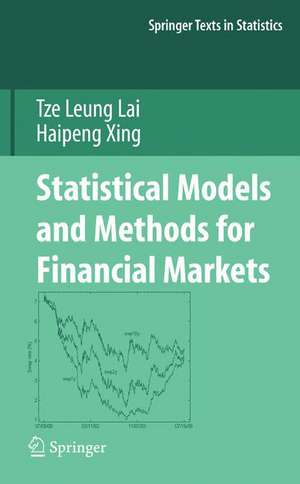
Statistical Models and Methods for Financial Markets
Autor Tze Leung Lai, Haipeng Xingen Limba Engleză Hardback – 25 iul 2008
Observăm că succesul în finanțele cantitative moderne nu depinde doar de stăpânirea formulelor de preț, ci de capacitatea de a ancora aceste modele matematice în realitatea empirică a piețelor. Modelul propus de Tze Leung Lai și Haipeng Xing în lucrarea Statistical Models and Methods for Financial Markets funcționează tocmai prin această punte solidă: transformă teoria abstractă a investițiilor în strategii aplicabile prin metode statistice riguroase. Dezvoltat inițial pentru programul de matematică financiară de la Stanford, volumul este conceput pentru a uniformiza competențele unor studenți cu fundaluri diverse, de la inginerie la economie. Subliniem progresia logică a conținutului, structurat în 14 capitole care ghidează cititorul de la fundamentele analizei multivariate și regresiei liniare către subiecte avansate precum econometria financiară și piețele ratelor de dobândă. Merită menționat că, spre deosebire de Statistics and Finance de David Ruppert, care se concentrează mai mult pe fundamentele probabilităților pentru studenții fără experiență în finanțe, lucrarea de față este mai puțin abstractă și mult mai aplicabilă în contextul tranzacționării algoritmice și al managementului riscului. Autorii nu se limitează la prezentarea metodelor, ci integrează cunoștințe de domeniu specifice industriei financiare. Poziționarea acestei cărți în opera lui Tze Leung Lai este una centrală, făcând legătura între fundamentele statistice și aplicațiile specializate pe care acesta le-a explorat în Quantitative Trading sau Data Science and Risk Analytics in Finance and Insurance. Dacă lucrările sale ulterioare se concentrează pe nișe precum tradingul de înaltă frecvență sau analiza riscului de asigurare, volumul de față rămâne pilonul metodologic esențial pentru orice specialist care dorește să înțeleagă dinamica activelor și volatilitatea prin prisma inferenței bayesiene și a modelelor dinamice.
Preț: 706.87 lei
Preț vechi: 831.61 lei
-15%
Carte tipărită la comandă
Livrare economică 11-25 noiembrie
Specificații
ISBN-10: 0387778268
Pagini: 356
Ilustrații: XX, 356 p.
Dimensiuni: 157 x 236 x 23 mm
Greutate: 0.64 kg
Ediția:2008 edition
Editura: Springer
Locul publicării:New York, NY, United States
V-ar putea interesa
-
 An Introduction to Quantitative FinanceStephen Blyth-12%Preț: 364.59 lei414.55 lei
 -
 Statistics for FinanceErik Lindström-8%Preț: 438.66 lei476.80 lei
 -
 The Elements of Statistical LearningJerome Friedman-20%Preț: 539.59 lei674.49 lei
 -
 Intermediate Financial TheoryJean-Pierre Danthine-33%Preț: 444.06 lei666.40 lei
 -
 Analysis of Financial Time Series 3eRuey S. Tsay-23%Preț: 887.01 lei1151.96 lei
 -
 Market Risk Analysis, Quantitative Methods in FinanceCarol AlexanderPreț: 441.25 lei
 -
 Market Risk Analysis, Practical Financial EconometricsCarol Alexander-19%Preț: 417.80 lei515.81 lei
 -
 Numerical Methods in Finance with C++Maciej J. Capi¿skiPreț: 329.19 lei
 -
 Quantitative Methods for FinanJohn L TeallPreț: 532.83 lei
 -
 Time Series AnalysisJames D. Hamilton-14%Preț: 517.37 lei601.60 lei
 -
 Financial Mathematics: A Comprehensive Treatment in Discrete TimeGiuseppe Campolieti-8%Preț: 482.52 lei524.48 lei
 -
 Mathematics of Financial ModelRavindran-8%Preț: 474.59 lei515.86 lei
 -
 An Introduction to Mathematical Finance with ApplicationsArlie O. Petters-15%Preț: 483.63 lei568.97 lei
 -
 A Cookbook with Probability OneDamiano RosselloPreț: 435.62 lei
 -
 Computation and Simulation for FinanceCónall Kelly-17%Preț: 408.65 lei492.34 lei
 -
 Statistics for ScientistsUmberto Michelucci-20%Preț: 275.88 lei344.84 lei
 -
 Mathematical Finance: Theory Review and ExercisesEmanuela Rosazza GianinPreț: 357.66 lei
 -
 Financial MathematicsAndrea PascucciPreț: 458.33 lei
 -
 Statistical Quantitative Methods in FinanceSamit Ahlawat-20%Preț: 218.14 lei272.67 lei
Public țintă
ResearchDe ce să citești această carte
Această carte este indispensabilă pentru viitorii analiști cantitativi (quants) și cercetători care doresc să depășească nivelul teoretic. Cititorul câștigă o metodologie clară pentru aplicarea regresiei non-parametrice și a metodelor statistice în managementul riscului și strategii de tranzacționare. Este o resursă pragmatică, testată în amfiteatrele de la Stanford, care transformă datele brute de piață în decizii de investiții fundamentate științific.
Descriere scurtă
Cuprins
Recenzii
"This book presents a comprehensive overview of how statistics can be used to solve problems in quantitative finance. The breadth and depth of the topics covered is impressive…. The authors have succeeded in writing a book that bridges the gap between theory and practice in financial markets…. how this book links finance theory to market practice via statistical modeling makes it original and fresh. As a result the book reflects the power of the intergrarion of financial and statistical methods in finance." (Lasse Koskinen, International Statistical Review, 2009, 77, 1)
"The book is divided into two parts: the first part introduces basic statistical methods and financial applications. … Part two deals with advanced topics in quantitative finance. … The book is not only useful for financial market economists, but, due to the wide range of special topics in the second part, also for students in the fields of engineering, mathematics, and statistics." (Herbert S. Buscher, Zentralblatt MATH, Vol. 1149, 2008)
“This text by Lai and Zing was completed as the tumult of 2008 was unfolding, but its methods are…timeless, and future students and teachers can benefit in better times from the clear and cohesive exposition that this text provides. …a useful text that anyone who teaches this material will want to consider. The list of topics covered is remarkably extensive; the exposition is always compact—and often quite elegant. …” ((Journal of the American Statistical Association, September 2009, Vol. 104, No. 487)
Textul de pe ultima copertă
The book has been developed as a textbook for courses on statistical modeling in quantitative finance in master's level financial mathematics (or engineering) and computational (or mathematical) finance programs. It is also designed for self-study by quantitative analysts in the financial industry who want to learn more about the background and details of the statistical methods used by the industry. It can also be used as a reference for graduate statistics and econometrics courses on regression, multivariate analysis, likelihood and Bayesian inference, nonparametrics, and time series, providing concrete examples and data from financial markets to illustrate the statistical methods.
Tze Leung Lai is Professor of Statistics and Director of Financial Mathematics at Stanford University. He received the Ph.D. degree in 1971 from Columbia University, where he remained on the faculty until moving to Stanford University in 1987. He received the Committee of Presidents of Statistical Societies Award in 1983 and is an elected member of Academia Sinica and the International Statistical Institute. His research interests include quantitative finance and risk management, sequential statistical methodology, stochastic optimization and adaptive control, probability theory and stochastic processes, econometrics, and biostatistics.
Haipeng Xing is Assistant Professor of Statistics at Columbia University. He received the Ph.D. degree in 2005 from Stanford University. His research interests include financial econometrics and engineering, time series modeling and adaptive control, fault detection, and change-point problems.