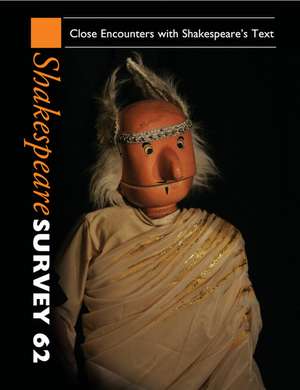
Shakespeare Survey
Editat de Peter Hollanden Limba Engleză Paperback – iun 2015
Preț: 489.45 lei
Puncte Express: 734
Carte tipărită la comandă
Livrare economică 02-16 decembrie
Livrare prin curier în România Termenul estimat este afișat lângă disponibilitate.
Transport gratuit pentru acest produs Plată online sau ramburs, în funcție de opțiunile comenzii.
Retur gratuit în 14 zile Comandă securizată și suport în română.
Specificații
ISBN-13: 9781107589391
ISBN-10: 1107589398
Pagini: 454
Ilustrații: 61 b/w illus. 12 tables
Dimensiuni: 189 x 246 x 25 mm
Greutate: 0.87 kg
Editura: Cambridge University Press
Locul publicării:New York, United States
ISBN-10: 1107589398
Pagini: 454
Ilustrații: 61 b/w illus. 12 tables
Dimensiuni: 189 x 246 x 25 mm
Greutate: 0.87 kg
Editura: Cambridge University Press
Locul publicării:New York, United States
V-ar putea interesa
-
 HamletCollins GcsePreț: 28.01 lei
 -
 Twelfth NightWilliam ShakespearePreț: 28.01 lei
 -
 XSONNETS_CLASSICS PBWilliam ShakespearePreț: 29.15 lei
 -
 Henry Fielding: Joseph AndrewsHenry Fielding-30%Preț: 544.14 lei772.79 lei
 -
 Shakespeare on Page and Stage: Selected EssaysStanley Wells-13%Preț: 139.86 lei161.37 lei
 -
 The Complete Sonnets and Poems: The Oxford ShakespeareWilliam Shakespeare-9%Preț: 66.23 lei72.68 lei
 -
 The New Oxford Shakespeare: Modern Critical Edition: The Complete WorksWilliam Shakespeare-16%Preț: 413.39 lei489.84 lei
 -
 The Animal Kingdom: A Very Short IntroductionPeter Holland-20%Preț: 56.65 lei70.82 lei
 -
 -13%Preț: 133.20 lei153.49 lei
 -
 The Taming Of The ShrewWilliam ShakespearePreț: 24.52 lei
 -
 All's Well That Ends WellWilliam ShakespearePreț: 29.25 lei
 -
 Literature and Utopian Politics in Seventeenth-Century EnglandRobert AppelbaumPreț: 301.24 lei
 -
 Maurice Scève Poet of LoveDorothy Gabe ColemanPreț: 270.02 lei
 -
 The Cambridge Companion to Shakespeare's PoetryPatrick CheneyPreț: 271.27 lei
 -
 The Cambridge Companion to VoltaireNicholas CronkPreț: 273.79 lei
 -
 The Cambridge Companion to Ben JonsonRichard HarpPreț: 297.32 lei
 -
 The Cambridge Companion to Early Modern Women's WritingLaura Lunger KnoppersPreț: 294.01 lei
 -
 The Cambridge Companion to Shakespearean ComedyAlexander LeggattPreț: 267.64 lei
 -
 Shakespearean and Jacobean TragedyRex GibsonPreț: 196.00 lei
 -
 The PoemsWilliam ShakespearePreț: 58.34 lei
 -
 Shakespeare in CambridgeAndrew MuirPreț: 93.38 lei
 -
 King Lear York Notes A-level English Literature - for 2026, 2027 examsMichael SherbornePreț: 67.69 lei
 -
 Othello York Notes A-level English Literature - for 2026, 2027 examsWilliam ShakespearePreț: 67.69 lei
 -
 Preț: 67.85 lei
 -
 -25%Preț: 197.75 lei265.20 lei
 -
 The Merchant of VeniceWilliam ShakespearePreț: 37.28 lei
 -
 King JohnWilliam ShakespearePreț: 37.70 lei
Cuprins
1. Shakespeare, text and paratext Sonia Massai; 2. The popularity of Shakespeare in print Lukas Erne; 3. The continuing importance of new bibliographical method Paul Werstine; 4. 'Honour the real thing': Shakespeare, trauma and Titus Andronicus in South Africa Catherine Silverstone; 5. 'O, these encounterers': on Shakespeare's meetings and partings David Hillman; 6. A play of modals: grammar and potential action in early Shakespeare Lynne Magnusson; 7. Merry, Marry, Mary: Shakespearean word-play and Twelfth Night Thomas Rist; 8. A subtle point: sleeves, tents, and 'Ariachne's broken woof' (again) Hester Lees-Jeffries; 9. The look of Othello Michael Neill; 10. Red button Shakespeare Rob Conkie; 11. 'Mark you/His absolute shall?': multitudinous tongues and contested words in Coriolanus Alysia Kolentsis; 12. Chagall's Tempest: an autobiographical reading Hanna Scolnicov; 13. Reading illustrated editions: methodology and the limits of interpretation Stuart Sillars; 14. Close encounters with Anne Brontë's Shakespeare Paul Edmondson; 15. Shakespeare and the magic lantern Judith Buchanan; 16. Shakespeare and the coconuts: close encounters in post-apartheid South Africa Natasha Distiller; 17. The Schrödinger effect: reading and misreading performance Andrew James Hartley; 18. Behind the scenes Robert Shaughnessy; 19. Inner monologues: realist acting and/as Shakespearean performance text Roberta Barker; 20. More Japanized, casual and transgender Shakespeares Shoichiro Kawai; 21. Translation futures: are Shakespeareans in search of the foreign text? Ton Hoenselaars; 22. After translation Yong Li Lan; 23. 'The single and peculiar life': Hamlet's heart and the early modern subject Graham Holderness; 24. Mapping King Lear Robert B. Pierce; 25. 'Last on the stage': the place of Shakespeare in Charles Darwin's ethology Reiko Oya; 26. Sense/memory/sense-memory: reading narratives of Shakespearean rehearsals Cary M. Mazer; Shakespeare performances in England, 2008 Carol Chillington Rutter; Professional Shakespeare productions in the British Isles, January-December 2007 James Shaw; The year's contribution to Shakespeare studies: 1. Critical studies reviewed by Julie Sanders; 2. Shakespeare in performance reviewed by Emma Smith; 3. Editions and textual studies reviewed by (a) Eric Rasmussen (b) Peter Holland.
Descriere
The theme for Shakespeare Survey 62 is 'Close Encounters with Shakespeare's Text'.
Recenzii
"As a collection, these essays group together several different ways of looking at the play without relying on a conception of a pure original, offering a strategy for analyzing how a text accrues meanings and how those meanings are transformed over time even as they are related to some, however hypothetical, original." Essays in Theatre Jennifer Feather, Brown University
"a very attractive and useful volume in the series begun over half a century ago." - Medieval and Renaissance Drama in England Jay L. Halio
"a very attractive and useful volume in the series begun over half a century ago." - Medieval and Renaissance Drama in England Jay L. Halio