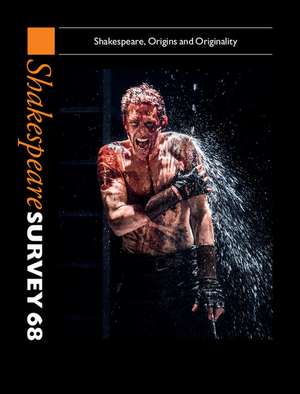
Shakespeare Survey: Shakespeare Survey, cartea Series Number 68
Editat de Peter Hollanden Limba Engleză Hardback – 24 sep 2015




Preț: 969.67 lei
Preț vechi: 1389.72 lei
-30%
Puncte Express: 1455
Carte indisponibilă temporar
Livrare prin curier în România Termenul estimat este afișat lângă disponibilitate.
Transport gratuit pentru acest produs Plată online sau ramburs, în funcție de opțiunile comenzii.
Retur gratuit în 14 zile Comandă securizată și suport în română.
Specificații
ISBN-13: 9781107108844
ISBN-10: 1107108845
Pagini: 487
Ilustrații: 35 b/w illus.
Dimensiuni: 196 x 253 x 25 mm
Greutate: 1.12 kg
Editura: Cambridge University Press
Colecția Shakespeare Survey
Seria Shakespeare Survey
Locul publicării:New York, United States
ISBN-10: 1107108845
Pagini: 487
Ilustrații: 35 b/w illus.
Dimensiuni: 196 x 253 x 25 mm
Greutate: 1.12 kg
Editura: Cambridge University Press
Colecția Shakespeare Survey
Seria Shakespeare Survey
Locul publicării:New York, United States
V-ar putea interesa
-
 XHAMLET_CLASSICS PBWilliam ShakespearePreț: 28.75 lei
 -
 CLASSICS TWELFTH NIGHTWilliam ShakespearePreț: 28.95 lei
 -
 XSONNETS_CLASSICS PBWilliam ShakespearePreț: 28.69 lei
 -
 Henry Fielding: Joseph AndrewsHenry Fielding-33%Preț: 544.14 lei816.36 lei
 -
 Shakespeare on Page and Stage: Selected EssaysStanley Wells-15%Preț: 134.84 lei158.83 lei
 -
 The Complete Sonnets and Poems: The Oxford ShakespeareWilliam Shakespeare-10%Preț: 64.20 lei71.33 lei
 -
 The New Oxford Shakespeare: Modern Critical Edition: The Complete WorksWilliam Shakespeare-16%Preț: 403.67 lei482.17 lei
 -
 The Animal Kingdom: A Very Short IntroductionPeter Holland-22%Preț: 54.66 lei69.74 lei
 -
 -14%Preț: 130.08 lei150.82 lei
 -
 The Taming Of The ShrewWilliam ShakespearePreț: 22.88 lei
 -
 All's Well That Ends WellWilliam ShakespearePreț: 29.25 lei
 -
 Literature and Utopian Politics in Seventeenth-Century EnglandRobert AppelbaumPreț: 301.24 lei
 -
 Maurice Scève Poet of LoveDorothy Gabe ColemanPreț: 270.02 lei
 -
 The Cambridge Companion to Shakespeare's PoetryPatrick CheneyPreț: 271.27 lei
 -
 The Cambridge Companion to VoltaireNicholas CronkPreț: 273.79 lei
 -
 The Cambridge Companion to Ben JonsonRichard HarpPreț: 297.32 lei
 -
 The Cambridge Companion to Early Modern Women's WritingLaura Lunger KnoppersPreț: 280.43 lei
 -
 The Cambridge Companion to Shakespearean ComedyAlexander LeggattPreț: 267.64 lei
 -
 Shakespearean and Jacobean TragedyRex GibsonPreț: 196.00 lei
 -
 The PoemsWilliam ShakespearePreț: 55.19 lei
 -
 Shakespeare in CambridgeAndrew MuirPreț: 91.87 lei
 -
 King Lear York Notes A-level English Literature - for 2026, 2027 examsMichael SherbornePreț: 66.63 lei
 -
 Othello York Notes A-level English Literature - for 2025, 2026 examsWilliam ShakespearePreț: 66.63 lei
 -
 Preț: 66.78 lei
 -
 -25%Preț: 197.75 lei265.20 lei
 -
 The Merchant of VeniceWilliam ShakespearePreț: 37.28 lei
 -
 King JohnWilliam ShakespearePreț: 37.70 lei
Cuprins
1. Shakespeare's anecdotal character Margreta de Grazia; 2. What is a source? Or, how Shakespeare read His Marlowe Laurie Maguire and Emma Smith; 3. Imitation or collaboration? Marlowe and the early Shakespeare canon Gary Taylor and John V. Nance; 4. 'O Jephthah, judge of Israel': from original to accreted meanings in Hamlet's allusion Péter Dávidházi; 5. The elephants' graveyard revisited: Shakespeare at work in Antony and Cleopatra, Romeo and Juliet and All's Well That Ends Well Catherine Belsey; 6. 'Every like is not the same': translating Shakespeare in Spanish today Alfredo Michel Modenessi; 7. Reading originals by the light of translations Tom Cheesman; 8. 'My name is Will': Shakespeare's sonnets and autobiography Stanley Wells; 9. Tracings and data in The Tempest: author, world and representation Janet Clare; 10. Shakespearean gesture: narrative and iconography Farah Karim-Cooper; 11. The origin of the late Renaissance dramatic convention of self-addressed speech James Hirsh; 12. Reading in their present: early readers and the origins of Shakespearian appropriation Jean-Christophe Mayer; 13. Shakespeare out of time (or, Hugo takes dictation from the beyond) Ruth Morse; 14. Betrayal, derail, or a thin veil: the myth of origin Bi-qi Beatrice Lei; 15. Global Shakespeares, affective histories, cultural memories Jyotsna G. Singh and Abdulhamit Arvas; 16. Spinach and tobacco: making Shakespearian unoriginals Peter Holland; 17. Ren Fest Shakespeare: the cosplay Bard Andrew James Hartley; 18. 'Dead as earth': contemporary topicality and myths of origin in King Lear and The Shadow King Kate Flaherty; 19. Shakespeare and the idea of national theatres Michael Dobson; 20. John Rice and the boys of the Jacobean King's Men David Kathman; 21. Shakespeare's Irish lives: the politics of biography Andrew Murphy; 22. Shakespeare in blockaded Berlin: the 1948 'Elizabethan Festival' Bettina Boecker; 23. Connecting the Globe: actors, audience and entrainment Robert Shaughnessy; 24. 'Freetown!': Shakespeare and social flourishing Ewan Fernie; 25. We'll always have Paris: the third household and the 'bed of death' in Romeo and Juliet Nicholas Crawford; 26. The 'serpent of old Nile': Cleopatra and the pragmatics of reported speech Jelena Marelj; 27. 'This insubstantial pageant faded': the drama of semiotic anxiety in The Tempest Lynn Forest-Hill; 28. Shakespeare performances in England 2014 Carol Chillington Rutter; 29. Professional Shakespeare productions in the British Isles, January–December 2013 James Shaw; The year's contribution to Shakespeare studies: 1. Critical studies Charlotte Scott; 2. Shakespeare in performance Russell Jackson; 3. Editions and textual studies Peter Kirwan.
Descriere
The theme for Shakespeare Survey 68 is 'Shakespeare, Origins and Originality'.
Recenzii
'Tiffany Stern's essay, 'Sermons, Plays and Note-Takers: Hamlet Q1 as a 'Noted' Text', reads like an especially well-written and deftly plotted mystery novel. Taking as her subject the so-called 'bad quarto' of Hamlet, Stern leads the reader through a thoroughly documented and totally compelling rethinking of Q1's origins. [She] persuasively argues that this text is the product of a note-taking scribal audience who employed contemporary notational habits to produce a 'pirated' text for publication … [She] brings to life a new world of early modern performance through descriptions and details that offer many small openings onto the textual culture of the period … this essay not only offers a significant reassessment of Hamlet Q1, but also makes a claim for the cultural importance of note-taking practices in the early modern period more generally.' Medieval and Renaissance Drama Society