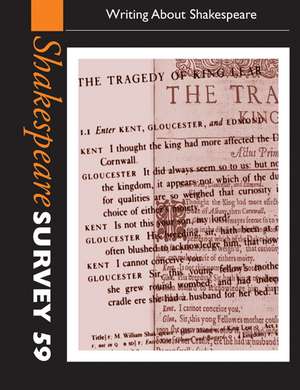
Shakespeare Survey
Editat de Peter Hollanden Limba Engleză Paperback – 8 feb 2011
Preț: 458.14 lei
Puncte Express: 687
Carte tipărită la comandă
Livrare economică 28 noiembrie-12 decembrie
Livrare prin curier în România Termenul estimat este afișat lângă disponibilitate.
Transport gratuit pentru acest produs Plată online sau ramburs, în funcție de opțiunile comenzii.
Retur gratuit în 14 zile Comandă securizată și suport în română.
Specificații
ISBN-13: 9780521201131
ISBN-10: 0521201136
Pagini: 406
Dimensiuni: 189 x 246 x 22 mm
Greutate: 0.78 kg
Editura: Cambridge University Press
Locul publicării:Cambridge, United Kingdom
ISBN-10: 0521201136
Pagini: 406
Dimensiuni: 189 x 246 x 22 mm
Greutate: 0.78 kg
Editura: Cambridge University Press
Locul publicării:Cambridge, United Kingdom
V-ar putea interesa
-
 HamletCollins GcsePreț: 28.01 lei
 -
 Twelfth NightWilliam ShakespearePreț: 28.01 lei
 -
 XSONNETS_CLASSICS PBWilliam ShakespearePreț: 29.15 lei
 -
 Henry Fielding: Joseph AndrewsHenry Fielding-30%Preț: 544.14 lei772.79 lei
 -
 Shakespeare on Page and Stage: Selected EssaysStanley Wells-13%Preț: 139.86 lei161.37 lei
 -
 The Complete Sonnets and Poems: The Oxford ShakespeareWilliam Shakespeare-9%Preț: 65.79 lei72.49 lei
 -
 The New Oxford Shakespeare: Modern Critical Edition: The Complete WorksWilliam Shakespeare-16%Preț: 413.39 lei489.84 lei
 -
 The Animal Kingdom: A Very Short IntroductionPeter Holland-20%Preț: 56.65 lei70.82 lei
 -
 -13%Preț: 133.20 lei153.49 lei
 -
 The Taming Of The ShrewWilliam ShakespearePreț: 24.52 lei
 -
 All's Well That Ends WellWilliam ShakespearePreț: 29.25 lei
 -
 Literature and Utopian Politics in Seventeenth-Century EnglandRobert AppelbaumPreț: 301.24 lei
 -
 Maurice Scève Poet of LoveDorothy Gabe ColemanPreț: 270.02 lei
 -
 The Cambridge Companion to Shakespeare's PoetryPatrick CheneyPreț: 271.27 lei
 -
 The Cambridge Companion to VoltaireNicholas CronkPreț: 273.79 lei
 -
 The Cambridge Companion to Ben JonsonRichard HarpPreț: 297.32 lei
 -
 The Cambridge Companion to Early Modern Women's WritingLaura Lunger KnoppersPreț: 280.43 lei
 -
 The Cambridge Companion to Shakespearean ComedyAlexander LeggattPreț: 267.64 lei
 -
 Shakespearean and Jacobean TragedyRex GibsonPreț: 196.00 lei
 -
 The PoemsWilliam ShakespearePreț: 58.34 lei
 -
 Shakespeare in CambridgeAndrew MuirPreț: 93.38 lei
 -
 King Lear York Notes A-level English Literature - for 2026, 2027 examsMichael SherbornePreț: 67.69 lei
 -
 Othello York Notes A-level English Literature - for 2026, 2027 examsWilliam ShakespearePreț: 67.69 lei
 -
 Preț: 67.85 lei
 -
 -25%Preț: 197.75 lei265.20 lei
 -
 The Merchant of VeniceWilliam ShakespearePreț: 37.28 lei
 -
 King JohnWilliam ShakespearePreț: 37.70 lei
Cuprins
Part I: 1. Editing Shakespeare's plays in the twentieth century John Jowett; 2. Crisis in editing? Edward Pechter; 3. On being a general editor Stanley Wells; 4. Altering the letter of Twelfth Night: 'Some are born great' and the missing signature Patricia Parker; 5. 'A thousand Shylocks': Orson Welles and The Merchant of Venice Tom Rooney; 6. The date and authorship of hand D's contribution to Sir Thomas More: evidence from 'Literature Online' MacDonald P. Jackson; 7. Ferdinand's wife and Prospero's wise Ron Tumelson; 8. Editing Stefano's book Andrew Gurr; 9. Manuscript, print, and the authentic Shakespeare: the Ireland forgeries again Tom Lockwood; 10. The author, the editor and the translator: William Shakespeare, Alexander Chalmers and Sándor Petofi or the nature of a Romantic edition Júlia Paraizs; 11. Women edit Shakespeare Jeanne Addison Roberts; 12. The Shakespeare edition in industrial capitalism Cary DiPietro; 13. Print and electronic editions inspired by the New Variorum Hamlet Project Bernice Kliman; 14. The evolution of online editing: where will it end? Christie Carson; 15. The director as Shakespeare editor Alan C. Dessen; 16. The editor as translator Balz Engler; 17. Performance editions, editing and editors Elizabeth Schafer; 18. Editing collaborative drama Suzanne Gossett; 19. Will in the Universe: Shakespeare's sonnets, Plato's Symposium, alchemy and Renaissance Neoplatonism Ronald Gray; 20. Giants and enemies of God: the relationship between Caliban and Prospero from the perspective of insular literary tradition Lynn Forest-Hill; 21. Shakespeare's ages Ruth Morse; 22. Who wrote William Basse's 'Elegy on Shakespeare'?: rediscovering a poem lost from the Donne canon Brandon S. Centerwall; 23. 'Sometime a paradox': Shakespeare, Diderot, and the problem of character Jonathan Holmes; 24. Shakespeare performances in England, 2005 Michael Dobson; 25. Professional Shakespeare productions in the British Isles, January–December 2004 James Shaw; Part II. The Year's Contribution to Shakespeare Studies: 1. Critical studies reviewed by Michael Taylor; 2. Shakespeare in performance reviewed by Emma Smith; 3. Editions and textual studies reviewed by Eric Rasmussen.
Descriere
The theme for Shakespeare Survey 59 is 'Editing Shakespeare'.
Recenzii
"As a collection, these essays group together several different ways of looking at the play without relying on a conception of a pure original, offering a strategy for analyzing how a text accrues meanings and how those meanings are transformed over time even as they are related to some, however hypothetical, original." Essays in Theatre Jennifer Feather, Brown University
"a very attractive and useful volume in the series begun over half a century ago." - Medieval and Renaissance Drama in England Jay L. Halio
"a very attractive and useful volume in the series begun over half a century ago." - Medieval and Renaissance Drama in England Jay L. Halio