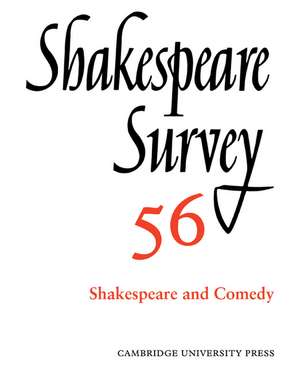
Shakespeare Survey
Editat de Peter Hollanden Limba Engleză Paperback – 25 oct 2007
Preț: 476.23 lei
Puncte Express: 714
Carte tipărită la comandă
Livrare economică 30 noiembrie-14 decembrie
Livrare prin curier în România Termenul estimat este afișat lângă disponibilitate.
Transport gratuit pentru acest produs Plată online sau ramburs, în funcție de opțiunile comenzii.
Retur gratuit în 14 zile Comandă securizată și suport în română.
Specificații
ISBN-13: 9780521049993
ISBN-10: 0521049997
Pagini: 384
Ilustrații: 25 b/w illus.
Dimensiuni: 191 x 235 x 21 mm
Greutate: 0.72 kg
Editura: Cambridge University Press
Locul publicării:Cambridge, United Kingdom
ISBN-10: 0521049997
Pagini: 384
Ilustrații: 25 b/w illus.
Dimensiuni: 191 x 235 x 21 mm
Greutate: 0.72 kg
Editura: Cambridge University Press
Locul publicării:Cambridge, United Kingdom
V-ar putea interesa
-
 HamletCollins GcsePreț: 28.01 lei
 -
 Twelfth NightWilliam ShakespearePreț: 28.01 lei
 -
 XSONNETS_CLASSICS PBWilliam ShakespearePreț: 29.15 lei
 -
 Henry Fielding: Joseph AndrewsHenry Fielding-30%Preț: 544.14 lei772.79 lei
 -
 Shakespeare on Page and Stage: Selected EssaysStanley Wells-13%Preț: 139.86 lei161.37 lei
 -
 The Complete Sonnets and Poems: The Oxford ShakespeareWilliam Shakespeare-9%Preț: 66.09 lei72.68 lei
 -
 The New Oxford Shakespeare: Modern Critical Edition: The Complete WorksWilliam Shakespeare-16%Preț: 413.39 lei489.84 lei
 -
 The Animal Kingdom: A Very Short IntroductionPeter Holland-20%Preț: 56.65 lei70.82 lei
 -
 -13%Preț: 133.20 lei153.49 lei
 -
 The Taming Of The ShrewWilliam ShakespearePreț: 24.52 lei
 -
 All's Well That Ends WellWilliam ShakespearePreț: 29.25 lei
 -
 Literature and Utopian Politics in Seventeenth-Century EnglandRobert AppelbaumPreț: 301.24 lei
 -
 Maurice Scève Poet of LoveDorothy Gabe ColemanPreț: 270.02 lei
 -
 The Cambridge Companion to Shakespeare's PoetryPatrick CheneyPreț: 271.27 lei
 -
 The Cambridge Companion to VoltaireNicholas CronkPreț: 273.79 lei
 -
 The Cambridge Companion to Ben JonsonRichard HarpPreț: 297.32 lei
 -
 The Cambridge Companion to Early Modern Women's WritingLaura Lunger KnoppersPreț: 280.43 lei
 -
 The Cambridge Companion to Shakespearean ComedyAlexander LeggattPreț: 267.64 lei
 -
 Shakespearean and Jacobean TragedyRex GibsonPreț: 196.00 lei
 -
 The PoemsWilliam ShakespearePreț: 58.34 lei
 -
 Shakespeare in CambridgeAndrew MuirPreț: 93.38 lei
 -
 King Lear York Notes A-level English Literature - for 2026, 2027 examsMichael SherbornePreț: 67.69 lei
 -
 Othello York Notes A-level English Literature - for 2026, 2027 examsWilliam ShakespearePreț: 67.69 lei
 -
 Preț: 67.85 lei
 -
 -25%Preț: 197.75 lei265.20 lei
 -
 The Merchant of VeniceWilliam ShakespearePreț: 37.28 lei
 -
 King JohnWilliam ShakespearePreț: 37.70 lei
Cuprins
List of illustrations; 1. Looking like a child - or - Titus: the comedy Carol Chillington Rutter; 2. Comedy and Epyllion in post-Reformation England Dympna Callaghan; 3. (Peter) Quince: love potions, carpenter's coigns and Athenian weddings Patricia Parker; 4. 'When everything seems double': Peter Quince, the other playwright in A Midsummer Night's Dream A. B. Taylor; 5. Cultural materialism and intertextuality: the limits of queer reading in A Midsummer Night's Dream and The Two Noble Kinsmen Alan Sinfield; 6. As you liken it: simile in the wilderness Robert N. Watson; 7. Infinite jest: the comedy of Hamlet, Prince of Denmark Ann Thompson; 8. Othello and the end of comedy Stephen Orgel; 9. Shakespeare as a joke: the English comic tradition, A Midsummer Night's Dream and amateur performance Michael Dobson; 10. Falstaff's belly, Bertie's kilt, Rosalind's legs: Shakespeare and the Victorian prince Adrian Poole; 11. The sixth act: Shakespeare after Joyce Maud Ellmann; 12. The return of Prospero's wife: mother figures in The Tempest's afterlife Sarah Annes Brown; 13. Directing Shakespeare's comedies: in conversation with Peter Holland Declan Donnellan; 14. 'To show our simple skill': scripts and performances in Shakespearian comedy Michael Cordner; 15. John Shakespeare's 'spiritual testament': a reappraisal Robert Bearman; 16. Shakespeare as a force for good Peter Holbrook; 17. Timon of Athens and Jacobean politics Andrew Hadfield; 18. Man, woman and beast in Timon's Athens Andreas Höfele; 19. Rough magic: northern broadsides at work at play Carol Chillington Rutter; 20. Shakespeare performances in England, 2002 Michael Dobson; 21. Professional Shakespeare productions in the British Isles, January–December 2001 James Shaw; The Year's Contributions to Shakespeare Studies: 22. Critical studies reviewed by Ruth Morse; 23. Shakespeare's life, times and stage reviewed by Leslie Thomson; 24. Editions and textual studies reviewed by Eric Rasmussen; Books received; Index.
Descriere
Shakespeare Survey is a yearbook of Shakespeare studies and production.
Recenzii
"As a collection, these essays group together several different ways of looking at the play without relying on a conception of a pure original, offering a strategy for analyzing how a text accrues meanings and how those meanings are transformed over time even as they are related to some, however hypothetical, original." Essays in Theatre Jennifer Feather, Brown University
"a very attractive and useful volume in the series begun over half a century ago." - Medieval and Renaissance Drama in England Jay L. Halio
"a very attractive and useful volume in the series begun over half a century ago." - Medieval and Renaissance Drama in England Jay L. Halio