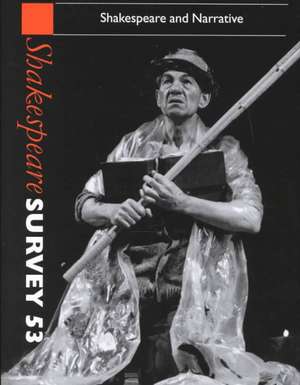
Shakespeare Survey: Shakespeare Survey, cartea Series Number 53
Editat de Peter Hollanden Limba Engleză Hardback – 2 noi 2000




Preț: 674.77 lei
Preț vechi: 993.58 lei
-32%
Puncte Express: 1012
Carte indisponibilă temporar
Livrare prin curier în România Termenul estimat este afișat lângă disponibilitate.
Transport gratuit pentru acest produs Plată online sau ramburs, în funcție de opțiunile comenzii.
Retur gratuit în 14 zile Comandă securizată și suport în română.
Specificații
ISBN-13: 9780521781145
ISBN-10: 0521781140
Pagini: 368
Ilustrații: 12 b/w illus. 1 table
Dimensiuni: 195 x 254 x 23 mm
Greutate: 0.83 kg
Editura: Cambridge University Press
Colecția Shakespeare Survey
Seria Shakespeare Survey
Locul publicării:Cambridge, United Kingdom
ISBN-10: 0521781140
Pagini: 368
Ilustrații: 12 b/w illus. 1 table
Dimensiuni: 195 x 254 x 23 mm
Greutate: 0.83 kg
Editura: Cambridge University Press
Colecția Shakespeare Survey
Seria Shakespeare Survey
Locul publicării:Cambridge, United Kingdom
V-ar putea interesa
-
 XHAMLET_CLASSICS PBWilliam ShakespearePreț: 28.75 lei
 -
 CLASSICS TWELFTH NIGHTWilliam ShakespearePreț: 28.95 lei
 -
 XSONNETS_CLASSICS PBWilliam ShakespearePreț: 28.69 lei
 -
 Henry Fielding: Joseph AndrewsHenry Fielding-33%Preț: 544.14 lei816.36 lei
 -
 Shakespeare on Page and Stage: Selected EssaysStanley Wells-15%Preț: 134.84 lei158.83 lei
 -
 The Complete Sonnets and Poems: The Oxford ShakespeareWilliam Shakespeare-10%Preț: 64.20 lei71.33 lei
 -
 The New Oxford Shakespeare: Modern Critical Edition: The Complete WorksWilliam Shakespeare-16%Preț: 403.67 lei482.17 lei
 -
 The Animal Kingdom: A Very Short IntroductionPeter Holland-22%Preț: 54.66 lei69.74 lei
 -
 -14%Preț: 130.08 lei150.82 lei
 -
 The Taming Of The ShrewWilliam ShakespearePreț: 22.88 lei
 -
 All's Well That Ends WellWilliam ShakespearePreț: 29.25 lei
 -
 Literature and Utopian Politics in Seventeenth-Century EnglandRobert AppelbaumPreț: 301.24 lei
 -
 Maurice Scève Poet of LoveDorothy Gabe ColemanPreț: 270.02 lei
 -
 The Cambridge Companion to Shakespeare's PoetryPatrick CheneyPreț: 271.27 lei
 -
 The Cambridge Companion to VoltaireNicholas CronkPreț: 273.79 lei
 -
 The Cambridge Companion to Ben JonsonRichard HarpPreț: 297.32 lei
 -
 The Cambridge Companion to Early Modern Women's WritingLaura Lunger KnoppersPreț: 280.43 lei
 -
 The Cambridge Companion to Shakespearean ComedyAlexander LeggattPreț: 267.64 lei
 -
 Shakespearean and Jacobean TragedyRex GibsonPreț: 196.00 lei
 -
 The PoemsWilliam ShakespearePreț: 55.19 lei
 -
 Shakespeare in CambridgeAndrew MuirPreț: 91.87 lei
 -
 King Lear York Notes A-level English Literature - for 2026, 2027 examsMichael SherbornePreț: 66.63 lei
 -
 Othello York Notes A-level English Literature - for 2025, 2026 examsWilliam ShakespearePreț: 66.63 lei
 -
 Preț: 66.78 lei
 -
 -25%Preț: 197.75 lei265.20 lei
 -
 The Merchant of VeniceWilliam ShakespearePreț: 37.28 lei
 -
 King JohnWilliam ShakespearePreț: 37.70 lei
Cuprins
1. Shakespeare's narremes Helmut Bonheim; 2. Stepping out of narrative line: a bit of word, and horse play in Venus and Adonis Margaret Tudeau-Clayton; 3. A 'consummation devoutly to be wished': the erotics of narration in Venus and Adonis Peter J. Smith; 4. Echoes inhabit a garden: the narratives of Romeo and Juliet Jill Levenson; 5. A Midsummer Night's Dream: comedy as Apotrope of myth A. D. Nuttall; 6. Plutarch, insurrection, and dearth in Coriolanus David George; 7. Shakespeare, crossing the Rubicon Cynthia Marshall; 8. Vernacular criticism and the scenes Shakespeare never wrote Michael D. Bristol; 9. The shadow of Lear's 'Houseless' in Dickens Adrian Poole; 10. Shakespearian margins in George Eliot's 'working-day world' John Lyon; 11. In her father's library: Margaret Fuller and the making of the American Miranda Phyllis McBride; 12. The magician in love Julia Griffin; 13. Narrative approaches to Shakespeare: active storytelling in schools Rex Gibson; 14. Monsters, magicians, movies: The Tempest and the final frontier Ruth Morse; 15. Shakespeare's self-repetitions and King John E. A. J. Honigmann; 16. Inside Othello Barbara Everett; 17. The view of London from the North and the playhouses in Holywell Herbert Berry; 18. Measured endings: how productions from 1720–1929 close Shakespeare's open silences in Measure for Measure Edward L. Rocklin; 19. Shakespearian Utopias Robert Shaughnessy; 20. Shakespeare performances in England, 1999 Robert Smallwood; 21. Professional Shakespeare productions in the British Isles, January - December 1998 Niky Rathbone; 22. The year's contributions to Shakespeare studies: 1. Critical studies reviewed by Edward Pechter; 2. Shakespeare's life, times, and stage reviewed by Alison Findlay; 3. Editions and textual studies reviewed by Eric Rasmussen; Books Received; Index.
Descriere
Shakespeare Survey is a yearbook of Shakespeare studies and production.
Recenzii
'Tiffany Stern's essay, 'Sermons, Plays and Note-Takers: Hamlet Q1 as a 'Noted' Text', reads like an especially well-written and deftly plotted mystery novel. Taking as her subject the so-called 'bad quarto' of Hamlet, Stern leads the reader through a thoroughly documented and totally compelling rethinking of Q1's origins. [She] persuasively argues that this text is the product of a note-taking scribal audience who employed contemporary notational habits to produce a 'pirated' text for publication … [She] brings to life a new world of early modern performance through descriptions and details that offer many small openings onto the textual culture of the period … this essay not only offers a significant reassessment of Hamlet Q1, but also makes a claim for the cultural importance of note-taking practices in the early modern period more generally.' Medieval and Renaissance Drama Society