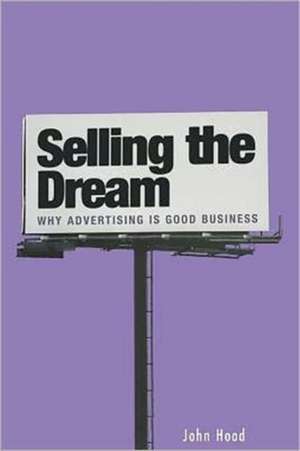
Selling the Dream: Why Advertising Is Good Business
Autor John M. Hooden Limba Engleză Paperback – 30 oct 2005
Experiența lui John M. Hood în analiza politicilor publice și jurnalism economic la publicații de prestigiu precum The Wall Street Journal fundamentează o perspectivă riguroasă asupra unei industrii deseori criticate. În Selling the Dream, autorul demontează ideea că publicitatea este un simplu balast informațional sau un mecanism de manipulare, argumentând că aceasta este, în fapt, o componentă esențială a experienței de consum și un pilon al libertății de alegere într-o societate democratică.
Remarcăm o structură narativă care îmbină cronologia istorică cu analiza tematică. De la „Nașterea culturii comerciale” în antichitate, textul progresează spre „Revoluția radiodifuziunii” și ajunge la analize contemporane despre „Economia și etica vânzării păcatului” (tutun și alcool). Această progresie permite cititorului să înțeleagă cum publicitatea a evoluat dintr-un simplu anunț într-o știință a dorinței. Abordarea diferă de Advertising, The Uneasy Persuasion (RLE Advertising) de Michael Schudson prin pragmatismul său — în timp ce Schudson privește publicitatea ca pe o instituție socială adesea ineficientă, Hood o prezintă ca pe un motor economic vital și o forță morală coerentă cu valorile pieței libere. Este o perspectivă mult mai aplicabilă pentru cei care vor să înțeleagă valoarea adăugată reală a marketingului.
Reținem analiza curajoasă a controverselor moderne. Autorul nu evită subiectele dificile, precum publicitatea adresată copiilor sau afirmațiile legate de sănătate și fraudă, oferind un context istoric și economic care lipsește din manualele standard. Lucrarea demonstrează cum publicitatea a devenit o necesitate pentru orice afacere care dorește să opereze la scară largă, integrând exemple practice care ilustrează teoriile propuse.
Preț: 193.64 lei
Preț vechi: 260.02 lei
-26%
Carte tipărită la comandă
Livrare economică 30 noiembrie-14 decembrie
Specificații
ISBN-10: 0313361878
Pagini: 272
Dimensiuni: 148 x 226 x 18 mm
Greutate: 0.37 kg
Editura: Bloomsbury Publishing
Colecția Praeger
Locul publicării:New York, United States
V-ar putea interesa
-
 Advertising: A Very Short IntroductionWinston Fletcher-20%Preț: 57.12 lei71.12 lei
 -
 Advertising – Concept and Copy 3eGeorge FeltonPreț: 444.12 lei
 -
 Preț: 223.54 lei
 -
 Decoding AdvertisementsJudith WilliamsonPreț: 142.98 lei
 -
 Preț: 101.85 lei
 -
 The Hidden PersuadersVance Packard-19%Preț: 92.66 lei114.52 lei
 -
 -19%Preț: 57.45 lei70.86 lei
 -
 Advertising in America: A Reference HandbookDanielle Sarver Coombs-48%Preț: 304.98 lei590.59 lei
 -
 Inside Digital Advertising: Platforms, Power, and Material PoliticsDonald MackenziePreț: 156.81 lei
 -
 Mad for AdsErica Fyvie-18%Preț: 99.59 lei121.77 lei
 -
 The Love FixRachel ThompsonPreț: 137.14 lei
 -
 Hacking AdvertisingJon SneiderPreț: 135.23 lei
 -
 The Attention MerchantsTim Wu-17%Preț: 79.15 lei95.34 lei
 -
 Consumed: How Big Brands Got Us Hooked on PlasticSaabira ChaudhuriPreț: 124.58 lei
 -
 Ogilvy on AdvertisingDavid Ogilvy-26%Preț: 68.86 lei93.41 lei
 -
 Confessions of an Advertising ManDavid Ogilvy-18%Preț: 88.22 lei108.16 lei
 -
 The Smart Advertising BookDan White-11%Preț: 64.49 lei72.25 lei
 -
 The Classical Marketing BookAnthony Tasgal-12%Preț: 62.54 lei71.01 lei
 -
 All-American Ads of the 30sJim HeimannPreț: 293.64 lei
 -
 Mid-Century AdsSteven HellerPreț: 237.68 lei
De ce să citești această carte
Recomandăm această carte profesioniștilor din marketing și studenților care doresc o apărare articulată, bazată pe date, a industriei lor. Veți învăța să priviți publicitatea nu ca pe un cost, ci ca pe o parte a produsului final. Cititorul câștigă un argument solid în favoarea rolului social și economic al comunicării comerciale, fiind o lectură esențială pentru a înțelege mecanismele pieței libere.
Descriere
Cuprins
Introduction
The Birth of Advertising and Commercial Culture
A Carnival of Conspicuous Consumption
Broadcasting Revolution, Advertising Evolution
The New Economics and Science of Advertising
Living the Commercial Life
Health Claims and the Problem of Fraud
Advertising and the Consuming Child
The Economics and Ethics of Selling Sin
Conclusion
Notes
Index
Recenzii
Consultant and journalist Hood reacts to how Americans feel in general about advertising by reminding them that marketing fulfills desires and demand while increasing profits and often making or breaking whole businesses and industries. Along with very well-chosen (and very funny) examples of how Americans feel and deal with advertising as represented in popular culture. Hood is brutally honest about why some may perceive advertising as a trail of lies, showing that in fact the industry is held to a rather strict set of standards and tends to react to that same consumer desire and demand that helps to define it.