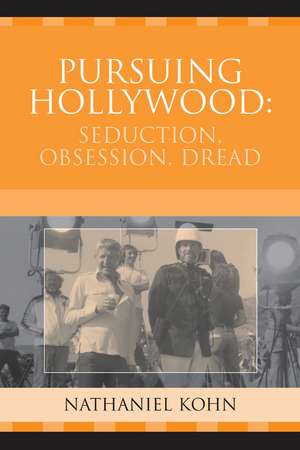
Pursuing Hollywood: Seduction, Obsession, Dread: Crossroads in Qualitative Inquiry
Autor Nathaniel Kohnen Limba Engleză Hardback – 2 iun 2006


Preț: 589.43 lei
Preț vechi: 870.14 lei
-32%
Puncte Express: 884
Carte tipărită la comandă
Livrare economică 27 noiembrie-11 decembrie
Livrare prin curier în România Termenul estimat este afișat lângă disponibilitate.
Transport gratuit pentru acest produs Plată online sau ramburs, în funcție de opțiunile comenzii.
Retur gratuit în 14 zile Comandă securizată și suport în română.
Specificații
ISBN-13: 9780759109247
ISBN-10: 0759109249
Pagini: 179
Dimensiuni: 162 x 236 x 18 mm
Greutate: 0.46 kg
Editura: Bloomsbury Publishing
Colecția AltaMira Press
Seria Crossroads in Qualitative Inquiry
Locul publicării:New York, United States
ISBN-10: 0759109249
Pagini: 179
Dimensiuni: 162 x 236 x 18 mm
Greutate: 0.46 kg
Editura: Bloomsbury Publishing
Colecția AltaMira Press
Seria Crossroads in Qualitative Inquiry
Locul publicării:New York, United States
V-ar putea interesa
-
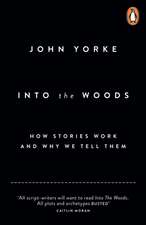 Into The WoodsJohn Yorke-30%Preț: 65.03 lei93.43 lei
 -
 Seeing Fictions in Film: The Epistemology of MoviesGeorge M. Wilson-13%Preț: 355.47 lei406.78 lei
 -
 The Social Science of CinemaJames C. Kaufman-31%Preț: 643.30 lei926.53 lei
 -
 The Sting ManRobert W. GreenePreț: 114.01 lei
 -
 What Art IsArthur C. DantoPreț: 103.81 lei
 -
 The Films of Steven SpielbergCharles L. P. Silet-33%Preț: 384.81 lei578.01 lei
 -
 John WayneAissa WaynePreț: 143.67 lei
 -
 A Companion to Literature, Film, and AdaptationDeborah CartmellPreț: 373.65 lei
 -
 The Art of Princess MononokeHayao Miyazaki-19%Preț: 182.43 lei226.61 lei
 -
 The Art of PonyoHayao Miyazaki-18%Preț: 187.66 lei229.90 lei
 -
 Preț: 213.83 lei
 -
 Cinema Sex SirensDave Worral-17%Preț: 118.29 lei142.52 lei
 -
 -20%Preț: 155.69 lei195.29 lei
Cuprins
Chapter 1 Prologue: Hail the Conquering Hero
2 The Ticket
Chapter 3 Oh, Dear, What Can the Matter Be?
Chapter 4 The Sony's Dying Glow
Chapter 5 My Elusive Dreams
Chapter 6 So to Speak
Chapter 7 Among Other Things
Chapter 8 Wonder Never Seizes
Chapter 9 Compounding Fracture
Chapter 10 Elementary Africa
Chapter 11 Messing
2 The Ticket
Chapter 3 Oh, Dear, What Can the Matter Be?
Chapter 4 The Sony's Dying Glow
Chapter 5 My Elusive Dreams
Chapter 6 So to Speak
Chapter 7 Among Other Things
Chapter 8 Wonder Never Seizes
Chapter 9 Compounding Fracture
Chapter 10 Elementary Africa
Chapter 11 Messing
Recenzii
This is an important work; it troubles our usual understandings of texts, authors, and the pursuit of celebrities, fame and recognition in the postmodern media culture. The seductions and obsessions that accompany the pursuit of self in this messy world are brilliantly exposed by Kohn.
Nate Kohn?s odyssey begins with a Muslim money changer in Johannesberg named Shorty, who hands him two suitcases containing a fortune in black market currency to pay the Zulu extras on an epic Kohn is producing named Zulu Dawn. Why, Kohn wonders, are the bills held together by rusty paper clips? His journey leads him thirty years later to a brilliant screenplay by a black college student named Hadjii, born in the deep South, who taught himself to write by doing hypothetical episodes of Seinfeld. Kohn produces Hadjii?s screenplay, Somebodies, which costs only $35,000 but is accepted as one of 118 official entries at Sundance, out of 3100 submissions. To be accepted as an official entry at Sundance is the most important thing that can happen to a low-budget independent film. Kohn in this remarkable book combines memoir and polemic, the campus and the sweaty real world. He begins and ends as a working producer, raising cash, making deals, persuading, negotiating, improvising. In betweenis another life as a university professor (Associate Director of the Peabody Awards, no less) who becomes seduced by Theory, even though he knows from his own experience how irrelevant Theory is to the jumble of hopes, compromises, scant glamour and endle
Insider/outsider, refugee/chronicler, and theorist/practioner. Kohn is all these and more. Few film scholars really know anything about the industry itself. Fewer still discuss their textual analyses in terms of the often bizarre discourses within which this industry conducts itself. Kohn's book shatters the illusion of 'cinema' and forages beneath the beguiling surface to expose contradictions, manipulations of capital, obfuscations and his own personal frustrations. In so doing his analysis reconnects Subject with Object. The result is entertaining, fascinating, and indicates a loss of innocence. This is a totally original approach to film and communication studies. It will be understood by academics and practitioners alike. All should read it.
Nate Kohn?s odyssey begins with a Muslim money changer in Johannesberg named Shorty, who hands him two suitcases containing a fortune in black market currency to pay the Zulu extras on an epic Kohn is producing named Zulu Dawn. Why, Kohn wonders, are the bills held together by rusty paper clips? His journey leads him thirty years later to a brilliant screenplay by a black college student named Hadjii, born in the deep South, who taught himself to write by doing hypothetical episodes of Seinfeld. Kohn produces Hadjii?s screenplay, Somebodies, which costs only $35,000 but is accepted as one of 118 official entries at Sundance, out of 3100 submissions. To be accepted as an official entry at Sundance is the most important thing that can happen to a low-budget independent film. Kohn in this remarkable book combines memoir and polemic, the campus and the sweaty real world. He begins and ends as a working producer, raising cash, making deals, persuading, negotiating, improvising. In betweenis another life as a university professor (Associate Director of the Peabody Awards, no less) who becomes seduced by Theory, even though he knows from his own experience how irrelevant Theory is to the jumble of hopes, compromises, scant glamour and endle
Insider/outsider, refugee/chronicler, and theorist/practioner. Kohn is all these and more. Few film scholars really know anything about the industry itself. Fewer still discuss their textual analyses in terms of the often bizarre discourses within which this industry conducts itself. Kohn's book shatters the illusion of 'cinema' and forages beneath the beguiling surface to expose contradictions, manipulations of capital, obfuscations and his own personal frustrations. In so doing his analysis reconnects Subject with Object. The result is entertaining, fascinating, and indicates a loss of innocence. This is a totally original approach to film and communication studies. It will be understood by academics and practitioners alike. All should read it.