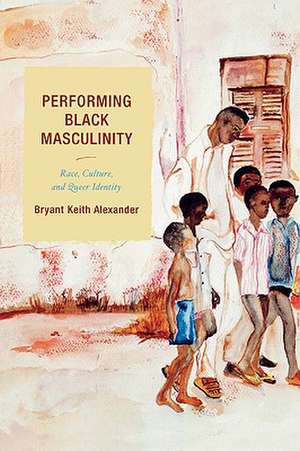
Performing Black Masculinity: Race, Culture, and Queer Identity: Crossroads in Qualitative Inquiry
Autor Bryant Keith Alexanderen Limba Engleză Paperback – 21 iul 2006


Preț: 313.34 lei
Preț vechi: 390.65 lei
-20%
Puncte Express: 470
Carte tipărită la comandă
Livrare economică 27 noiembrie-11 decembrie
Livrare prin curier în România Termenul estimat este afișat lângă disponibilitate.
Transport gratuit de la 400.00 lei Plată online sau ramburs, în funcție de opțiunile comenzii.
Retur gratuit în 14 zile Comandă securizată și suport în română.
Specificații
ISBN-13: 9780759109292
ISBN-10: 075910929X
Pagini: 257
Dimensiuni: 150 x 226 x 18 mm
Greutate: 0.42 kg
Editura: Bloomsbury Publishing
Colecția AltaMira Press
Seria Crossroads in Qualitative Inquiry
Locul publicării:New York, United States
ISBN-10: 075910929X
Pagini: 257
Dimensiuni: 150 x 226 x 18 mm
Greutate: 0.42 kg
Editura: Bloomsbury Publishing
Colecția AltaMira Press
Seria Crossroads in Qualitative Inquiry
Locul publicării:New York, United States
V-ar putea interesa
-
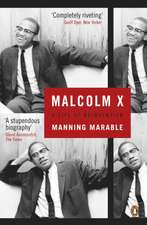 Malcolm XManning Marable-27%Preț: 88.79 lei121.51 lei
 -
 -23%Preț: 219.42 lei284.93 lei
 -
 The Works of Alain LockeCharles Molesworth-30%Preț: 578.54 lei831.37 lei
 -
 Jones, C: Behind the DreamClarence B. JonesPreț: 71.66 lei
 -
 A Breath of FreedomM. HöhnPreț: 470.93 lei
 -
 The Black Campus MovementIbram X KendiPreț: 276.28 lei
 -
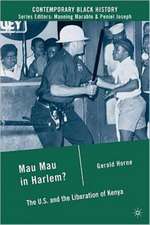 Mau Mau in Harlem?G. Horne-15%Preț: 602.14 lei708.40 lei
 -
 Black British WritingLauri RameyPreț: 394.38 lei
 -
 Head Off & Split: PoemsNikky FinneyPreț: 102.97 lei
 -
 The New BlackEvie ShockleyPreț: 85.48 lei
 -
 John Oliver KillensKeith GilyardPreț: 282.74 lei
 -
 Politics of InnocenceSimon TurnerPreț: 225.45 lei
 -
 Hmong and American: From Refugees to CitizensVincent K. HerPreț: 133.53 lei
 -
 Our Southern Home-Scottsboro to Montgomery to BirminghamWaights Taylor JrPreț: 197.34 lei
 -
 Shoulda Been Jimi SavannahPatricia SmithPreț: 94.52 lei
 -
 Ira Aldridge – The African RosciusBernth LindforsPreț: 289.20 lei
 -
 Preț: 177.32 lei
Cuprins
1 Introduction: Exploring Modalities and Subjectiveness that Shape Social Relations
2 Crossing Borders and Changing Customs: Moments When the Spectator Becomes the Spectacle
3 Placement and Displacement of Black Identity: The Case of Migration across Borders from Campus to Community
4 Passing, Cultural Performance and Individual Agency: Performative Reflections on Black Masculine Identity
5 (Re) Visioning the Ethnographic Site: Interpretive Ethnography, Performing Drag, and Feminist Pedagogy
6 Fading, Twisting, and Weaving: An Interpretive Ethnography of the Black Barbershop/Salon as Cultural Space
7 "Were/Are, Fort/Da": The Eulogy as Constitutive (Auto)biography (or, Traveling to Coalesce a Public Memory)
2 Crossing Borders and Changing Customs: Moments When the Spectator Becomes the Spectacle
3 Placement and Displacement of Black Identity: The Case of Migration across Borders from Campus to Community
4 Passing, Cultural Performance and Individual Agency: Performative Reflections on Black Masculine Identity
5 (Re) Visioning the Ethnographic Site: Interpretive Ethnography, Performing Drag, and Feminist Pedagogy
6 Fading, Twisting, and Weaving: An Interpretive Ethnography of the Black Barbershop/Salon as Cultural Space
7 "Were/Are, Fort/Da": The Eulogy as Constitutive (Auto)biography (or, Traveling to Coalesce a Public Memory)
Recenzii
This is a vastly important book. In every chapter, the rich theoretical breadth of Alexanders's radically interdisciplinary thinking is meaningfully linked to a multi-sited ethnography and politics of human experience. Theory and practice are merged in Performing Black Masculinity to deepen and illuminate the "everyday" particularly the hidden complexities of race, sexuality and economies of belonging. This work is personal and political offering fresh, new insights to the relevance of autoethnography as a method of critical reflexivity that at its best is always already contesting both the small and the large machinations of injustice.
Bryant Alexander deftly examines intersections of race, gender and sexuality, performance, and spectatorship, as these emerge in everyday life, in the classroom, in tourism, public discourse, and in academic writing. He explores the intimate connections between lived experience, ethnographic methods, and cultural critique in new and compelling ways. This heartfelt and learned book makes important contributions to African American, performance, communication and cultural studies. Intercultural and interpersonal communication, communication education and critical pedagogy, and critical race, gender, and sexuality studies will also benefit from his moving and thoughtful analyses.
Bryant Alexander deftly examines intersections of race, gender and sexuality, performance, and spectatorship, as these emerge in everyday life, in the classroom, in tourism, public discourse, and in academic writing. He explores the intimate connections between lived experience, ethnographic methods, and cultural critique in new and compelling ways. This heartfelt and learned book makes important contributions to African American, performance, communication and cultural studies. Intercultural and interpersonal communication, communication education and critical pedagogy, and critical race, gender, and sexuality studies will also benefit from his moving and thoughtful analyses.