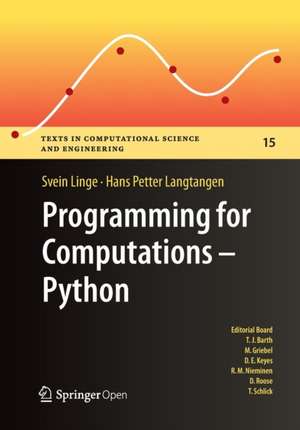
Programming for Computations - Python: A Gentle Introduction to Numerical Simulations with Python: Texts in Computational Science and Engineering, cartea 15
Autor Svein Linge, Hans Petter Langtangenen Limba Engleză Paperback – 31 mai 2018
The book outlines the shortest possible path from no previous experience with programming to a set of skills that allows the students to write simple programs for solving common mathematical problems with numerical methods in engineering and science courses. The emphasis is on generic algorithms, clean design of programs, use of functions, and automatic tests for verification.
Din seria Texts in Computational Science and Engineering
- 19%
 Preț: 580.82 lei
 -
 Preț: 401.66 lei
 - 20%
 Preț: 652.82 lei
 - 20%
 Preț: 351.40 lei
 - 15%
 Preț: 583.26 lei
 - 20%
 Preț: 657.52 lei
 -
 Preț: 391.02 lei
 -
 Preț: 422.68 lei
 -
 Preț: 422.62 lei
 -
 Preț: 396.69 lei
 -
 Preț: 455.50 lei
 -
 Preț: 496.39 lei
 - 15%
 Preț: 609.98 lei
 -
 Preț: 396.25 lei
 -
 Preț: 395.27 lei
 -
 Preț: 389.10 lei
 -
 Preț: 509.03 lei
 -
 Preț: 382.10 lei
 -
 Preț: 472.77 lei
 - 20%
 Preț: 325.15 lei
 -
 Preț: 502.82 lei
 -
 Preț: 402.42 lei
 -
 Preț: 393.74 lei
 - 15%
 Preț: 565.00 lei
Preț: 406.24 lei
Puncte Express: 609
Carte tipărită la comandă
Livrare economică 13-27 august
Livrare prin curier în România Termenul estimat este afișat lângă disponibilitate.
Transport gratuit pentru acest produs Plată online sau ramburs, în funcție de opțiunile comenzii.
Retur gratuit în 14 zile Comandă securizată și suport în română.
Specificații
ISBN-13: 9783319812823
ISBN-10: 3319812823
Pagini: 232
Ilustrații: XVI, 232 p. 45 illus.
Dimensiuni: 178 x 254 x 18 mm
Greutate: 0.44 kg
Ediția:Softcover reprint of the original 1st ed. 2016
Editura: Springer International Publishing
Colecția Springer
Seria Texts in Computational Science and Engineering
Locul publicării:Cham, Switzerland
ISBN-10: 3319812823
Pagini: 232
Ilustrații: XVI, 232 p. 45 illus.
Dimensiuni: 178 x 254 x 18 mm
Greutate: 0.44 kg
Ediția:Softcover reprint of the original 1st ed. 2016
Editura: Springer International Publishing
Colecția Springer
Seria Texts in Computational Science and Engineering
Locul publicării:Cham, Switzerland
V-ar putea interesa
-
 -23%Preț: 1470.04 lei1909.14 lei
 -
 -20%Preț: 628.15 lei785.18 lei
 -
 Modern Formal Methods and ApplicationsHossam A. Gabbar-15%Preț: 696.15 lei819.00 lei
 -
 La Chimie Macromoléculaire-4 / Macromolecular Chemistry-4International Symposium on Macromolecular ChemistryPreț: 380.77 lei
 -
 Numerical Methods for EngineersD. Vaughan Griffiths-20%Preț: 1460.12 lei1825.14 lei
 -
 Mathematics for Physical ChemistryDonald A. McquarriePreț: 424.03 lei
 -
 -15%Preț: 640.51 lei753.55 lei
 -
 Preț: 390.96 lei
 -
 Traffic and Granular Flow '17Samer H. Hamdar-18%Preț: 966.06 lei1178.11 lei
 -
 High Performance Computing in Science and Engineering ' 18Wolfgang E. Nagel-24%Preț: 908.28 lei1195.10 lei
 -
 Introduction to Numerical Methods for Variational ProblemsHans Petter Langtangen-15%Preț: 492.70 lei579.64 lei
 -
 -15%Preț: 707.54 lei832.39 lei
 -
 Age Structured Epidemic ModelingXue-Zhi Li-18%Preț: 740.81 lei903.43 lei
 -
 Programming for Computations - MATLAB/OctaveSvein LingePreț: 422.68 lei
 -
 Scaling of Differential EquationsHans Petter LangtangenPreț: 174.17 lei
 -
 Solving PDEs in PythonHans Petter LangtangenPreț: 177.22 lei
 -
 Finite Difference Computing with PDEsHans Petter LangtangenPreț: 455.50 lei
 -
 -18%Preț: 865.08 lei1054.98 lei
 -
 Advanced Topics in Computational Partial Differential EquationsHans Petter LangtangenPreț: 395.69 lei
 -
 Python Scripting for Computational ScienceHans Petter LangtangenPreț: 472.77 lei
 -
 Elements of Scientific ComputingAslak TveitoPreț: 402.42 lei
 -
 Preț: 363.26 lei
 -
 Group Chase and EscapeAtsushi Kamimura-15%Preț: 697.34 lei820.39 lei
 -
 -15%Preț: 706.65 lei831.36 lei
Cuprins
Preface.- The first few steps.- Basic constructions.- Computing integrals.- Solving ordinary differential equations.- Solving partial differential equations.- Solving nonlinear algebraic equations.- Getting access to Python.- References.- Index
Recenzii
“The book uses programming to impart a deeper understanding of the pragmatic meaning of some of the mathematics most frequently used in engineering and the sciences. … This very good introductory textbook could be used in a variety of courses. A motivated reader with knowledge of calculus could easily use it for self-study. I highly recommend it.” (David Naugler, Computing Reviews, February, 2017)
“This book is intended for novice programmers, especially students, teachers, engineers and scientists from areas related to mathematics and numerical mathematics. … each treated concept is illustrated and explained in detail by means of working examples. On the basis of exercises, the reader is given the opportunity to deepen acquired knowledge. … The clear presentation and the large number of concrete examples, often with a graphical output, make this book ideally suited for self-study and ensures a quick success.” (Stefan Meyer, zbMATH 1350.68003, 2017)Notă biografică
Svein Linge is a professor of modelling and simulation at the University College of Southeast Norway and holds a Dr. Scient. degree in biomechanics from the Norwegian School of Sport Sciences. He works part-time at a Norwegian Center of Excellence: "Center for Biomedical Computing", at Simula Research Laboratory, to which he has been linked for the last 13 years. His main research interests includes cerebrospinal fluid dynamics, cardiac electro-mechanics and sport biomechanics. Over the last decade, Linge has been particularly engaged in reforming the engineering education in mathematics and physics to take advantage of computer programming and simulation.
Hans Petter Langtangen is a professor of computer science at the University of Oslo. He has formerly been a professor of mechanics and is now the director of a Norwegian Center of Excellence: "Center for Biomedical Computing", at Simula Research Laboratory. Langtangen haspublished over 100 scientific publications and written several books, including papers and the bestseller TCSE 6 "A Primer on Scientific Programming with Python", now in its 5th edition. He has also developed open source and commercial software systems for computational sciences.
Textul de pe ultima copertă
This book presents computer programming as a key method for solving mathematical problems. There are two versions of the book, one for MATLAB and one for Python. The book was inspired by the Springer book TCSE 6: A Primer on Scientific Programming with Python (by Langtangen), but the style is more accessible and concise, in keeping with the needs of engineering students.
The book outlines the shortest possible path from no previous experience with programming to a set of skills that allows the students to write simple programs for solving common mathematical problems with numerical methods in engineering and science courses. The emphasis is on generic algorithms, clean design of programs, use of functions, and automatic tests for verification.
The book outlines the shortest possible path from no previous experience with programming to a set of skills that allows the students to write simple programs for solving common mathematical problems with numerical methods in engineering and science courses. The emphasis is on generic algorithms, clean design of programs, use of functions, and automatic tests for verification.
Caracteristici
Easy-to-read text offering a gentle introduction to the necessary mathematics and computer science concepts Focuses on explaining all details of how to construct programs to solve mathematical problems Further emphasizes verification procedures and how to embed them in automatic test frameworks Includes supplementary material: sn.pub/extras