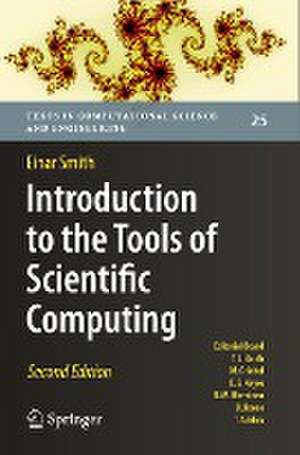
Introduction to the Tools of Scientific Computing: Texts in Computational Science and Engineering
Autor Einar Smithen Limba Engleză Paperback – 29 oct 2023
Typically, new concepts are first introduced in the particularly user-friendly Python language and then transferred and extended in various programming environments from C/C++, Julia and MATLAB to Maple and Mathematica. This includes various approaches to distributed computing. By examining and comparing different languages, the book is also helpful for mathematicians and practitioners in deciding which programming language to use for which purposes.
At a more advanced level, special tools for the automated solution of partial differential equations using the finite element method are discussed. On a more experimental level, the basic methods of scientific machine learning in artificial neural networks are explained and illustrated.
| Toate formatele și edițiile | Preț | Express |
|---|---|---|
| Paperback (2) | 378.41 lei 43-57 zile | |
| Springer – 4 dec 2021 | 378.41 lei 43-57 zile | |
| Springer – 29 oct 2023 | 383.63 lei 43-57 zile | |
| Hardback (1) | 485.86 lei 43-57 zile | |
| Springer – 28 oct 2022 | 485.86 lei 43-57 zile |
Din seria Texts in Computational Science and Engineering
- 15%
 Preț: 572.89 lei
 -
 Preț: 459.05 lei
 -
 Preț: 385.06 lei
 - 19%
 Preț: 573.83 lei
 - 15%
 Preț: 565.66 lei
 - 20%
 Preț: 351.67 lei
 - 20%
 Preț: 636.94 lei
 -
 Preț: 374.34 lei
 -
 Preț: 413.82 lei
 -
 Preț: 422.33 lei
 -
 Preț: 434.32 lei
 -
 Preț: 475.21 lei
 - 15%
 Preț: 582.98 lei
 -
 Preț: 379.89 lei
 -
 Preț: 378.95 lei
 -
 Preț: 373.03 lei
 -
 Preț: 485.21 lei
 -
 Preț: 464.02 lei
 - 20%
 Preț: 325.15 lei
 -
 Preț: 479.83 lei
 -
 Preț: 383.23 lei
 -
 Preț: 376.01 lei
Preț: 383.63 lei
Nou
Puncte Express: 575
Preț estimativ în valută:
67.87€ • 79.07$ • 59.27£
67.87€ • 79.07$ • 59.27£
Carte tipărită la comandă
Livrare economică 19 ianuarie-02 februarie 26
Preluare comenzi: 021 569.72.76
Specificații
ISBN-13: 9783031169748
ISBN-10: 3031169743
Pagini: 444
Ilustrații: XIII, 428 p. 1 illus.
Dimensiuni: 155 x 235 x 24 mm
Greutate: 0.67 kg
Ediția:Second Edition 2022
Editura: Springer
Seria Texts in Computational Science and Engineering
Locul publicării:Cham, Switzerland
ISBN-10: 3031169743
Pagini: 444
Ilustrații: XIII, 428 p. 1 illus.
Dimensiuni: 155 x 235 x 24 mm
Greutate: 0.67 kg
Ediția:Second Edition 2022
Editura: Springer
Seria Texts in Computational Science and Engineering
Locul publicării:Cham, Switzerland
Cuprins
Introduction.- Part I, Background.- Part II, Core Languages.- Part III, Commercial Computing Environments.- Part IV, Distributed Computing.- Part V, Specialized Programming Environments.- References.- Index.
Recenzii
“This book covers a lot of ground, and overall it does so very well. … On nearly every page, the reader can find numerous code snippets … that are explained in great detail. … I can warmly recommend it to my colleagues and STEM students as a welcome resource to help them with this decision tree.” (Andreas Mang, SIAM Review, Vol. 64 (2), June, 2022)
Notă biografică
Einar Smith holds academic degrees in Mathematics from the Unversity of Bonn, in Economics from the University of Oslo, and in Computer Science from the University of Hamburg.
He has published a textbook on Mathematical Computability Theory, and a biography of the German computer scientist C.A. Petri. Both books have been published by Springer. In recent years he has mainly been concerned with the teaching of numerical methods at the University of Bonn, with an emphasis on computer programming.
Textul de pe ultima copertă
The book provides an introduction to common programming tools and methods in numerical mathematics and scientific computing. Unlike standard approaches, it does not focus on any specific language, but aims to explain the underlying ideas.
Typically, new concepts are first introduced in the particularly user-friendly Python language and then transferred and extended in various programming environments from C/C++, Julia and MATLAB to Maple and Mathematica. This includes various approaches to distributed computing. By examining and comparing different languages, the book is also helpful for mathematicians and practitioners in deciding which programming language to use for which purposes.
At a more advanced level, special tools for the automated solution of partial differential equations using the finite element method are discussed. On a more experimental level, the basic methods of scientific machine learning in artificial neural networks are explained and illustrated.
Typically, new concepts are first introduced in the particularly user-friendly Python language and then transferred and extended in various programming environments from C/C++, Julia and MATLAB to Maple and Mathematica. This includes various approaches to distributed computing. By examining and comparing different languages, the book is also helpful for mathematicians and practitioners in deciding which programming language to use for which purposes.
At a more advanced level, special tools for the automated solution of partial differential equations using the finite element method are discussed. On a more experimental level, the basic methods of scientific machine learning in artificial neural networks are explained and illustrated.
Caracteristici
Surveys and compares many different programming languages Helps to decide which programming language to use for which purpose Programming concepts are introduced in well-known mathematical contexts