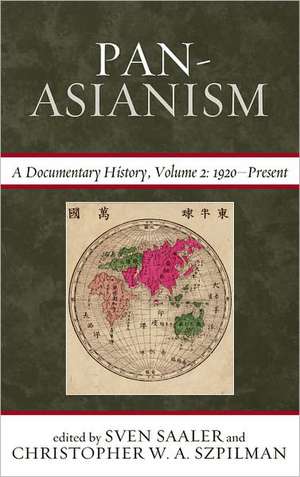
Pan-Asianism: A Documentary History, 1920–Present, Volume 2: Asia/Pacific/Perspectives
Editat de Sven Saaler, Christopher W. A. Szpilmanen Limba Engleză Hardback – 16 apr 2011
Thoroughly remedying this problem, this unique sourcebook provides a wealth of documents on Pan-Asianism from 1920 to the present, many translated for the first time from Asian languages. All sources are accompanied by expert commentaries that provide essential background information. Providing an essential overview of Pan-Asianism as it developed throughout modern Asia, this collection will be an indispensable tool for scholars in history, political science, international relations, and sociology. Its accessible presentation makes it a valuable resource for non-specialists as well.
Contributions by: Roger H. Brown, Kristine Dennehy, Prasenjit Duara, Eddy Dufourmont, Curtis Anderson Gayle, Jung-Sun N. Han, Hatsuse Ryuhei, Eri Hotta, Eun-jeung Lee, Stefano von Loë, Ethan Mark, Muto Shutaro, Li Narangoa, Sven Saaler, Michael A. Schneider, Kyoko Selden, Mark Selden, Christopher W. A. Szpilman, Brij Tankha, Christian Uhl, and Torsten Weber.
Din seria Asia/Pacific/Perspectives
- 39%
 Preț: 101.39 lei
 - 19%
 Preț: 469.67 lei
 - 29%
 Preț: 789.89 lei
 - 23%
 Preț: 264.02 lei
 - 23%
 Preț: 277.28 lei
 - 33%
 Preț: 517.98 lei
 - 24%
 Preț: 366.91 lei
 - 19%
 Preț: 220.85 lei
 - 34%
 Preț: 755.07 lei
 - 14%
 Preț: 139.68 lei
 - 27%
 Preț: 259.10 lei
 - 25%
 Preț: 347.66 lei
 - 33%
 Preț: 354.43 lei
 - 19%
 Preț: 328.98 lei
 - 22%
 Preț: 351.06 lei
 - 23%
 Preț: 260.87 lei
 - 24%
 Preț: 224.32 lei
 - 26%
 Preț: 362.16 lei
 - 22%
 Preț: 265.41 lei
 - 33%
 Preț: 578.84 lei
 - 32%
 Preț: 375.48 lei
 - 29%
 Preț: 347.27 lei
 - 25%
 Preț: 219.27 lei
 - 28%
 Preț: 222.14 lei
 - 33%
 Preț: 577.37 lei
 - 38%
 Preț: 717.63 lei
 - 37%
 Preț: 723.68 lei
 - 19%
 Preț: 317.07 lei
 -
 Preț: 352.86 lei
 - 33%
 Preț: 792.68 lei
 - 34%
 Preț: 356.01 lei
 - 33%
 Preț: 357.65 lei
 - 36%
 Preț: 677.08 lei
 - 23%
 Preț: 323.49 lei
 - 37%
 Preț: 659.03 lei
 - 19%
 Preț: 313.48 lei
 - 34%
 Preț: 354.88 lei
Preț: 658.88 lei
Preț vechi: 1058.81 lei
-38%
Puncte Express: 988
Carte tipărită la comandă
Livrare economică 04-18 decembrie
Livrare prin curier în România Termenul estimat este afișat lângă disponibilitate.
Transport gratuit pentru acest produs Plată online sau ramburs, în funcție de opțiunile comenzii.
Retur gratuit în 14 zile Comandă securizată și suport în română.
Specificații
ISBN-13: 9781442205994
ISBN-10: 1442205997
Pagini: 422
Dimensiuni: 164 x 239 x 36 mm
Greutate: 0.82 kg
Editura: Bloomsbury Publishing
Colecția Rowman & Littlefield
Seria Asia/Pacific/Perspectives
Locul publicării:New York, United States
ISBN-10: 1442205997
Pagini: 422
Dimensiuni: 164 x 239 x 36 mm
Greutate: 0.82 kg
Editura: Bloomsbury Publishing
Colecția Rowman & Littlefield
Seria Asia/Pacific/Perspectives
Locul publicării:New York, United States
Cuprins
Introduction: The Emergence of Pan-Asianism as an Ideal of Asian Identity and Solidarity, 1850-2008
Sven Saaler and Christopher W. A. Szpilman
Part I: The Radicalization of Japanese Pan-Asianism and Intra-Asian Disputes, 1920-1930
Chapter 1: Nakano Seigo: Populist, Fascist, Pan-Asianist, 1917-1942
Stefano von Loë
Chapter 2: The Yuzonsha's "War Cry," 1920
Christopher W. A. Szpilman
Chapter 3: Japan, Korea, and Pan-Asianism: The Dokokai, 1921
Sven Saaler
Chapter 4: Okawa Shumei: "Various Problems of Asia in Revival," 1922
Christopher W. A. Szpilman
Chapter 5: Sun Yat-sen: "Pan-Asianism," 1924
Roger H. Brown
Chapter 6: Tanaka Ippei: "Islam and Pan-Asianism," 1924
Eddy Dufourmont
Chapter 7: The Greater India Society: Indian Culture and an Asian Federation
Brij Tankha
Chapter 8: The Pan-Asiatic Society and the "Conference of Asian Peoples" in Nagasaki, 1926
Sven Saaler
Chapter 9: Raja Mahendra Pratap: Indian Independence, Asian Solidarity, World Federation, 1930
Sven Saaler
Part II: Pan-Asian
Sven Saaler and Christopher W. A. Szpilman
Part I: The Radicalization of Japanese Pan-Asianism and Intra-Asian Disputes, 1920-1930
Chapter 1: Nakano Seigo: Populist, Fascist, Pan-Asianist, 1917-1942
Stefano von Loë
Chapter 2: The Yuzonsha's "War Cry," 1920
Christopher W. A. Szpilman
Chapter 3: Japan, Korea, and Pan-Asianism: The Dokokai, 1921
Sven Saaler
Chapter 4: Okawa Shumei: "Various Problems of Asia in Revival," 1922
Christopher W. A. Szpilman
Chapter 5: Sun Yat-sen: "Pan-Asianism," 1924
Roger H. Brown
Chapter 6: Tanaka Ippei: "Islam and Pan-Asianism," 1924
Eddy Dufourmont
Chapter 7: The Greater India Society: Indian Culture and an Asian Federation
Brij Tankha
Chapter 8: The Pan-Asiatic Society and the "Conference of Asian Peoples" in Nagasaki, 1926
Sven Saaler
Chapter 9: Raja Mahendra Pratap: Indian Independence, Asian Solidarity, World Federation, 1930
Sven Saaler
Part II: Pan-Asian
Recenzii
The first substantial compilation of materials on the topic in the English language . . . [which] not only fulfills the historiographical gap and teaching needs but also opens up further research into the subject. . . . The editors do not assume a coherent Pan-Asianism; rather, the strength of this collection lies in its acknowledgment of varieties, tensions, and changes within various voices of Pan-Asianism. . . . Each short chapter comes with an informative, easy-to-follow essay as well as translations of primary materials, making the collection ideal for undergraduate teaching. . . . Despite the sense of taboo around the subject of pan-Asianism, or rather because of it, carefully contextualized analyses of its history are highly important. Not only for teachers but also for any critical readers of Asian history and contemporary discussions of Asian integration, Pan-Asianism is a welcome and invaluable collection.
These engaging tomes . . . offer a mint of scholarship on what has long been a troubling issue to decipher for students limited to the English language; namely, what is the deal with Pan-Asianism? . . . The question has long been of interest but few were the tools one could employ to gain insight or even access to more than mere cursory introductions. These books change the nature of that game [with] a two-volume set of fine translations covering the 19th and 20th centuries (with a bit into the 21st), focusing on a wide variety of well-known, and some lesser known, ideologues (Japanese and other) on the topic of pan-Asianism. . . . This is a set for any library and to serve as a reference on [researchers'] shelves. . . . These books bring an enormous span of disparate writings together, an exceedingly admirable goal even without the translations and introductions. . . . Each selection is preceded with a clear explanation from the translator, noting the significance and providing some background on the text itself. Sometimes the introductions or explanatory sections are longer than the actual translation, and that is fine because these volumes offer precisely that to the beginning reader an introduction. I can think of no better set of current volumes on the market that offer this wealth in terms of both coverage, depth of explanation, and then actual translation of primary text, to readers in English . . . . Saaler and Szpilman should be commended on being able both to corral an army of able and intellectually gifted scholars from around the world and get them to produce translations and introductions in this multi-layered collection of tracts from the last century and a half. . . . I can only imagine the effort put forward in producing this publication and the two volumes sit proudly on my shelf, already well-thumbed as I paw through them looking for insight.
The publication of Pan-Asianism is a seminal event: until now it has been almost impossible to find translations on this strand of thought. . . . [I]n its scope and variety this easily is the best sourcebook on Pan-Asianism available in any language. Every academic library on Japan should stock this collection, and many scholars on modern Japan and Asia will benefit from owning it.
Finally there is an excellent source book on Pan-Asianism, an ideology that has played an important role in Japan's regional interactions since the late 19th century. These two volumes are essential for any university or research library as they cover modern Asian history from the mid-19th century until the present. The set is an incredibly good value because it provides access to a comprehensive range of translated materials that encompass a number of languages. The contributors preface their translations with useful commentary that help readers understand the significance of what they are about to read, making this very useful for students and scholars. . . . A treasure trove of primary documents, some translated into English for the first time.
[A] welcome addition to an on-going conversation and a substantial resource for both scholars and students. . . . [T]his two-volume collection of documents brings together prominent visions of Asia from across the region and over nearly two centuries, all carefully placed in historical and intellectual context by thoughtful introductions from a long list of contributing scholars. . . . [R]emarkable in part for its breadth: geographical, chronological and ideological.
This is an extraordinary undertaking, simply breathtaking in the range of writings it introduces to an English-speaking readership. The two volumes contain Pan-Asian writings by many well-known Japanese, Chinese, Korean, Indian, Indonesian, and Malaysian authors, in addition to manifestos produced by various Pan-Asian organizations. It is particularly helpful that these translations are introduced by essays written by leading scholars in the field. These two books together make an important scholarly contribution by opening up access to an area of modern history that has remained largely impenetrable to many of us.
'Pan-Asianism' galvanized-and still galvanizes-political imaginations from Afghanistan to Japan, from the Suez to Sakhalin, in an array of sometimes conflicting projects: defense against 'the West,' internal colonialism, transnational class solidarity, and celebration of religious and other traditions. These volumes, in translating seminal works from many languages and presenting skilled commentary, provide an unprecedented basis for a historical understanding of this perplexing yet vital concept. A gift to scholars and students for years to come.
These engaging tomes . . . offer a mint of scholarship on what has long been a troubling issue to decipher for students limited to the English language; namely, what is the deal with Pan-Asianism? . . . The question has long been of interest but few were the tools one could employ to gain insight or even access to more than mere cursory introductions. These books change the nature of that game [with] a two-volume set of fine translations covering the 19th and 20th centuries (with a bit into the 21st), focusing on a wide variety of well-known, and some lesser known, ideologues (Japanese and other) on the topic of pan-Asianism. . . . This is a set for any library and to serve as a reference on [researchers'] shelves. . . . These books bring an enormous span of disparate writings together, an exceedingly admirable goal even without the translations and introductions. . . . Each selection is preceded with a clear explanation from the translator, noting the significance and providing some background on the text itself. Sometimes the introductions or explanatory sections are longer than the actual translation, and that is fine because these volumes offer precisely that to the beginning reader an introduction. I can think of no better set of current volumes on the market that offer this wealth in terms of both coverage, depth of explanation, and then actual translation of primary text, to readers in English . . . . Saaler and Szpilman should be commended on being able both to corral an army of able and intellectually gifted scholars from around the world and get them to produce translations and introductions in this multi-layered collection of tracts from the last century and a half. . . . I can only imagine the effort put forward in producing this publication and the two volumes sit proudly on my shelf, already well-thumbed as I paw through them looking for insight.
The publication of Pan-Asianism is a seminal event: until now it has been almost impossible to find translations on this strand of thought. . . . [I]n its scope and variety this easily is the best sourcebook on Pan-Asianism available in any language. Every academic library on Japan should stock this collection, and many scholars on modern Japan and Asia will benefit from owning it.
Finally there is an excellent source book on Pan-Asianism, an ideology that has played an important role in Japan's regional interactions since the late 19th century. These two volumes are essential for any university or research library as they cover modern Asian history from the mid-19th century until the present. The set is an incredibly good value because it provides access to a comprehensive range of translated materials that encompass a number of languages. The contributors preface their translations with useful commentary that help readers understand the significance of what they are about to read, making this very useful for students and scholars. . . . A treasure trove of primary documents, some translated into English for the first time.
[A] welcome addition to an on-going conversation and a substantial resource for both scholars and students. . . . [T]his two-volume collection of documents brings together prominent visions of Asia from across the region and over nearly two centuries, all carefully placed in historical and intellectual context by thoughtful introductions from a long list of contributing scholars. . . . [R]emarkable in part for its breadth: geographical, chronological and ideological.
This is an extraordinary undertaking, simply breathtaking in the range of writings it introduces to an English-speaking readership. The two volumes contain Pan-Asian writings by many well-known Japanese, Chinese, Korean, Indian, Indonesian, and Malaysian authors, in addition to manifestos produced by various Pan-Asian organizations. It is particularly helpful that these translations are introduced by essays written by leading scholars in the field. These two books together make an important scholarly contribution by opening up access to an area of modern history that has remained largely impenetrable to many of us.
'Pan-Asianism' galvanized-and still galvanizes-political imaginations from Afghanistan to Japan, from the Suez to Sakhalin, in an array of sometimes conflicting projects: defense against 'the West,' internal colonialism, transnational class solidarity, and celebration of religious and other traditions. These volumes, in translating seminal works from many languages and presenting skilled commentary, provide an unprecedented basis for a historical understanding of this perplexing yet vital concept. A gift to scholars and students for years to come.