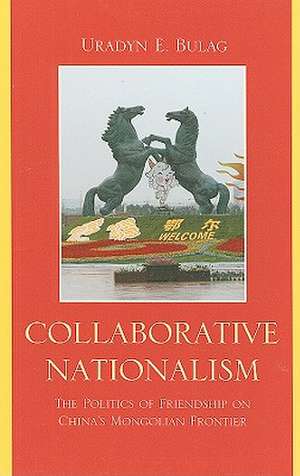
Collaborative Nationalism: The Politics of Friendship on China's Mongolian Frontier: Asia/Pacific/Perspectives
Autor Uradyn E. Bulagen Limba Engleză Hardback – 16 iul 2010
Din seria Asia/Pacific/Perspectives
- 39%
 Preț: 101.39 lei
 - 19%
 Preț: 469.67 lei
 - 29%
 Preț: 789.89 lei
 - 23%
 Preț: 264.02 lei
 - 23%
 Preț: 277.28 lei
 - 33%
 Preț: 517.98 lei
 - 24%
 Preț: 366.91 lei
 - 19%
 Preț: 220.85 lei
 - 34%
 Preț: 755.07 lei
 - 13%
 Preț: 141.09 lei
 - 27%
 Preț: 259.10 lei
 - 25%
 Preț: 347.66 lei
 - 33%
 Preț: 354.43 lei
 - 19%
 Preț: 328.98 lei
 - 22%
 Preț: 351.06 lei
 - 23%
 Preț: 260.87 lei
 - 24%
 Preț: 224.32 lei
 - 26%
 Preț: 362.16 lei
 - 22%
 Preț: 265.41 lei
 - 33%
 Preț: 578.84 lei
 - 32%
 Preț: 375.48 lei
 - 29%
 Preț: 347.27 lei
 - 25%
 Preț: 219.27 lei
 - 28%
 Preț: 222.14 lei
 - 33%
 Preț: 577.37 lei
 - 38%
 Preț: 717.63 lei
 - 19%
 Preț: 317.07 lei
 -
 Preț: 352.86 lei
 - 33%
 Preț: 792.68 lei
 - 34%
 Preț: 356.01 lei
 - 33%
 Preț: 357.65 lei
 - 36%
 Preț: 677.08 lei
 - 23%
 Preț: 323.49 lei
 - 37%
 Preț: 659.03 lei
 - 19%
 Preț: 313.48 lei
 - 34%
 Preț: 354.88 lei
Preț: 723.68 lei
Preț vechi: 1149.05 lei
-37%
Puncte Express: 1086
Carte tipărită la comandă
Livrare economică 07-21 decembrie
Livrare prin curier în România Termenul estimat este afișat lângă disponibilitate.
Transport gratuit pentru acest produs Plată online sau ramburs, în funcție de opțiunile comenzii.
Retur gratuit în 14 zile Comandă securizată și suport în română.
Specificații
ISBN-13: 9781442204317
ISBN-10: 1442204311
Pagini: 283
Dimensiuni: 160 x 232 x 24 mm
Greutate: 0.6 kg
Editura: Bloomsbury Publishing
Colecția Rowman & Littlefield
Seria Asia/Pacific/Perspectives
Locul publicării:New York, United States
ISBN-10: 1442204311
Pagini: 283
Dimensiuni: 160 x 232 x 24 mm
Greutate: 0.6 kg
Editura: Bloomsbury Publishing
Colecția Rowman & Littlefield
Seria Asia/Pacific/Perspectives
Locul publicării:New York, United States
Descriere
Cosmopolitanism and friendship have become key themes for understanding ethnicity and nationalism. In this deeply original study of the Mongols, leading scholar Uradyn E. Bulag draws on these themes to develop a new concept he terms "collaborative nationalism." He uses this concept to explore the paradoxical dilemma of minorities in China as they fight not against being excluded but against being embraced too tightly in the bonds of "friendship." Going beyond traditional binary relationships, he offers a unique triangular perspective that illuminates the complexity of regional interaction.
Thus, Collaborative Nationalism traces the regional and global significance of the Mongols in the fierce competition among China, Japan, Mongolia, and Russia to appropriate the Mongol heritage to buttress their own national identities. The book considers a rich array of case studies that range from Chinggis Khan to reincarnate lamas, from cadres to minority revolutionary history, and from building the Mongolian working class to interethnic adoption. So-called friendship and collaboration permeate all of these arenas, but Bulag digs below the surface to focus on the animosity and conflicts they both generate and mask. Weighing the options the Mongols face, he argues that the ethnopolitical is not so much about identity as it is about the capacity of an ethnic group to decide and organize its own vision of itself, both within its community and in relation to other groups. Nationalism, he contends, is collaborative at the same time that it is predicated on the pursuit of sovereignty.
Thus, Collaborative Nationalism traces the regional and global significance of the Mongols in the fierce competition among China, Japan, Mongolia, and Russia to appropriate the Mongol heritage to buttress their own national identities. The book considers a rich array of case studies that range from Chinggis Khan to reincarnate lamas, from cadres to minority revolutionary history, and from building the Mongolian working class to interethnic adoption. So-called friendship and collaboration permeate all of these arenas, but Bulag digs below the surface to focus on the animosity and conflicts they both generate and mask. Weighing the options the Mongols face, he argues that the ethnopolitical is not so much about identity as it is about the capacity of an ethnic group to decide and organize its own vision of itself, both within its community and in relation to other groups. Nationalism, he contends, is collaborative at the same time that it is predicated on the pursuit of sovereignty.
Cuprins
Introduction: Triangulating China's Ethnopolitics
Part I: Subimperial Desires
Chapter 1: Hunting Chinggis Khan's Skull and Soul
Chapter 2: Lamas to the Rescue: Tibeto-Mongolian Buddhism and Imperial Nationalisms
Part II: Collaborative Nationalism
Chapter 3: Friendship, Treason, and Collaborative Nationalism
Chapter 4: Yearning for Friendship: The Political in Minority Revolutionary History
Part III: Interethnic Intimacy
Chapter 5: The Flight of the Golden Pony: Socialism and the Stillbirth of the Mongolian Working Class
Chapter 6: Interethnic Adoption and the Regime of Affection
Conclusion: The Specter of Interethnic Friendship
Bibliography
Part I: Subimperial Desires
Chapter 1: Hunting Chinggis Khan's Skull and Soul
Chapter 2: Lamas to the Rescue: Tibeto-Mongolian Buddhism and Imperial Nationalisms
Part II: Collaborative Nationalism
Chapter 3: Friendship, Treason, and Collaborative Nationalism
Chapter 4: Yearning for Friendship: The Political in Minority Revolutionary History
Part III: Interethnic Intimacy
Chapter 5: The Flight of the Golden Pony: Socialism and the Stillbirth of the Mongolian Working Class
Chapter 6: Interethnic Adoption and the Regime of Affection
Conclusion: The Specter of Interethnic Friendship
Bibliography
Recenzii
Bulag's brilliant new book examines China's 'culture of intimacy,' in which minorities like the Mongolians and Tibetans are embraced in a suffocating hug. In a theoretical tour-de-force, Bulag overturns old conceptions of majority-minority relations, replacing them with a notion of society as a triadic space of possibilities. This is an essential book for understanding China, seeing it not as a unity but as a field of collaboration and contention.
Uradyn Bulag, a distinguished ethnographer of Mongolia, explores emotional and political ties between Mongols and Chinese in this intriguing new book. Mongolia, as a former great empire that divided into an independent nation and a subordinated ethnic group within China, offers an unusual and fascinating case study that will interest students of nationalism and of Chinese history, as well as theorists of contemporary identities in the age of globalization.
Bulag has succeeded in capturing-or recapturing-the significance of Inner Mongolia to the geopolitics of East Asia. In showing how virtually all twentieth-century regimes in Northeast Asia competed to appropriate the world-conquering symbolism of Chinggis Khan, and, paradoxically, the spiritual power of Lamaism, Collaborative Nationalism makes a case for Mongol agency in this exemplary study of the 'new' political history.
Uradyn Bulag, a distinguished ethnographer of Mongolia, explores emotional and political ties between Mongols and Chinese in this intriguing new book. Mongolia, as a former great empire that divided into an independent nation and a subordinated ethnic group within China, offers an unusual and fascinating case study that will interest students of nationalism and of Chinese history, as well as theorists of contemporary identities in the age of globalization.
Bulag has succeeded in capturing-or recapturing-the significance of Inner Mongolia to the geopolitics of East Asia. In showing how virtually all twentieth-century regimes in Northeast Asia competed to appropriate the world-conquering symbolism of Chinggis Khan, and, paradoxically, the spiritual power of Lamaism, Collaborative Nationalism makes a case for Mongol agency in this exemplary study of the 'new' political history.