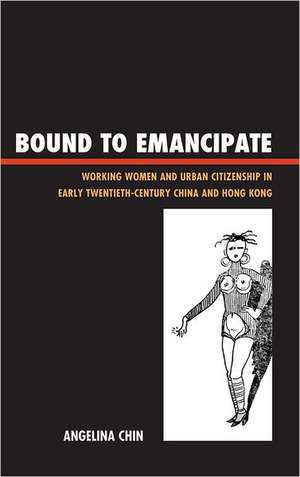
Bound to Emancipate: Working Women and Urban Citizenship in Early Twentieth-Century China and Hong Kong: Asia/Pacific/Perspectives
Autor Angelina Chinen Limba Engleză Hardback – 29 mar 2012
At the time, the concept of"women's emancipation" was high on the nationalist and modernizing agenda of progressive intellectuals, missionaries, and political activists. The metaphor of freeing an enslaved or bound woman's body was ubiquitous in local discussions and social campaigns in both cities as a way of empowering women to free their bodies and to seek marriage and work opportunities. Nevertheless, the highly visible presence of sexualized lower-class women in the urban space raised disturbing questions in the two modernizing cities about morality and the criteria for urban citizenship. Examining various efforts by the Guangzhou and Hong Kong political participants to regulate women's occupations and public behaviors, Bound to Emancipate shows how the increased visibility of lower-class women and their casual interactions with men in urban South China triggered new concerns about identity, consumption, governance, and mobility in the 1920s and 1930s. Shedding new light on the significance of South China in modern Chinese history, Chin also contributes to our understanding of gender and women's history in China.
Din seria Asia/Pacific/Perspectives
- 39%
 Preț: 101.39 lei
 - 19%
 Preț: 469.67 lei
 - 29%
 Preț: 789.89 lei
 - 23%
 Preț: 264.02 lei
 - 23%
 Preț: 277.28 lei
 - 33%
 Preț: 517.98 lei
 - 24%
 Preț: 366.91 lei
 - 19%
 Preț: 220.85 lei
 - 34%
 Preț: 755.07 lei
 - 13%
 Preț: 141.09 lei
 - 27%
 Preț: 259.10 lei
 - 25%
 Preț: 347.66 lei
 - 33%
 Preț: 354.43 lei
 - 19%
 Preț: 328.98 lei
 - 22%
 Preț: 351.06 lei
 - 23%
 Preț: 260.87 lei
 - 24%
 Preț: 224.32 lei
 - 26%
 Preț: 362.16 lei
 - 22%
 Preț: 265.41 lei
 - 33%
 Preț: 578.84 lei
 - 32%
 Preț: 375.48 lei
 - 29%
 Preț: 347.27 lei
 - 25%
 Preț: 219.27 lei
 - 28%
 Preț: 222.14 lei
 - 33%
 Preț: 577.37 lei
 - 37%
 Preț: 723.68 lei
 - 19%
 Preț: 317.07 lei
 -
 Preț: 352.86 lei
 - 33%
 Preț: 792.68 lei
 - 34%
 Preț: 356.01 lei
 - 33%
 Preț: 357.65 lei
 - 36%
 Preț: 677.08 lei
 - 23%
 Preț: 323.49 lei
 - 37%
 Preț: 659.03 lei
 - 19%
 Preț: 313.48 lei
 - 34%
 Preț: 354.88 lei
Preț: 717.63 lei
Preț vechi: 1151.34 lei
-38%
Puncte Express: 1076
Carte tipărită la comandă
Livrare economică 08-22 decembrie
Livrare prin curier în România Termenul estimat este afișat lângă disponibilitate.
Transport gratuit pentru acest produs Plată online sau ramburs, în funcție de opțiunile comenzii.
Retur gratuit în 14 zile Comandă securizată și suport în română.
Specificații
ISBN-13: 9781442215597
ISBN-10: 1442215593
Pagini: 279
Ilustrații: 1
Dimensiuni: 161 x 238 x 27 mm
Greutate: 0.62 kg
Editura: Bloomsbury Publishing
Colecția Rowman & Littlefield
Seria Asia/Pacific/Perspectives
Locul publicării:New York, United States
ISBN-10: 1442215593
Pagini: 279
Ilustrații: 1
Dimensiuni: 161 x 238 x 27 mm
Greutate: 0.62 kg
Editura: Bloomsbury Publishing
Colecția Rowman & Littlefield
Seria Asia/Pacific/Perspectives
Locul publicării:New York, United States
Cuprins
Chapter 1: Introduction: Geographies of Emancipation
Chapter 2: British Colonialism and Regulating Women in Hong Kong
Chapter 3: Emancipating Women from Social Customs (Fengsu) in 1920s Guangzhou
Chapter 4: Nüling and Nü Zhaodai in 1920s and 1930s Guangzhou and Hong Kong
Chapter 5: The Fenghua Protection Movement in Guangzhou, 1929-1935
Chapter 6: Social Control through Charity: The Role of the Hong Kong Po Leung Kuk in the 1930s
Chapter 7: Testimonies from the Po Leung Kuk
Chapter 8: Women Service Workers and Labor Activism
Conclusion: Lower-Class Women, "Emancipation," and Urban Citizenship
Glossary
Works Cited
Chapter 2: British Colonialism and Regulating Women in Hong Kong
Chapter 3: Emancipating Women from Social Customs (Fengsu) in 1920s Guangzhou
Chapter 4: Nüling and Nü Zhaodai in 1920s and 1930s Guangzhou and Hong Kong
Chapter 5: The Fenghua Protection Movement in Guangzhou, 1929-1935
Chapter 6: Social Control through Charity: The Role of the Hong Kong Po Leung Kuk in the 1930s
Chapter 7: Testimonies from the Po Leung Kuk
Chapter 8: Women Service Workers and Labor Activism
Conclusion: Lower-Class Women, "Emancipation," and Urban Citizenship
Glossary
Works Cited
Recenzii
This well-written, thoughtfully researched book presents new insights on the meaning of 'women's emancipation' from a comparative, gender, and regional perspective during a particular era. The volume's comparative use, in regional context, of its documentary and secondary sources makes for a refreshing approach to this issue.
Careful attention to language marks this thoughtful study of lower-class women in 1920s and 1930s South China. Chin (Pomona College) analyzes how social commentators discussed the project of 'emancipating' (jiefang) women in revolutionary Guangzhou and compares that to the discourse of protection of helpless females in British-controlled Hong Kong. A range of occupations was available to poor women, primarily in various forms of service. In Guangzhou, emancipation was expected to lead to service to the nation; women were to bind themselves to the ideals of patriotic citizenship. Service workers, however, found gaining recognition within the labor movement difficult. In Hong Kong, the colonial government sought to regulate women's roles to promote social order. The colony's Chinese elite responded with their own ideas of charity for unattached females, including the famous Po Leung Kuk (Society for the Protection of Women and Children). Chin includes a chapter of 'testimony' from women admitted to the Po Leung Kuk, who were routinely interviewed by the staff. This part of the book is a helpful addition to Maria Jaschok's pioneering work Concubines and Bondservants: A Social History (CH, Sep'89, 27-0452). Summing Up: Recommended.
In this energetically written and carefully researched study, Angelina Chin makes clear how indispensable women's labor in its various forms was to the political economy, reform culture, and global aspiration of early twentieth-century China. By placing mui tsai in the context of both economic struggle and debates about emancipation and citizenship, she offers a nuanced, though never facile, history of women's agency as a crucial dimension of national and imperial histories. This is history from below with women, work, and mobility at the center-a tremendous feat-and it should draw students of the urban, the regional, and the global who care about the complexities of China's ascendancy and the 'small' stories of resistance to it.
Angelina Chin's richly textured study of lower-class women-from blind singers to teahouse waitresses-in 1920s and 1930s South China raises complex and important questions about the meaning of 'women's emancipation,' revealing the ambivalent attitudes of Chinese social reformers toward the sexualized working women they were aiming to emancipate. This fascinating, deeply researched book should be required reading for anyone interested in global feminism and its localized histories.
Careful attention to language marks this thoughtful study of lower-class women in 1920s and 1930s South China. Chin (Pomona College) analyzes how social commentators discussed the project of 'emancipating' (jiefang) women in revolutionary Guangzhou and compares that to the discourse of protection of helpless females in British-controlled Hong Kong. A range of occupations was available to poor women, primarily in various forms of service. In Guangzhou, emancipation was expected to lead to service to the nation; women were to bind themselves to the ideals of patriotic citizenship. Service workers, however, found gaining recognition within the labor movement difficult. In Hong Kong, the colonial government sought to regulate women's roles to promote social order. The colony's Chinese elite responded with their own ideas of charity for unattached females, including the famous Po Leung Kuk (Society for the Protection of Women and Children). Chin includes a chapter of 'testimony' from women admitted to the Po Leung Kuk, who were routinely interviewed by the staff. This part of the book is a helpful addition to Maria Jaschok's pioneering work Concubines and Bondservants: A Social History (CH, Sep'89, 27-0452). Summing Up: Recommended.
In this energetically written and carefully researched study, Angelina Chin makes clear how indispensable women's labor in its various forms was to the political economy, reform culture, and global aspiration of early twentieth-century China. By placing mui tsai in the context of both economic struggle and debates about emancipation and citizenship, she offers a nuanced, though never facile, history of women's agency as a crucial dimension of national and imperial histories. This is history from below with women, work, and mobility at the center-a tremendous feat-and it should draw students of the urban, the regional, and the global who care about the complexities of China's ascendancy and the 'small' stories of resistance to it.
Angelina Chin's richly textured study of lower-class women-from blind singers to teahouse waitresses-in 1920s and 1930s South China raises complex and important questions about the meaning of 'women's emancipation,' revealing the ambivalent attitudes of Chinese social reformers toward the sexualized working women they were aiming to emancipate. This fascinating, deeply researched book should be required reading for anyone interested in global feminism and its localized histories.