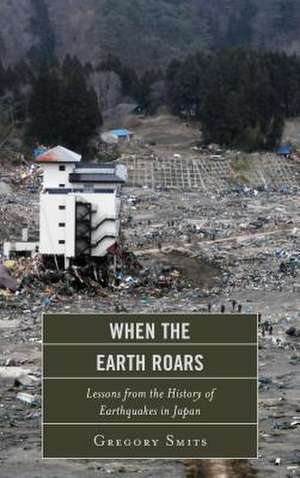
When the Earth Roars: Lessons from the History of Earthquakes in Japan: Asia/Pacific/Perspectives
Autor Gregory Smitsen Limba Engleză Paperback – 10 noi 2017
Din seria Asia/Pacific/Perspectives
- 39%
 Preț: 101.39 lei
 - 19%
 Preț: 469.67 lei
 - 29%
 Preț: 789.89 lei
 - 23%
 Preț: 264.02 lei
 - 23%
 Preț: 277.28 lei
 - 33%
 Preț: 517.98 lei
 - 24%
 Preț: 366.91 lei
 - 34%
 Preț: 755.07 lei
 - 14%
 Preț: 139.68 lei
 - 27%
 Preț: 259.10 lei
 - 25%
 Preț: 347.66 lei
 - 33%
 Preț: 354.43 lei
 - 19%
 Preț: 328.98 lei
 - 22%
 Preț: 351.06 lei
 - 23%
 Preț: 260.87 lei
 - 24%
 Preț: 224.32 lei
 - 26%
 Preț: 362.16 lei
 - 22%
 Preț: 265.41 lei
 - 33%
 Preț: 578.84 lei
 - 32%
 Preț: 375.48 lei
 - 29%
 Preț: 347.27 lei
 - 25%
 Preț: 219.27 lei
 - 28%
 Preț: 222.14 lei
 - 33%
 Preț: 577.37 lei
 - 38%
 Preț: 717.63 lei
 - 37%
 Preț: 723.68 lei
 - 19%
 Preț: 317.07 lei
 -
 Preț: 352.86 lei
 - 33%
 Preț: 792.68 lei
 - 34%
 Preț: 356.01 lei
 - 33%
 Preț: 357.65 lei
 - 36%
 Preț: 677.08 lei
 - 23%
 Preț: 323.49 lei
 - 37%
 Preț: 659.03 lei
 - 19%
 Preț: 313.48 lei
 - 34%
 Preț: 354.88 lei
Preț: 220.85 lei
Preț vechi: 273.32 lei
-19%
Puncte Express: 331
Carte tipărită la comandă
Livrare economică 30 noiembrie-14 decembrie
Livrare prin curier în România Termenul estimat este afișat lângă disponibilitate.
Transport gratuit de la 400.00 lei Plată online sau ramburs, în funcție de opțiunile comenzii.
Retur gratuit în 14 zile Comandă securizată și suport în română.
Specificații
ISBN-13: 9780810895577
ISBN-10: 0810895579
Pagini: 226
Ilustrații: 8 b/w illustrations; 3 b/w photos;
Dimensiuni: 151 x 230 x 17 mm
Greutate: 0.34 kg
Editura: Bloomsbury Publishing
Colecția Rowman & Littlefield
Seria Asia/Pacific/Perspectives
Locul publicării:New York, United States
ISBN-10: 0810895579
Pagini: 226
Ilustrații: 8 b/w illustrations; 3 b/w photos;
Dimensiuni: 151 x 230 x 17 mm
Greutate: 0.34 kg
Editura: Bloomsbury Publishing
Colecția Rowman & Littlefield
Seria Asia/Pacific/Perspectives
Locul publicării:New York, United States
Cuprins
Introduction
Chapter 1: Setting the Stage
Chapter 2: Early Modern Earthquakes and Their Modern Relevance
Chapter 3: Nobi and Great Kanto
Chapter 4: Prewar Tsunamigenic Earthquakes in the Northeast
Chapter 5: Prediction to Forecasting: Attempting to Outsmart the Earth in Postwar Japan
Chapter 6: Conclusions
Glossary of Terms and Entities
Bibliography
Chapter 1: Setting the Stage
Chapter 2: Early Modern Earthquakes and Their Modern Relevance
Chapter 3: Nobi and Great Kanto
Chapter 4: Prewar Tsunamigenic Earthquakes in the Northeast
Chapter 5: Prediction to Forecasting: Attempting to Outsmart the Earth in Postwar Japan
Chapter 6: Conclusions
Glossary of Terms and Entities
Bibliography
Recenzii
Smits offers a very well-written and insightful study of the eternal quest to create and validate the shaky science of earthquake prediction. Basing his book on an analysis of major earthquakes in Japan over the last 200 years, including the earthquake and tsunami of 3/11, the author concludes that it is impossible to predict them (neither their timing nor location). He bases this conclusion on an easily understandable description of the geology of earthquakes. Unfortunately, the resources of government and the scientific community, particularly in Japan, are fixated on this misguided task; in the postwar era, this effort has shifted from 'predicting' to 'forecasting.' Smits argues that great benefits can accrue by using earthquakes and their results as precedents and guideposts to instead focus resources on mitigating their social and economic impact. For example, lessons from earlier earthquakes in the Tohoku region of Japan might very well have reduced the impact of the disastrous 3/11 events. This valuable, persuasive, and very readable study will appeal to all interested in the history of modern Japan, the history of earthquakes in Japan, and the science of seismology. Summing Up: Essential. All levels.
Deeply researched and easily readable. . . .Anyone with a serious interest in Japanese earthquakes should read [this book].
Smits's research both draws and supports important conclusions about the impact of earthquakes and tsunamis on Japanese life, property, and culture. The first is that seismic events cannot be predicted, and the second is that such an ability is currently nowhere on the horizon. The third is that memories are short, and the willingness to return to tsunami-prone regions is strong, due to a disbelief that the event will recur.
When the Earth Roars is an excellent guide to the history of earthquakes in Japan that focuses on how these seismic events become what are termed natural disasters. . . .Smits warns that people have unrealistic expectations of science and the state to protect them from natural hazards. He argues persuasively that residents and officials should focus on mitigating the impact of devastating earthquakes, citing strict seismic building codes and innovative engineering as a far better use of funding than seismic forecasting. He closes this excellent book by warning that the Pacific Northwest of North America will experience a massive tsunami following a subduction quake in the Pacific, making this essential reading for residents and policymakers in that region.
When the Earth Roars constitute[s] a provocative addition to the study of earthquakes in Japan.
This wise and readable study brings reason to the questions of what we can know about the volatile earth, what the historical record can teach us, and what we can and cannot predict. When the Earth Roars is an important book that should be read widely.
Deeply researched and easily readable. . . .Anyone with a serious interest in Japanese earthquakes should read [this book].
Smits's research both draws and supports important conclusions about the impact of earthquakes and tsunamis on Japanese life, property, and culture. The first is that seismic events cannot be predicted, and the second is that such an ability is currently nowhere on the horizon. The third is that memories are short, and the willingness to return to tsunami-prone regions is strong, due to a disbelief that the event will recur.
When the Earth Roars is an excellent guide to the history of earthquakes in Japan that focuses on how these seismic events become what are termed natural disasters. . . .Smits warns that people have unrealistic expectations of science and the state to protect them from natural hazards. He argues persuasively that residents and officials should focus on mitigating the impact of devastating earthquakes, citing strict seismic building codes and innovative engineering as a far better use of funding than seismic forecasting. He closes this excellent book by warning that the Pacific Northwest of North America will experience a massive tsunami following a subduction quake in the Pacific, making this essential reading for residents and policymakers in that region.
When the Earth Roars constitute[s] a provocative addition to the study of earthquakes in Japan.
This wise and readable study brings reason to the questions of what we can know about the volatile earth, what the historical record can teach us, and what we can and cannot predict. When the Earth Roars is an important book that should be read widely.