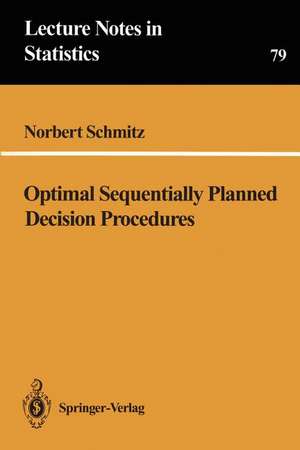
Optimal Sequentially Planned Decision Procedures: Lecture Notes in Statistics, cartea 79
Autor Norbert Schmitzen Limba Engleză Paperback – 28 oct 1992
Din seria Lecture Notes in Statistics
-
 Preț: 477.59 lei
 - 18%
 Preț: 1236.28 lei
 - 18%
 Preț: 947.14 lei
 - 15%
 Preț: 643.38 lei
 - 18%
 Preț: 891.96 lei
 -
 Preț: 367.52 lei
 - 15%
 Preț: 608.90 lei
 - 15%
 Preț: 611.12 lei
 -
 Preț: 378.78 lei
 - 15%
 Preț: 635.22 lei
 - 15%
 Preț: 640.80 lei
 - 15%
 Preț: 673.53 lei
 - 15%
 Preț: 646.18 lei
 - 15%
 Preț: 617.80 lei
 - 15%
 Preț: 648.75 lei
 -
 Preț: 367.85 lei
 - 15%
 Preț: 611.74 lei
 - 15%
 Preț: 651.89 lei
 -
 Preț: 364.92 lei
 - 18%
 Preț: 848.72 lei
 - 15%
 Preț: 609.85 lei
 - 15%
 Preț: 623.70 lei
 -
 Preț: 364.56 lei
 - 18%
 Preț: 783.75 lei
 - 15%
 Preț: 616.45 lei
 - 18%
 Preț: 1059.82 lei
 - 15%
 Preț: 618.34 lei
 -
 Preț: 369.19 lei
 - 15%
 Preț: 613.36 lei
 - 18%
 Preț: 946.75 lei
 - 15%
 Preț: 654.41 lei
 - 15%
 Preț: 650.18 lei
 - 5%
 Preț: 721.02 lei
 - 15%
 Preț: 641.11 lei
 - 15%
 Preț: 607.49 lei
 - 5%
 Preț: 784.54 lei
 -
 Preț: 401.66 lei
 - 15%
 Preț: 617.39 lei
 - 18%
 Preț: 695.39 lei
 -
 Preț: 374.60 lei
 - 15%
 Preț: 639.64 lei
 - 18%
 Preț: 904.67 lei
 - 15%
 Preț: 613.15 lei
 - 15%
 Preț: 639.02 lei
 -
 Preț: 376.77 lei
 - 15%
 Preț: 646.40 lei
 -
 Preț: 367.04 lei
 - 15%
 Preț: 651.67 lei
 - 15%
 Preț: 612.99 lei
Preț: 609.96 lei
Preț vechi: 717.59 lei
-15%
Puncte Express: 915
Carte tipărită la comandă
Livrare economică 19 noiembrie-03 decembrie
Livrare prin curier în România Termenul estimat este afișat lângă disponibilitate.
Transport gratuit pentru acest produs Plată online sau ramburs, în funcție de opțiunile comenzii.
Retur gratuit în 14 zile Comandă securizată și suport în română.
Specificații
ISBN-13: 9780387979083
ISBN-10: 0387979085
Pagini: 228
Ilustrații: XII, 207 p.
Dimensiuni: 155 x 235 x 13 mm
Greutate: 0.35 kg
Editura: Springer
Colecția Lecture Notes in Statistics
Seria Lecture Notes in Statistics
Locul publicării:New York, NY, United States
ISBN-10: 0387979085
Pagini: 228
Ilustrații: XII, 207 p.
Dimensiuni: 155 x 235 x 13 mm
Greutate: 0.35 kg
Editura: Springer
Colecția Lecture Notes in Statistics
Seria Lecture Notes in Statistics
Locul publicării:New York, NY, United States
V-ar putea interesa
-
 Probability Through ProblemsMarek Capiński-18%Preț: 1029.18 lei1255.10 lei
 -
 Efficient and Adaptive Estimation for Semiparametric ModelsPeter J. Bickel-20%Preț: 775.81 lei969.76 lei
 -
 Applied Longitudinal AnalysisGarrett M Fitzmaurice-9%Preț: 877.93 lei964.76 lei
 -
 Solutions Manual to Accompany Introduction to Time Series Analysis and ForecastingDouglas C. MontgomeryPreț: 342.08 lei
 -
 Bayesian Analysis of StochastiInsuari-9%Preț: 731.40 lei803.74 lei
 -
 Cluster AnalysisBrian S. Everitt-8%Preț: 596.92 lei648.83 lei
 -
 Latent Variable Models and Factor 3eBartholomew-8%Preț: 585.19 lei636.07 lei
 -
 -15%Preț: 673.47 lei792.32 lei
 -
 -26%Preț: 652.72 lei882.06 lei
 -
 Asymptotic Theory of Statistics and ProbabilityAnirban Dasgupta-15%Preț: 611.34 lei719.22 lei
 -
 Applied Regression AnalysisJohn O. Rawlings-15%Preț: 587.18 lei690.80 lei
 -
 Exercises and Solutions in Biostatistical TheoryLawrence Kupper-15%Preț: 535.41 lei629.89 lei
 -
 Séminaire de Probabilités XLVICatherine Donati-MartinPreț: 405.14 lei
 -
 Probability EssentialsJean Jacod-15%Preț: 459.73 lei540.86 lei
 -
 Concentration Inequalities and Model SelectionPascal Massart-15%Preț: 477.23 lei561.45 lei
 -
 Fluctuations in Markov ProcessesTomasz Komorowski-15%Preț: 655.08 lei770.67 lei
Public țintă
ResearchCuprins
I. Introduction.- § 1 Sequential statistical procedures.- § 2 Objectives of sequential analysis.- § 3 Historical remarks on the development of sequential analysis.- § 4 Examples of sequential procedures; purely sequential statistical decision procedures.- § 5 Objections to purely sequential statistical decision procedures.- § 6 Sequentially planned statistical procedures.- II. Optimal sequential sampling plans.- § 1 Problems of optimal sampling.- § 2 Optimal sampling plans for finite horizon.- § 3 Existence of optimal sampling plans for general A.- § 4 Optimal sampling plans for the Markov case.- III. Sequentially planned tests; sequentially planned probability ratio tests.- § 1 Notation.- § 2 The iid case.- § 3 Sequentially planned probability ratio tests.- § 4 Algorithms for computing the OC- and ASC-function of SPPRT’s in the iid case.- § 5 Remarks on the implementation of the algorithms; Examples.- § 6 Remarks on the comparison of the methods and on convergence-improvements for the BF-/EV- method.- IV. Bayes-optimal sequentially planned decision procedures.- § 1 Introduction.- § 2 Bayes-procedures.- § 3 A posteriori-distributions.- § 4 Bayes-optimal sampling plans; Markov case.- V. Optimal sequentially planned tests under side conditions.- § 1 Decision problems with side conditions.- § 2 Characterizations of optimal sequentially planned decision procedures.- § 3 Sequentially planned tests for simple hypotheses in the iid case.- § 4 The modified Kiefer-Weiss problem in the iid case.- § 5 Locally optimal sequentially planned tests in the dominated iid case.- § 6 Remarks on the monotonicity of the power functions of SPPRT’s and GSPPRT’s.- Appendix A: Mathematical models for sequentially planned sampling procedures.- § A.1 The concept ofpolicies by Mandelbaum and Vanderbei.- § A.2 The concept of tactics by Krengel and Sucheston.- § A.3 The concept of decision functions by Washburn and Willsky.- § A.4 The concept of stopped decision models by Rieder.- Appendix B: Implementation of the algorithms EV, BF and ILE; Diophantine Approximation.- § B.1 Listing of the modules.- § B.2 Diophantine approximation.- Appendix C: References, Bibliography.