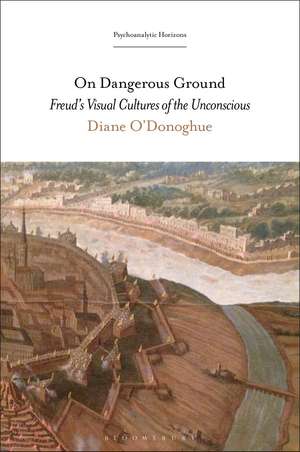
On Dangerous Ground: Freud’s Visual Cultures of the Unconscious: Psychoanalytic Horizons
Autor Dr. Diane O'Donoghueen Limba Engleză Paperback – 30 apr 2020
In the final years of the 19th century, Sigmund Freud began to construct evidence for the workings of an "unconscious." On Dangerous Ground offers an innovative assessment of the complex role that his encounters with visual cultures-architecture, objects from earlier cultural epochs ("antiquities"), paintings, and illustrated books-played in that process. Diane O'Donoghue introduces, often using unpublished archival sources, the ways in which material phenomena profoundly informed Freud's decisions about what would, and would not, constitute the workings of an inner life. By returning to view content that Freud treated as forgettable, as distinct from repressed, O'Donoghue shows us a realm of experiences that Freud wished to remove from psychical meaning. These erasures form an amnesic core within Freud's psychoanalytic project, an absence that includes difficult aspects of his life narrative, beginning with the dislocations of his early childhood that he declared "not worth remembering." What is made visible here is far from the inconsequential surface of experience; rather, we are shown a dangerous ground that exceeds the limits of what Freud wished to include within his early model of mind. In Freud's relation to visual cultures we find clues to what he attempted, in crafting his unconscious, to remove from sight.
Din seria Psychoanalytic Horizons
- 11%
 Preț: 159.88 lei
 - 16%
 Preț: 147.99 lei
 - 26%
 Preț: 130.87 lei
 - nou
 Preț: 161.13 lei
 - 17%
 Preț: 157.73 lei
 - 16%
 Preț: 170.67 lei
 - 75%
 Preț: 128.50 lei
 - 33%
 Preț: 107.03 lei
 - 25%
 Preț: 239.73 lei
 - 25%
 Preț: 207.73 lei
 - 15%
 Preț: 132.70 lei
 - 25%
 Preț: 239.04 lei
 - 20%
 Preț: 162.30 lei
 - 20%
 Preț: 164.50 lei
 - 15%
 Preț: 165.88 lei
 - 26%
 Preț: 210.56 lei
 - 11%
 Preț: 426.10 lei
 - 40%
 Preț: 211.06 lei
 - 25%
 Preț: 242.31 lei
 - 24%
 Preț: 234.30 lei
 - 7%
 Preț: 168.83 lei
 - 23%
 Preț: 236.74 lei
 - 26%
 Preț: 206.09 lei
 - 33%
 Preț: 580.87 lei
 - 26%
 Preț: 210.58 lei
 - 26%
 Preț: 214.41 lei
 - 24%
 Preț: 234.41 lei
Preț: 244.70 lei
Preț vechi: 323.39 lei
-24%
Puncte Express: 367
Carte tipărită la comandă
Livrare economică 21 noiembrie-05 decembrie
Livrare prin curier în România Termenul estimat este afișat lângă disponibilitate.
Transport gratuit de la 400.00 lei Plată online sau ramburs, în funcție de opțiunile comenzii.
Retur gratuit în 14 zile Comandă securizată și suport în română.
Specificații
ISBN-13: 9781501363047
ISBN-10: 1501363042
Pagini: 400
Ilustrații: 40 bw illus
Dimensiuni: 140 x 216 x 25 mm
Greutate: 0.46 kg
Editura: Bloomsbury Publishing
Colecția Bloomsbury Academic
Seria Psychoanalytic Horizons
Locul publicării:New York, United States
ISBN-10: 1501363042
Pagini: 400
Ilustrații: 40 bw illus
Dimensiuni: 140 x 216 x 25 mm
Greutate: 0.46 kg
Editura: Bloomsbury Publishing
Colecția Bloomsbury Academic
Seria Psychoanalytic Horizons
Locul publicării:New York, United States
V-ar putea interesa
-
 The Interpretation of DreamsSigmund FreudPreț: 28.01 lei
 -
 The Essentials of Psycho-AnalysisSigmund Freud-17%Preț: 91.12 lei109.90 lei
 -
 The Examined LifeStephen Grosz-37%Preț: 57.99 lei92.46 lei
 -
 The UncannySigmund Freud-20%Preț: 62.23 lei77.38 lei
 -
 The UnconsciousSigmund Freud-20%Preț: 56.65 lei70.83 lei
 -
 Interpreting DreamsSigmund Freud-27%Preț: 80.49 lei110.21 lei
 -
 The UncannySigmund FreudPreț: 95.18 lei
 -
 Psychology and ReligionCarl Gustav JungPreț: 130.15 lei
 -
 Totem and TabooSigmund Freud-19%Preț: 36.96 lei45.85 lei
 -
 A People's History of PsychoanalysisFlorent Gabarron-GarciaPreț: 133.46 lei
 -
 The Age of InsightEric Kandel-18%Preț: 321.79 lei391.82 lei
 -
 -28%Preț: 65.88 lei91.00 lei
 -
 Dream PsychologySigmund FreudPreț: 40.46 lei
 -
 The Interpretation of Dreams (Concise Edition)Sigmund Freud-32%Preț: 48.57 lei71.53 lei
 -
 Freud and the Non-EuropeanEdward W. SaidPreț: 69.95 lei
 -
 Introducing FreudRichard AppignanesiPreț: 63.27 lei
 -
 A Non-Oedipal Psychoanalysis?Philippe Van HautePreț: 371.44 lei
 -
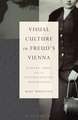
 Visual Culture in Freud's Vienna: Science, Eros, and the Psychoanalytic ImaginationProfessor Emerita Mary Bergstein-20%Preț: 162.30 lei202.18 lei
Cuprins
List of Illustrations
Acknowledgements
Introduction
Chapter One: The Lost Language of Stones
Chapter Two: Phantasmal Fragments
Chapter Three: Libido Awakened: In Transit and Enframed
Chapter Four: The Painting of Everyday Life
Chapter Five: Paper Dreams: Illustrated Books and the Magic of the Manifest
Conclusion: Objects' Lessons
Afterword
Bibliography
Index
Acknowledgements
Introduction
Chapter One: The Lost Language of Stones
Chapter Two: Phantasmal Fragments
Chapter Three: Libido Awakened: In Transit and Enframed
Chapter Four: The Painting of Everyday Life
Chapter Five: Paper Dreams: Illustrated Books and the Magic of the Manifest
Conclusion: Objects' Lessons
Afterword
Bibliography
Index
Recenzii
Diane O'Donoghue's On Dangerous Ground: Freud's Visual Cultures of the Unconscious is an original contribution to the study of psychoanalysis and our visual world. The wide range of images from Freud's world shows us how wide and deep his visual world impacted on his writing and thinking. Focussing on Freud's emphasis on visualization as a core element of the unconscious, O'Donoghue's work actually illustrates how each and every one of us incorporates our visual context, real or virtual, into the articulation of our desires. We are in complex ways what we see and thus how we dream and how we imagine ourselves. A strong, readable and compelling book!
In this startlingly brilliant, original and deeply researched book, Diane O'Donoghue presents an entirely new way of understanding Freud--indeed, of writing intellectual history. She examines examples of art and architecture in Freud's life and links his complex aesthetic responses and insights to his developing psychoanalytic theory. This remarkable book is a landmark and an absolutely indispensable understanding of Freud.
This is a bold and imaginative exploration of the interplay not just between visual culture and Freudian psychoanalysis, but of Freud's personal Dingwelt and its role the complex genesis of his theorization of the unconscious. In a field as trampled as Freudian biography, O'Donoghue has managed to take a refreshingly different approach that argues for a whole new way of thinking with, through, and about things-from whole buildings and railway lines to specific books and tiny artifacts. She arrives at a new vision of how Freud's thinking about the unconscious converges around experiences, places, and objects that threaded through his life's trajectory. This is a deep dive into some of the most essential questions surrounding Freud's creation of psychoanalysis, and rewards the reader throughout with ways of reframing Freud's life and writings. Fruit of a long labor of preparation, this is a work of committed and critical scholarship, and merits careful consideration.
In this startlingly brilliant, original and deeply researched book, Diane O'Donoghue presents an entirely new way of understanding Freud--indeed, of writing intellectual history. She examines examples of art and architecture in Freud's life and links his complex aesthetic responses and insights to his developing psychoanalytic theory. This remarkable book is a landmark and an absolutely indispensable understanding of Freud.
This is a bold and imaginative exploration of the interplay not just between visual culture and Freudian psychoanalysis, but of Freud's personal Dingwelt and its role the complex genesis of his theorization of the unconscious. In a field as trampled as Freudian biography, O'Donoghue has managed to take a refreshingly different approach that argues for a whole new way of thinking with, through, and about things-from whole buildings and railway lines to specific books and tiny artifacts. She arrives at a new vision of how Freud's thinking about the unconscious converges around experiences, places, and objects that threaded through his life's trajectory. This is a deep dive into some of the most essential questions surrounding Freud's creation of psychoanalysis, and rewards the reader throughout with ways of reframing Freud's life and writings. Fruit of a long labor of preparation, this is a work of committed and critical scholarship, and merits careful consideration.
Notă biografică
Diane O'Donoghue is a visual and cultural historian who directs the Program for Public Humanities at the Jonathan M. Tisch College for Civic Life at Tufts University, USA, where she is also the Senior Fellow for the Humanities and has served as chair of the University's Department of Visual and Critical Studies. She is a scholar member and on the faculty of the Boston Psychoanalytic Society and Institute, on the editorial board of American Imago, and has been the recipient of the CORST Prize from the American Psychoanalytic Association, the Sigmund Freud/Fulbright Scholar for Psychoanalysis award at the University of Vienna and the Freud Museum, and an Erikson Scholar fellowship.