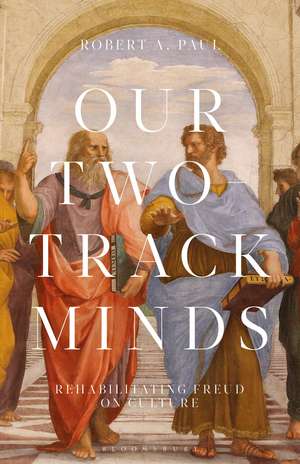
Our Two-Track Minds: Rehabilitating Freud on Culture: Psychoanalytic Horizons
Autor Professor or Dr. Robert A. Paulen Limba Engleză Paperback – 14 ian 2021
Robert A. Paul shows that Freud's ideas in these books, and his thinking on how human society is possible, given the unpromising materials out of which it is constructed (i.e. human beings), can appear in a different and more favorable light when viewed through the lens of contemporary anthropology, cultural studies, and evolutionary theory.
Din seria Psychoanalytic Horizons
- 11%
 Preț: 159.88 lei
 - 16%
 Preț: 147.99 lei
 - 26%
 Preț: 130.87 lei
 - nou
 Preț: 161.13 lei
 - 17%
 Preț: 157.73 lei
 - 16%
 Preț: 170.67 lei
 - 75%
 Preț: 128.50 lei
 - 33%
 Preț: 107.03 lei
 - 25%
 Preț: 239.73 lei
 - 25%
 Preț: 207.73 lei
 - 15%
 Preț: 132.70 lei
 - 25%
 Preț: 239.04 lei
 - 20%
 Preț: 162.30 lei
 - 20%
 Preț: 164.50 lei
 - 26%
 Preț: 210.56 lei
 - 11%
 Preț: 426.10 lei
 - 40%
 Preț: 211.06 lei
 - 25%
 Preț: 242.31 lei
 - 24%
 Preț: 234.30 lei
 - 7%
 Preț: 168.83 lei
 - 23%
 Preț: 236.74 lei
 - 26%
 Preț: 206.09 lei
 - 24%
 Preț: 244.70 lei
 - 33%
 Preț: 580.87 lei
 - 26%
 Preț: 210.58 lei
 - 26%
 Preț: 214.41 lei
 - 24%
 Preț: 234.41 lei
Preț: 165.88 lei
Preț vechi: 194.61 lei
-15%
Puncte Express: 249
Carte tipărită la comandă
Livrare economică 20 noiembrie-04 decembrie
Livrare prin curier în România Termenul estimat este afișat lângă disponibilitate.
Transport gratuit de la 400.00 lei Plată online sau ramburs, în funcție de opțiunile comenzii.
Retur gratuit în 14 zile Comandă securizată și suport în română.
Specificații
ISBN-13: 9781501370038
ISBN-10: 1501370030
Pagini: 232
Dimensiuni: 136 x 214 x 16 mm
Greutate: 0.36 kg
Editura: Bloomsbury Publishing
Colecția Bloomsbury Academic
Seria Psychoanalytic Horizons
Locul publicării:New York, United States
ISBN-10: 1501370030
Pagini: 232
Dimensiuni: 136 x 214 x 16 mm
Greutate: 0.36 kg
Editura: Bloomsbury Publishing
Colecția Bloomsbury Academic
Seria Psychoanalytic Horizons
Locul publicării:New York, United States
Cuprins
Introduction: The Stream and the Road
Part I. DROSS INTO GOLD: Recuperating Freud's Social Theory
1. Freud's Theory of Society
2. Biology and Culture in Civilization and Its Discontents
3. Yes, the Primal Crime Did Take Place
PART II. LIKE RABBITS OR LIKE ROBOTS? Sexual versus Non-Sexual Reproduction in the Western Tradition
4. The Genealogy of Civilization
5. Sons or Sonnets?
6. The Pygmalion Complex
PART III. OUR TWO TRACK-MINDS: A Dual Inheritance Perspective on Some Classic Psychoanalytic Issues
7. Incest Avoidance: Oedipal and Preoedipal, Natural and Cultural
8. Sexuality: Biological Fact or Cultural Construction?
9. Consciousness, Language, and Dual Inheritance
References
Index
Part I. DROSS INTO GOLD: Recuperating Freud's Social Theory
1. Freud's Theory of Society
2. Biology and Culture in Civilization and Its Discontents
3. Yes, the Primal Crime Did Take Place
PART II. LIKE RABBITS OR LIKE ROBOTS? Sexual versus Non-Sexual Reproduction in the Western Tradition
4. The Genealogy of Civilization
5. Sons or Sonnets?
6. The Pygmalion Complex
PART III. OUR TWO TRACK-MINDS: A Dual Inheritance Perspective on Some Classic Psychoanalytic Issues
7. Incest Avoidance: Oedipal and Preoedipal, Natural and Cultural
8. Sexuality: Biological Fact or Cultural Construction?
9. Consciousness, Language, and Dual Inheritance
References
Index
Recenzii
Based on his dual inheritance theory, Robert Paul provides us with an excellent integration of contemporary psychoanalytic thinking, evolutionary theory, and cultural anthropology, without minimizing the contributions of each of them. This thought-provoking book shows ways to bridge the gap between the disciplines and how this opens up new insights and approaches for psychoanalytic theory-building.