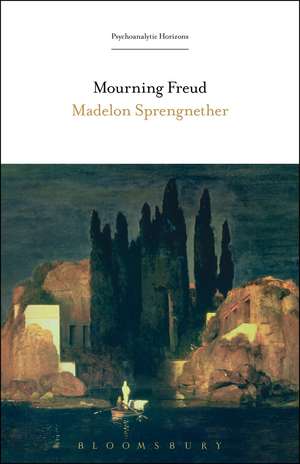
Mourning Freud: Psychoanalytic Horizons
Autor Professor Madelon Sprengnetheren Limba Engleză Paperback – 8 feb 2018
The modernist Freud of the early 20th century has ceded to the postmodern Freud of the 21st. Madelon Sprengnether examines this phenomenon from the perspective of Freud's self-analysis in relation to his generation of theory, the challenges and transformations wrought by feminism, cultural studies and postmodernism, and the speculations of contemporary neuroscience concerning the unreliability of memory. She offers a significant interpretation of major biographical episodes in Freud's life, arguing that Freud's inability to mourn the losses of his early life shaped his theories of mourning, which in turn opened the field of pre-oedipal studies to his successors, enabling a host of new psychoanalytic theories such as object relations, intersubjective and countertransference theories, Lacanian analysis, and trauma theory. Many of these approaches converge on the formulation of mourning as critical to the process of ego development. Through this argument, Sprengnether traces the shift from modernism to postmodernism-from an emphasis on mastery to vulnerability, from vertical to horizontal systems of meaning-making, and from what is representable in words to the realm of the nonverbal.
Mourning Freud, by exploring Freud's own struggles with mourning, allows us, in turn, to mourn him-releasing him from frozen idealization while demonstrating the relevance of his work to the 21st century.
Din seria Psychoanalytic Horizons
- 11%
 Preț: 159.88 lei
 - 16%
 Preț: 147.99 lei
 - 26%
 Preț: 130.87 lei
 - nou
 Preț: 161.13 lei
 - 17%
 Preț: 157.73 lei
 - 16%
 Preț: 170.67 lei
 - 75%
 Preț: 128.50 lei
 - 33%
 Preț: 107.03 lei
 - 25%
 Preț: 239.73 lei
 - 15%
 Preț: 132.70 lei
 - 25%
 Preț: 239.04 lei
 - 20%
 Preț: 162.30 lei
 - 20%
 Preț: 164.50 lei
 - 15%
 Preț: 165.88 lei
 - 26%
 Preț: 210.56 lei
 - 11%
 Preț: 426.10 lei
 - 40%
 Preț: 211.06 lei
 - 25%
 Preț: 242.31 lei
 - 24%
 Preț: 234.30 lei
 - 7%
 Preț: 168.83 lei
 - 23%
 Preț: 236.74 lei
 - 26%
 Preț: 206.09 lei
 - 24%
 Preț: 244.70 lei
 - 33%
 Preț: 580.87 lei
 - 26%
 Preț: 210.58 lei
 - 26%
 Preț: 214.41 lei
 - 24%
 Preț: 234.41 lei
Preț: 207.73 lei
Preț vechi: 275.69 lei
-25%
Puncte Express: 312
Carte disponibilă
Livrare economică 30 octombrie-13 noiembrie
Livrare prin curier în România Termenul estimat este afișat lângă disponibilitate.
Transport gratuit de la 400.00 lei Plată online sau ramburs, în funcție de opțiunile comenzii.
Retur gratuit în 14 zile Comandă securizată și suport în română.
Specificații
ISBN-13: 9781501327995
ISBN-10: 1501327992
Pagini: 288
Dimensiuni: 140 x 216 x 27 mm
Greutate: 0.39 kg
Editura: Bloomsbury Publishing
Colecția Bloomsbury Academic
Seria Psychoanalytic Horizons
Locul publicării:New York, United States
ISBN-10: 1501327992
Pagini: 288
Dimensiuni: 140 x 216 x 27 mm
Greutate: 0.39 kg
Editura: Bloomsbury Publishing
Colecția Bloomsbury Academic
Seria Psychoanalytic Horizons
Locul publicării:New York, United States
Cuprins
Preface
Acknowledgments
Introduction: Insight and Blindness
Biography and Theory
1: Reading Freud's Life
2: Mourning Freud
3: Freud, Irma, and the Dream of Psychoanalysis
Transitions
4: Undoing Incest
5: Freud as Memoirist
6: Literature and Psychoanalysis
Ghosts and Ancestors
7: Reflections on Melancholia and Mourning
Conclusion
Bibliography
Index
Acknowledgments
Introduction: Insight and Blindness
Biography and Theory
1: Reading Freud's Life
2: Mourning Freud
3: Freud, Irma, and the Dream of Psychoanalysis
Transitions
4: Undoing Incest
5: Freud as Memoirist
6: Literature and Psychoanalysis
Ghosts and Ancestors
7: Reflections on Melancholia and Mourning
Conclusion
Bibliography
Index
Recenzii
Neither a Freud idealizer nor a Freud basher, Sprengnether offers an intriguing discussion of one of the major areas of psychoanalytic theory ... Sprengnether is well qualified to undertake this ambitious project . Sprengnether, well versed in psychoanalysis, deconstructionism, and feminism, brings to Freudian studies an uncommon knowledge of 'high theory' and a notable capacity for close reading ... [A] valuable addition to the vast scholarship on a man who continues to disturb the world's peace. The scholarly footnotes are fascinating, revealing not only Sprengnether's erudition but also her generosity in paying tribute to scholars who have influenced her thinking.
Mourning Freud is an important intervention in discussions of psychoanalysis, literature and feminism. The product of a quarter-century of careful and deep thought by a prominent literary and academic figure, it delivers a set of beautifully written analyses of the relationship between psychoanalysis and social issues, mediated through the motif of mourning. In this book, Madelon Sprengnether offers a delicate and immersive experience of rethinking Freudian and post-Freudian theories of intimacy and loss.
Mourning Freud is a beautifully written book in which Sprengnether respectfully, intelligently develops penetrating critiques of Freud's work-particularly in the areas of pre-Oedipal development, mourning, and female psychology-not for the purpose of dismissing Freud, but for the purpose of revising and extending some of his most pivotal ideas. This is a book that leaves the reader feeling that he or she has not simply listened to a writer in the act of thinking; instead, the reader feels that he or she has had the privilege of taking part in a remarkable conversation.
Madelon Sprengnether's The Spectral Mother was one of the essential texts to grow out of the fruitful intersection of feminism, literary theory and psychoanalysis. In this collection of essays, Mourning Freud, she has made another important contribution to the psychoanalytic theory of culture. Sprengnether is to be congratulated for deploying her mastery of the pre-Oedipal turn in psychoanalysis, trauma theory, Freud studies, and neuropsychology to properly mourn Freud-to transform him from 'a ghost into an ancestor.' In so doing, she has not only advanced psychoanalytic discourse beyond the infantile polemics of the Freud Wars, but also helped us to form a more mature picture of the first psychoanalyst as well as of ourselves.
An odyssey of scholarship, Mourning Freud is a beautifully written book. Sprengnether is clear-eyed and compelling.
An important contribution to the recent rethinking on Freudian theoretical concerns, including the place of the literary within theoretical formulations, the relation of the biographical to the analytic, and the possibilities of recasting certain concepts in light of developments in the field since Freud. The essays are part homage and part critique, and must be read as a sustained rethinking of some of the intellectual fulcrum points by which the critics of Freudian theory have positioned their revisions . The book is best suited to scholars addressing Freudian themes. Summing Up: Recommended.
Mourning Freud is an important intervention in discussions of psychoanalysis, literature and feminism. The product of a quarter-century of careful and deep thought by a prominent literary and academic figure, it delivers a set of beautifully written analyses of the relationship between psychoanalysis and social issues, mediated through the motif of mourning. In this book, Madelon Sprengnether offers a delicate and immersive experience of rethinking Freudian and post-Freudian theories of intimacy and loss.
Mourning Freud is a beautifully written book in which Sprengnether respectfully, intelligently develops penetrating critiques of Freud's work-particularly in the areas of pre-Oedipal development, mourning, and female psychology-not for the purpose of dismissing Freud, but for the purpose of revising and extending some of his most pivotal ideas. This is a book that leaves the reader feeling that he or she has not simply listened to a writer in the act of thinking; instead, the reader feels that he or she has had the privilege of taking part in a remarkable conversation.
Madelon Sprengnether's The Spectral Mother was one of the essential texts to grow out of the fruitful intersection of feminism, literary theory and psychoanalysis. In this collection of essays, Mourning Freud, she has made another important contribution to the psychoanalytic theory of culture. Sprengnether is to be congratulated for deploying her mastery of the pre-Oedipal turn in psychoanalysis, trauma theory, Freud studies, and neuropsychology to properly mourn Freud-to transform him from 'a ghost into an ancestor.' In so doing, she has not only advanced psychoanalytic discourse beyond the infantile polemics of the Freud Wars, but also helped us to form a more mature picture of the first psychoanalyst as well as of ourselves.
An odyssey of scholarship, Mourning Freud is a beautifully written book. Sprengnether is clear-eyed and compelling.
An important contribution to the recent rethinking on Freudian theoretical concerns, including the place of the literary within theoretical formulations, the relation of the biographical to the analytic, and the possibilities of recasting certain concepts in light of developments in the field since Freud. The essays are part homage and part critique, and must be read as a sustained rethinking of some of the intellectual fulcrum points by which the critics of Freudian theory have positioned their revisions . The book is best suited to scholars addressing Freudian themes. Summing Up: Recommended.