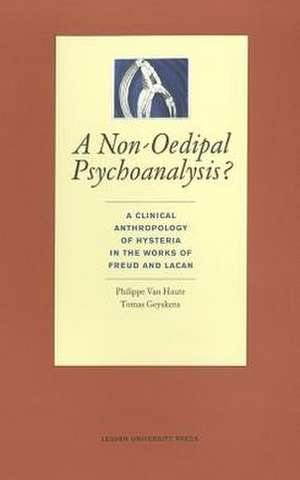
A Non-Oedipal Psychoanalysis?
Autor Philippe Van Haute, Tomas Geyskensen Limba Engleză Paperback – 3 mai 2012
Observăm în ultimele decenii o reevaluare profundă a fundamentelor psihanalizei, o tranziție de la interpretările dogmatice către o interogare a structurilor ontologice care definesc subiectul uman. A Non-Oedipal Psychoanalysis? se înscrie în această mișcare critică, propunând o „antropologie clinică” ce recalibrează înțelegerea isteriei și a condiției umane. Considerăm că miza centrală a autorilor este demonstrarea faptului că, deși Freud și-a început parcursul explorând tensiunea dintre cultură și patologie, introducerea ulterioară a complexului Oedip a fracturat acest proiect antropologic inițial. Apreciem rigoarea cu care Philippe Van Haute și Tomas Geyskens analizează textele lui Freud și Lacan, argumentând că omul este, în esență, o ființă a „între-ului”, un „animal bolnav” a cărui normativitate rămâne imposibil de fixat teoretic. Această perspectivă pato-analitică, prezentă în studiile timpurii despre isterie, oferă o alternativă la structura oedipiană clasică, pe care autorii o consideră restrictivă. Lucrarea completează perspectiva oferită de The Oedipus Complex de Éric Smadja; în timp ce Smadja explorează tensiunile istorice dintre antropologie și psihanaliză prin prisma lucrării „Totem și Tabu”, Van Haute și Geyskens merg mai departe, propunând o deconstrucție a modelului oedipian pentru a salva proiectul antropologic freudian. În contextul operei lor comune, acest volum continuă direcția începută în Confusion of Tongues, aprofundând critica adaptării și a normativității tratată anterior de Van Haute în Against Adaptation. Tonul este unul academic, dens, dar extrem de precis, fiind o lectură esențială pentru cei interesați de fundamentele filozofice ale psihanalizei franceze și de modul în care structurile psihopatologice reflectă, în mod caricatural, esența existenței umane.
Preț: 386.16 lei
Carte disponibilă
Livrare economică 01-15 decembrie
Specificații
ISBN-10: 905867911X
Pagini: 180
Dimensiuni: 162 x 238 x 15 mm
Greutate: 0.34 kg
Editura: Leuven University Press
V-ar putea interesa
-
 The Future of an IllusionSigmund FreudPreț: 55.43 lei
-
 From the Couch to the Lab: Trends in Psychodynamic NeuroscienceAikaterini Fotopoulou-29%Preț: 910.10 lei1290.33 lei
-
 Archetype and CharacterV. Odajnyk-15%Preț: 672.01 lei790.60 lei
-
 The Red BookC G Jung-9%Preț: 1604.62 lei1763.31 lei
-
 Betweenity: A Discussion of the Concept of BorderlineJudy GammelgaardPreț: 445.53 lei
-
 An Experiment in LeisureMarion Milner-5%Preț: 227.08 lei239.04 lei
-
 Preț: 264.02 lei
-
 Eternity's Sunrise: A Way of Keeping a DiaryMarion MilnerPreț: 259.90 lei
-
 On Not Being Able to PaintMarion MilnerPreț: 260.55 lei
-
 Preț: 388.70 lei
-
 Preț: 390.14 lei
-
 Preț: 386.66 lei
-
 Psychoanalysis and Motivational Systems: A New LookJoseph D. LichtenbergPreț: 399.32 lei
-
 Preț: 474.90 lei
-
 Psychoanalysis in a New LightGunnar KarlssonPreț: 293.73 lei
-
 -15%Preț: 282.56 lei330.72 lei
-
 General Introduction to PsychoanalysisSigmund FreudPreț: 45.09 lei
-
 Wolf ManRichard Appignanesi-11%Preț: 93.80 lei105.48 lei
De ce să citești această carte
Recomandăm această carte cercetătorilor și practicienilor care doresc să depășească limitele interpretării oedipiene tradiționale. Cititorul va câștiga o înțelegere nuanțată a isteriei ca structură antropologică și va descoperi cum textele timpurii ale lui Freud pot fundamenta o psihanaliză modernă, non-normativă. Este un instrument teoretic esențial pentru a înțelege de ce sănătatea psihică nu poate fi redusă la o simplă conformitate socială.
Despre autor
Philippe Van Haute este psihanalist practician și profesor de antropologie filozofică la Universitatea din Nijmegen, fiind cunoscut pentru lucrări care chestionează conformismul în psihanaliză, precum Against Adaptation. Tomas Geyskens este doctor în filozofie, membru al Școlii Belgiene de Psihanaliză și autor al lucrării Our Original Scenes. Împreună, cei doi autori formează o echipă de referință în cadrul Centrului pentru Psihanaliză și Antropologie Filozofică, dedicându-și activitatea deconstrucției conceptelor freudiene și lacaniene din perspective interdisciplinare.
Descriere scurtă
This patho-analytic perspective progressively disappears in Freud's texts after 1905. This book reveals the crucial moments of that development. In doing so, it shows clearly not only that Freud introduced the Oedipus complex much later than is usually assumed, but also that the theory of the Oedipus complex is irreconcilable with the project of a clinical anthropology.
The authors not only examine the philosophical meaning of this thesis in the work of Freud. They also examine its avatars in the texts of Jacques Lacan and show how this project of a patho-analysis of existence inevitably obliges us to formulate a non-oedipal psychoanalytic anthropology.
Notă biografică
Cuprins
Table of Contents
Acknowledgements
Introduction
A Clinical Anthropology of Hysteria
Hysteria as a Philosophical Problem
Chapter 1
Between Trauma and Disposition
The Specific Aetiology of Hysteria in Freud's Early Works
Introduction: From Real Trauma to Oedipal Phantasy?
1. Trauma and Disposition in Studies on Hysteria
2. The Seduction Theory
3. After the Theory of Seduction
Conclusion 43
Chapter 2
Dora
Symptom, Trauma and Phantasy in Freud's Analysis of Dora
Introduction
1. Two Traumas
2. The Meaning of Dora's Symptoms
3. The Oedipal Legend in the Case of Dora
4. Bisexuality and its Consequences
Conclusion: Dora's un-Oedipal Desires
Chapter 3
From Day-dream to Novel
On Hysterical Phantasy and Literary Fiction
Introduction: a Disposition towards Literature?
1. Hysterical Phantasying
2. The Novel and Hysteria
3. Sources of Pleasure - the Joke and Literature
Conclusion: The Novel as Sublimation of Hysteria
Chapter 4
The Indifference of a Healthy Lesbian Bisexuality versus the Oedipus Complex
Introduction
1. From Bisexuality to the Oedipus Complex
2. From Oedipus Complex to Bisexuality
Conclusion
Chapter 5
Lacan's Structuralist Rereading of Dora
Introduction
1. Structure versus Psychogenesis
2. The Female Oedipus Complex: Frustration and Gift
3. L acan's Reading of Fragment of an Analysis of a Case of Hysteria ("Dora")
4. Dora and the L-scheme
5. The Lesson of Lévi-Strauss
6. The Hysterical Desire for an Unfulfilled Desire: the Dream of the Beautiful Butcher's Wife
7. Dora and the Dream of the Beautiful Butcher's Wife
Conclusion
Chapter 6
Lacan and the Homosexual Young Woman: between Pathology and Poetry?
Introduction
1. Dora versus the Homosexual Young Woman
2. A Lacanian Clinical Anthropology of Hysteria and Perversion?
Conclusion
Chapter 7
Beyond Oedipus?
Introduction
1. Freud reads Sophocles
2. A Psychoanalytical Origin Tale: Totem and Taboo
3. Freud's Dream
4. Castration as the Truth of the Oedipus Complex
5. Oedipus as Incarnation of the Master
6. Dora and the Search for a Master
Conclusion
Chapter 8
Return to Freud?
Lacan's Pathoanalysis of Hysteria
Introduction
1. The formulas of Sexuation
2. Hysteria and the Formulas of Sexuation
3. Courtly Love and the Jouissance of the Other
Conclusion 151
Conclusion
The Project of a Psychoanalytical Anthropology in Freud and Lacan
1. Freud and Hysteria
2. Hysteria and Literature
3. The Oedipal Trap
4. Development versus Structure
5. The Human as a Being of the In-between
6. The Hysterical Subject, its Master and Female Jouissance
7. Beyond Hysteria...
8. Freud versus Lacan: the Position of Science
References
Index