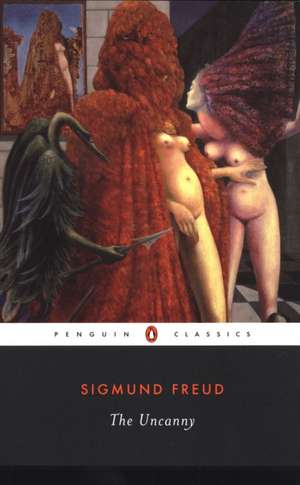
The Uncanny
Autor Sigmund Freud Traducere de David McLintocken Limba Engleză Paperback – 30 sep 2003
Găsim în această ediție de tip culegere de studii, publicată în seria Penguin Modern Classics - Freud, o explorare fascinantă a intersecției dintre psihanaliză, artă și literatură. The Uncanny reunește eseuri fundamentale în care Sigmund Freud își aplică metoda clinică asupra unor fenomene culturale și biografice, depășind granițele cabinetului medical. Volumul este structurat în jurul conceptului de „neliniștitor” (das Unheimliche), dar se extinde către mecanismele creativității și ale memoriei. Putem afirma că piesa centrală a volumului, eseul despre Leonardo da Vinci, reprezintă o mostră timpurie de psihobiografie. Sigmund Freud deconstruiește caracterul artistului renascentist, căutând explicații pentru „incomprehensibilitatea” geniului său în sexualitatea infantilă și în relația cu ucenicii săi. Această abordare continuă temele explorate în The Interpretation of Dreams, unde visul era poarta către inconștient, însă aici accentul cade pe modul în care amintirile ecran (Screen Memories) și fanteziile familiale (Family Romances) modelează actul creativ. Ca alternativă la On Freud’s “The Uncanny” de Catalina Bronstein — care oferă o perspectivă contemporană și clinică la un secol de la publicarea textului original — acest volum Penguin oferă textul sursă într-o traducere de referință semnată de David McLintock. Dacă lucrări precum The Ego and the Id se concentrează pe structura aparatului psihic, eseul The Uncanny investiguează acea senzație stranie de familiaritate fracturată, fiind esențial pentru înțelegerea esteticii moderne. Progresia volumului, de la mecanismele memoriei la analiza geniului artistic, oferă o imagine completă a stilului literar rafinat al lui Freud, recunoscut de critici pentru claritatea sa analitică.
Preț: 97.34 lei
Carte disponibilă
Livrare economică 17 noiembrie-01 decembrie
Specificații
ISBN-10: 0142437476
Pagini: 240
Dimensiuni: 131 x 199 x 16 mm
Greutate: 0.19 kg
Editura: Penguin Publishing Group
V-ar putea interesa
-
 Home is Where We Start fromClare WinnicottPreț: 93.26 lei
 -
 The PiggleD. W. Winnicott-20%Preț: 85.07 lei106.33 lei
 -
 A Critical Dictionary of PsychoanalysisCharles Rycroft-18%Preț: 65.18 lei79.25 lei
 -
 WinnicottAdam Phillips-32%Preț: 62.58 lei92.11 lei
 -
 The Future of an IllusionSigmund FreudPreț: 55.43 lei
 -
 The UnconsciousSigmund Freud-20%Preț: 56.65 lei70.83 lei
 -
 Modern Classics Psychology of LoveSigmund Freud-18%Preț: 76.49 lei93.76 lei
 -
 Interpreting DreamsSigmund Freud-27%Preț: 81.10 lei110.39 lei
 -
 The Psychoanalysis of RaceChristopher LanePreț: 327.18 lei
 -
 On BalanceAdam PhillipsPreț: 116.22 lei
 -
 SybilFlora SchreiberPreț: 94.27 lei
 -
 Preț: 487.08 lei
 -
 Freud, Sex, and DreamsSigmund FreudPreț: 140.77 lei
 -
 Understanding Ethics in Applied Behavior AnalysisAnn B. BeirnePreț: 380.24 lei
 -
 Dream PsychologySigmund FreudPreț: 53.91 lei
 -
 Lo Siniestro (Spanish Edition)Sigmund FreudPreț: 50.51 lei
 -
 DreamSigmund FreudPreț: 51.75 lei
 -
 Über Psychoanalyse Fünf VorlesungenSigmund FreudPreț: 225.52 lei
 -
 Preț: 169.03 lei
De ce să citești această carte
Recomandăm acest volum oricărui cititor interesat de psihanaliza aplicată în artă și literatură. Dincolo de terminologia tehnică, Sigmund Freud oferă o lecție de interpretare a simbolurilor și a comportamentului uman. Veți câștiga o perspectivă nouă asupra conceptului de „straniu” și o înțelegere profundă a legăturii dintre traumele timpurii și geniul creativ, totul într-o ediție clasică, impecabil tradusă.
Despre autor
Sigmund Freud (1856–1939), medic neurolog austriac, este fondatorul psihanalizei, disciplină care a revoluționat înțelegerea minții umane. Prin conceptele de inconștient, refulare și structura tripartită a psihicului (sine, eu, supraeu), Freud a influențat nu doar psihologia, ci întreaga cultură a secolului XX. Deși a început ca cercetător în neuropatologie la Viena, și-a dedicat cea mai mare parte a carierei dezvoltării asocierii libere și interpretării viselor ca metode terapeutice. Refugiat în Marea Britanie în 1938 pentru a scăpa de persecuția nazistă, Freud rămâne unul dintre cei mai citiți și contestați gânditori, textele sale fiind prețuite astăzi și pentru calitatea lor literară deosebită.
Descriere scurtă
Cuprins
Translator's Preface
Screen Memories
The Creative Writer and Daydreaming
Family Romances
Leonardo da Vinci and a Memory of his Childhood
The Uncanny
Recenzii
Notă biografică
His career began with several years of brilliant work on the anatomy and physiology of the nervous system. He was almost thirty when, after a period of study under Charcot in Paris, his interests first turned to psychology, and another ten years of clinical work in Vienna(at first in collaboration with Breuer, an older colleague) saw the birth of his creation, psychoanalysis. This began simply as a method of treating neurotic patients by investigating their minds, but it quickly grew into an accumulation of knowledge about the workings of the mind in general, whether sick or healthy. Freud was thus able to demonstrate the normal development of the sexual instinct in childhood and, largely on the basis of an examination of dreams, arrived at his fundamental discovery of the unconscious forces that influence our everyday thoughts and actions. Freud's life was uneventful, but his ideas have shaped not only many specialist disciplines, but the whole intellectual climate of the last half-century
Descriere
An extraordinary collection of thematically linked essays, including THE UNCANNY, SCREEN MEMORIES and FAMILY ROMANCES.
Leonardo da Vinci fascinated Freud primarily because he was keen to know why his personality was so incomprehensible to his contemporaries. In this probing biographical essay he deconstructs both da Vinci's character and the nature of his genius. As ever, many of his exploratory avenues lead to the subject's sexuality - why did da Vinci depict the naked human body the way hedid? What of his tendency to surround himself with handsome young boys that he took on as his pupils? Intriguing, thought-provoking and often contentious, this volume contains some of Freud's best writing.