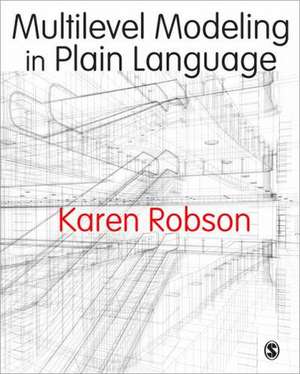
Multilevel Modeling in Plain Language
Autor Karen Robson, David Pevalinen Limba Engleză Paperback – 23 noi 2015
Structura acestui volum este concepută pentru a demistifica un domeniu adesea perceput ca fiind arid, punând accent pe logică și interpretare în detrimentul formalismului matematic. Descoperim aici o metodologie de predare care prioritizează limbajul natural, facilitând tranziția de la regresia liniară simplă (OLS) către structuri de date ierarhice. Capitolul introductiv stabilește fundamentul teoretic și avantajele statistice ale abordării multinivel, în timp ce secțiunile următoare ghidează cititorul prin complexitățile modelelor cu interceptări și coeficienți aleatori.
Reținem modul în care Karen Robson și David Pevalin utilizează software-ul Stata pentru a ilustra conceptele, oferind exemple adnotate care transformă teoria în practică imediată. Putem afirma că lucrarea este o extensie naturală a preocupărilor academice ale autoarei, vizibile și în The Stata Survival Manual, unde accentul cade pe utilizarea corectă a instrumentelor de analiză în cercetarea socială. Spre deosebire de The Story of a Generation, care se concentrează pe date longitudinale specifice, acest volum oferă un cadru metodologic general aplicabil în diverse discipline.
Comparabil cu Multilevel Modeling de George David Garson în ceea ce privește rigoarea conceptuală, textul de față este actualizat pentru utilizatorii care caută o cale de învățare bazată pe exemple practice în Stata, fără a fi copleșiți de „pădurea de ecuații”. În timp ce alte lucrări din domeniu pot fi descurajante prin densitatea formulelor, acest manual reușește să explice clar de ce și când trebuie folosite modelele multinivel pentru a evita erorile de interpretare în datele grupate.
Preț: 303.16 lei
Carte tipărită la comandă
Livrare economică 25 mai-08 iunie
Specificații
ISBN-10: 0857029169
Pagini: 160
Dimensiuni: 170 x 242 x 10 mm
Greutate: 0.25 kg
Ediția:1
Editura: SAGE Publications
Colecția Sage Publications Ltd
Locul publicării:London, United Kingdom
V-ar putea interesa
-
 Preț: 203.22 lei
 -
 -27%Preț: 176.09 lei241.30 lei
 -
 The Stata Survival ManualDavid Pevalin-28%Preț: 228.42 lei315.78 lei
 -
 Statistical Concepts - A Second CourseDebbie L. Hahs-Vaughn-13%Preț: 463.95 lei533.28 lei
 -
 Applied Statistics for the Social and Health SciencesRachel A. GordonPreț: 407.84 lei
 -
 -18%Preț: 688.22 lei839.29 lei
 -
 -9%Preț: 1345.99 lei1479.11 lei
 -
 Practical Multilevel Modeling Using RFrancis L. Huang-26%Preț: 642.75 lei868.58 lei
 -
 Applied Regression Models in the Social SciencesDudley L Poston Jr-19%Preț: 704.52 lei869.77 lei
 -
 R-TiculateMartin Bader-23%Preț: 624.36 lei810.87 lei
 -
 Statistics II for DummiesDeborah J RumseyPreț: 111.40 lei
 -
 An Introduction to Statistical ConceptsDebbie L. Hahs-Vaughn-14%Preț: 936.41 lei1088.84 lei
 -
 Statistical Analysis with Python for DummiesJoseph SchmullerPreț: 188.00 lei
 -
 Discovering Statistics Using RAndy Field-26%Preț: 632.99 lei855.39 lei
 -
 -8%Preț: 415.76 lei451.91 lei
 -
 Multilevel ModelingDouglas A. A. LukePreț: 342.25 lei
 -
 Multilevel and Longitudinal Modeling Using Stata, Volume I: Continuous ResponsesSophia Rabe-Hesketh-8%Preț: 543.38 lei590.63 lei
 -
 -8%Preț: 543.28 lei590.52 lei
 -
 Interpreting and Visualizing Regression Models Using StataMichael N. Mitchell-8%Preț: 469.03 lei509.81 lei
 -
 Statistics for ScientistsUmberto Michelucci-20%Preț: 286.96 lei358.70 lei
De ce să citești această carte
Această carte este soluția ideală pentru cercetătorii care doresc să stăpânească modelarea multinivel fără a fi experți în matematică. Cititorul câștigă abilitatea de a rula și interpreta modele complexe în Stata, înțelegând intuitiv diferența dintre efectele fixe și cele aleatorii. Este un instrument practic care transformă un subiect dificil într-o metodă de lucru accesibilă, esențială pentru analizele moderne de date din științele sociale.
Despre autor
Karen Robson este profesor asociat de sociologie la Universitatea York, fiind recunoscută pentru expertiza sa în analiza seturilor de date longitudinale și mobilitatea socială. Interesele sale de cercetare includ barierele în educația post-secundară pentru tinerii marginalizați și teoria critică a rasei. Cu o bogată activitate publicistică, Dr. Robson a semnat manuale fundamentale în domeniul metodelor de cercetare socială, precum The Stata Survival Manual și Quantifying Theory: Pierre Bourdieu, consolidându-și reputația de pedagog capabil să explice tehnici statistice avansate unui public academic larg.
Recenzii
The Authors do really introduce the subject in a very friendly way, propose examples which facilitate the reader to better understand and explain the output of Stata. I suggest the book both to students and instructors who want a specific text on this subject. On the one hand, students will be not afraid of formula, considering that the book is centred on the understanding of the subjects, on the other hand, instructors will benefit in reviewing the path of the multilevel analysis very quickly.
It is a book for those who have some knowledge of statistic but I think that this aspect is definitely clear to the reader. The book is really complete in all the phases of a multilevel analysis, the “plain approach” helps the reader to grasp the idea, follow the Stata commands and outputs and, finally, to interpret the findings. I think that the Authors were very skillful in preparing this book and added a very useful resource, in particular, for those who use Stata for their analysis.
Cuprins
Chapter 1: What Is Multilevel Modeling and Why Should I Use It?
Mixing levels of analysis
Theoretical reasons for multilevel modeling
What are the advantages of using multilevel models?
Statistical reasons for multilevel modeling
Assumptions of OLS
Software
How this book is organized
Chapter 2: Random Intercept Models: When intercepts vary
A review of single-level regression
Nesting structures in our data
Getting starting with random intercept models
What do our findings mean so far?
Changing the grouping to schools
Adding Level 1 explanatory variables
Adding Level 2 explanatory variables
Group mean centring
Interactions
Model fit
What about R-squared?
R-squared?
A further assumption and a short note on random and fixed effects
Chapter 3: Random Coefficient Models: When intercepts and coefficients vary
Getting started with random coefficient models
Trying a different random coefficient
Shrinkage
Fanning in and fanning out
Examining the variances
A dichotomous variable as a random coefficient
More than one random coefficient
A note on parsimony and fitting a model with multiple random coefficients
A model with one random and one fixed coefficient
Adding Level 2 variables
Residual diagnostics
First steps in model-building
Some tasters of further extensions to our basic models
Where to next?
Chapter 4: Communicating Results to a Wider Audience
Creating journal-formatted tables
The fixed part of the model
The importance of the null model
Centring variables
Stata commands to make table-making easier
What do you talk about?
Models with random coefficients
What about graphs?
Cross-level interactions
Parting words
Descriere
Have you been told you need to do multilevel modeling, but you can't get past the forest of equations? Do you need the techniques explained with words and practical examples so they make sense?
Help is here! This book unpacks these statistical techniques in easy-to-understand language with fully annotated examples using the statistical software Stata. The techniques are explained without reliance on equations and algebra so that new users will understand when to use these approaches and how they are really just special applications of ordinary regression. Using real life data, the authors show you how to model random intercept models and random coefficient models for cross-sectional data in a way that makes sense and can be retained and repeated.
This book is the perfect answer for anyone who needs a clear, accessible introduction to multilevel modeling.