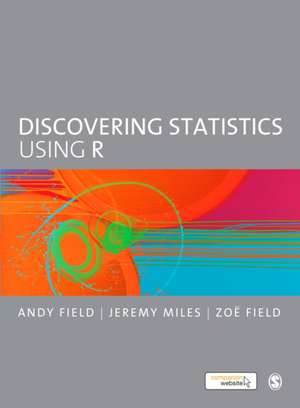
Discovering Statistics Using R
Autor Andy Field, Jeremy Miles, Zoé Fielden Limba Engleză Paperback – 21 mar 2012
Evoluția recentă a analizei de date în mediul academic reflectă o migrare masivă către instrumente open-source, flexibile și dinamice. Discovering Statistics Using R surprinde exact acest moment, adaptând pedagogia celebră a lui Andy Field pentru limbajul R, un standard care devine indispensabil în științele sociale. Observăm că această lucrare nu este un simplu manual de codare, ci o reconstrucție a modului în care statistica poate fi predată fără a intimida studentul, păstrând rigoarea necesară cercetării contemporane. Suntem de părere că forța acestui volum rezidă în structura sa narativă. Autorii ghidează cititorul prin mediul R, începând cu instalarea și utilizarea R Commander, pentru ca apoi să escaladeze natural către modele statistice complexe. Cuprinsul indică o progresie logică: de la „Ce naiba caut eu aici?” — o secțiune dedicată demistificării fricii de statistică — până la stăpânirea tehnicilor de tip MANOVA și a modelelor multinivel. Această abordare completează perspectiva oferită de Univariate, Bivariate, and Multivariate Statistics Using R, adăugând acea componentă de angajament emoțional și umor care lipsește deseori manualelor tehnice stricte. În contextul operei sale, această carte reprezintă pilonul tehnic modern care transformă viziunea din Discovering Statistics Using IBM SPSS Statistics într-un format accesibil gratuit oricărui cercetător. Dacă în eseuri precum Encounterism Andy Field explorează interacțiunea umană în spații fizice, aici el analizează interacțiunea minții umane cu datele brute, folosind un ton ireverențios și exemple din viața reală care transformă învățarea într-o experiență memorabilă. Găsim în cele aproape 1000 de pagini un echilibru rar între teorie conceptuală și aplicație practică, susținut de sarcini de lucru și resurse digitale suplimentare.
Preț: 653.90 lei
Preț vechi: 883.65 lei
-26%
Carte disponibilă
Livrare economică 07-21 iulie
Livrare express 20-26 iunie pentru 97.98 lei
Specificații
ISBN-10: 1446200469
Pagini: 992
Dimensiuni: 262 x 193 x 54 mm
Greutate: 2.31 kg
Ediția:1
Editura: SAGE Publications Ltd
Locul publicării:London, United Kingdom
V-ar putea interesa
-
 Descartes' ErrorAntonio Damasio-20%Preț: 73.20 lei91.99 lei
 -
 Fooled by RandomnessNassim Nicholas TalebPreț: 92.27 lei
 -
 You Are Not A GadgetJaron Lanier-21%Preț: 61.36 lei77.48 lei
 -
 -46%Preț: 49.17 lei91.22 lei
 -
 Writing Science in Plain EnglishAnne E. GreenePreț: 116.66 lei
 -
 Preț: 99.68 lei
 -
 The Little Book of HyggeMeik Wiking-18%Preț: 89.04 lei108.90 lei
 -
 The Age Of Extremes: 1914-1991Eric Hobsbawm-27%Preț: 89.49 lei121.89 lei
 -
 Preț: 171.43 lei
 -
 Action Research: Principles and practiceJean McNiffPreț: 414.77 lei
 -
 The Transformation of the WorldJurgen OsterhammelPreț: 268.30 lei
 -
 Teaching Research Methods in the Social SciencesMark GarnerPreț: 426.31 lei
 -
 In Europe's ShadowRobert D. Kaplan-21%Preț: 84.13 lei105.94 lei
 -
 Interpreting InterviewsMats AlvessonPreț: 344.38 lei
 -
 The Art and Craft of ComparisonJohn BoswellPreț: 239.89 lei
 -
 Preț: 390.10 lei
 -
 The Literature ReviewDiana RidleyPreț: 389.42 lei
 -
 An Introduction to the Philosophy of MethodologyKerry E Howell-8%Preț: 483.04 lei525.04 lei
 -
 Development FieldworkRegina ScheyvensPreț: 498.70 lei
 -
 The SAGE Handbook of Case-Based MethodsDavid ByrnePreț: 413.72 lei
 -
 Digital EthnographySarah PinkPreț: 425.09 lei
 -
 Sophie's World: 20th Anniversary EditionJostein GaarderPreț: 79.17 lei
 -
 NetnographyRobert KozinetsPreț: 435.31 lei
 -
 Research QuestionZina O'LearyPreț: 91.44 lei
 -
 On the Edge of the New CenturyEric HobsbawmPreț: 119.28 lei
 -
 Preț: 81.45 lei
De ce să citești această carte
Recomandăm această carte studenților și cercetătorilor care doresc să stăpânească limbajul R fără stresul unui manual arid. Cititorul câștigă nu doar competențe tehnice solide în modelarea datelor, ci și încrederea de a naviga prin analize complexe, totul într-un format interactiv și amuzant. Este resursa ideală pentru a transforma statistica dintr-o barieră curriculară într-un instrument de descoperire.
Despre autor
Andy Field este profesor de psihopatologie infantilă la Universitatea din Sussex și o figură de referință în educația statistică la nivel mondial. Cu o activitate prodigioasă ce include peste 80 de lucrări de cercetare și 17 cărți, Field a reușit să revoluționeze modul în care este predată statistica, primind numeroase distincții pentru calitatea actului didactic. Este editor fondator al Journal of Experimental Psychopathology și a activat în comitetele editoriale ale unor publicații prestigioase precum British Journal of Mathematical and Statistical Psychology. Expertiza sa în dezvoltarea emoțională a copiilor se reflectă în stilul empatic și plin de umor prin care explică cele mai dificile concepte matematice.
Descriere scurtă
The journey begins by explaining basic statistical and research concepts before a guided tour of the R software environment. Next you discover the importance of exploring and graphing data, before moving onto statistical tests that are the foundations of the rest of the book (for example correlation and regression). You will then stride confidently into intermediate level analyses such as ANOVA, before ending your journey with advanced techniques such as MANOVA and multilevel models. Although there is enough theory to help you gain the necessary conceptual understanding of what you're doing, the emphasis is on applying what you learn to playful and real-world examples that should make the experience more fun than you might expect.
Like its sister textbooks, Discovering Statistics Using R is written in an irreverent style and follows the same ground-breaking structure and pedagogical approach. The core material is augmented by a cast of characters to help the reader on their way, together with hundreds of examples, self-assessment tests to consolidate knowledge, and additional website material for those wanting to learn more.
Given this book's accessibility, fun spirit, and use of bizarre real-world research it should be essential for anyone wanting to learn about statistics using the freely-available R software.
Recenzii
Take, for example, the chapter on t-tests. The chapter explains how to compare the means of two groups from scratch. It explains the logic behind the tests, it explains how to do the tests in R with a complete worked example, which papers to read in the unlikely event you do need to go further, and it explains what you need to write in your practical report or paper. But it also goes further, and explains how t-tests and regression are related---and are really the same thing---as part of the general linear model. So this book offers not just the step-by-step guidance needed to complete a particular test, but it also offers the chance to reach the zen state of total statistical understanding.
Prof. Neil Stewart
Warwick University
Field's Discovering Statistics is popular with students for making a sometimes deemed inaccessible topic accessible, in a fun way. In Discovering Statistics Using R, the authors have managed to do this using a statistics package that is known to be powerful, but sometimes deemed just as inaccessible to the uninitiated, all the while staying true to Field's off-kilter approach.
Dr Marcel van Egmond
University of Amsterdam
Probably the wittiest and most amusing of the lot (no, really), this book takes yet another approach: it is 958 pages of R-based stats wisdom (plus online accoutrements)... A thoroughly engaging, expansive, thoughtful and complete guide to modern statistics. Self-deprecating stories lighten the tone, and the undergrad-orientated 'stupid faces' (Brian Haemorrhage, Jane Superbrain, Oliver Twisted, etc.) soon stop feeling like a gimmick, and help to break up the text with useful snippets of stats wisdom. It is very mch a student textbook but it is brilliant... Field et al. is the complete package.
David M. Shuker
AnimJournal of Animal Behaviour
"This work should be in the library of every institution where statistics is taught. It contains much more content than what is required for a beginning or advanced undergraduate course, but instructors for such courses would do well to consider this book; it is priced comparably to books which contain only basic material, and students who are fascinated by the subject may find the additional material a real bonus. The book would also be very good for self-study. Overall, an excellent resource."
The main strength of this book is that it presents a lot of information in an accessible, engaging and irreverent way. The style is informal with interesting excursions into the history of statistics and psychology. There is reference to research papers which illustrate the methods explained, and are also very entertaining. The authors manage to pull off the Herculean task of teaching statistics through the medium of R... All in all, an invaluable resource.
Cuprins
What will this chapter tell me?
What the hell am I doing here? I don't belong here
Initial observation: finding something that needs explaining
Generating theories and testing them
Data collection 1: what to measure
Data collection 2: how to measure
Analysing data
What have I discovered about statistics?
Key terms that I've discovered
Smart Alex's tasks
Further reading
Interesting real research
Everything You Ever Wanted to Know About Statistics (Well, Sort of)
What will this chapter tell me?
Building statistical models
Populations and samples
Simple statistical models
Going beyond the data
Using statistical models to test research questions
What have I discovered about statistics?
Key terms that I've discovered
Smart Alex's tasks
Further reading
Interesting real research
The R Environment
What will this chapter tell me?
Before you start
Getting started
Using R
Getting data into R
Entering data with R Commander
Using other software to enter and edit data
Saving Data
Manipulating Data
What have I discovered about statistics?
R Packages Used in This Chapter
R Functions Used in This Chapter
Key terms that I've discovered
Smart Alex's Tasks
Further reading
Exploring Data with Graphs
What will this chapter tell me?
The art of presenting data
Packages used in this chapter
Introducing ggplot2
Graphing relationships: the scatterplot
Histograms: a good way to spot obvious problems
Boxplots (box-whisker diagrams)
Density plots
Graphing means
Themes and options
What have I discovered about statistics?
R packages used in this chapter
R functions used in this chapter
Key terms that I've discovered
Smart Alex's tasks
Further reading
Interesting real research
Exploring Assumptions
What will this chapter tell me?
What are assumptions?
Assumptions of parametric data
Packages used in this chapter
The assumption of normality
Testing whether a distribution is normal
Testing for homogeneity of variance
Correcting problems in the data
What have I discovered about statistics?
R packages used in this chapter
R functions used in this chapter
Key terms that I've discovered
Smart Alex's tasks
Further reading
Correlation
What will this chapter tell me?
Looking at relationships
How do we measure relationships?
Data entry for correlation analysis
Bivariate correlation
Partial correlation
Comparing correlations
Calculating the effect size
How to report correlation coefficents
What have I discovered about statistics?
R packages used in this chapter
R functions used in this chapter
Regression
What will this chapter tell me?
An Introduction to regression
Packages used in this chapter
General procedure for regression in R
Interpreting a simple regression
Multiple regression: the basics
How accurate is my regression model?
How to do multiple regression using R Commander and R
Testing the accuracy of your regression model
Robust regression: bootstrapping
How to report multiple regression
Categorical predictors and multiple regression
What have I discovered about statistics?
R packages used in this chapter
R functions used in this chapter
Key terms that I've discovered
Smart Alex's tasks
Further reading
Interesting real research
Logistic Regression
What will this chapter tell me?
Background to logistic regression
What are the principles behind logistic regression?
Assumptions and things that can go wrong
Packages used in this chapter
Binary logistic regression: an example that will make you feel eel
How to report logistic regression
Testing assumptions: another example
Predicting several categories: multinomial logistic regression
What have I discovered about statistics?
R packages used in this chapter
R functions used in this chapter
Key terms that I've discovered
Smart Alex's tasks
Further reading
Interesting real research
Comparing Two Means
What will this chapter tell me?
Packages used in this chapter
Looking at differences
The <i>t</i>-test
The independent <i>t</i>-test
The dependent <i>t</i>-test
Between groups or repeated measures?
What have I discovered about statistics?
R packages used in this chapter
R functions used in this chapter
Key terms that I've discovered
Smart Alex's tasks
Further reading
Interesting real research
Comparing Several Means: ANOVA (GLM 1)
What will this chapter tell me?
The theory behind ANOVA
Assumptions of ANOVA
Planned contrasts
<i>Post hoc</i> procedures
One-way ANOVA using R
Calculating the effect size
Reporting results from one-way independent ANOVA
What have I discovered about statistics?
R packages used in this chapter
R functions used in this chapter
Key terms that I've discovered
Smart Alex's tasks
Further reading
Interesting real research
Analysis of Covariance, ANCOVA (GLM 2)
What will this chapter tell me?
What is ANCOVA?
Assumptions and issues in ANCOVA
ANCOVA using R
Robust ANCOVA
Calculating the effect size
Reporting results
What have I discovered about statistics?
R packages used in this chapter
R functions used in this chapter
Key terms that I've discovered
Smart Alex's tasks
Further reading
Interesting real research
Factorial ANOVA (GLM 3)
What will this chapter tell me?
Theory of factorial ANOVA (independant design)
Factorial ANOVA as regression
Two-Way ANOVA: Behind the scenes
Factorial ANOVA using R
Interpreting interaction graphs
Robust factorial ANOVA
Calculating effect sizes
Reporting the results of two-way ANOVA
What have I discovered about statistics?
R packages used in this chapter
R functions used in this chapter
Key terms that I've discovered
Smart Alex's tasks
Further reading
Interesting real research
Repeated-Measures Designs (GLM 4)
What will this chapter tell me?
Introduction to repeated-measures designs
Theory of one-way repeated-measures ANOVA
One-way repeated measures designs using R
Effect sizes for repeated measures designs
Reporting one-way repeated measures designs
Factorisal repeated measures designs
Effect Sizes for factorial repeated measures designs
Reporting the results from factorial repeated measures designs
What have I discovered about statistics?
R packages used in this chapter
R functions used in this chapter
Key terms that I've discovered
Smart Alex's tasks
Further reading
Interesting real research
Mixed Designs (GLM 5)
What will this chapter tell me?
Mixed designs
What do men and women look for in a partner?
Entering and exploring your data
Mixed ANOVA
Mixed designs as a GLM
Calculating effect sizes
Reporting the results of mixed ANOVA
Robust analysis for mixed designs
What have I discovered about statistics?
R packages used in this chapter
R functions used in this chapter
Key terms that I've discovered
Smart Alex's tasks
Further reading
Interesting real research
Non-Parametric Tests
What will this chapter tell me?
When to use non-parametric tests
Packages used in this chapter
Comparing two independent conditions: the Wilcoxon rank-sum test
Comparing two related conditions: the Wilcoxon signed-rank test
Differences between several independent groups: the Kruskal-Wallis test
Differences between several related groups: Friedman's ANOVA
What have I discovered about statistics?
R packages used in this chapter
R functions used in this chapter
Key terms that I've discovered
Smart Alex's tasks
Further reading
Interesting real research
Multivariate Analysis of Variance (MANOVA)
What will this chapter tell me?
When to use MANOVA
Introduction: similarities and differences to ANOVA
Theory of MANOVA
Practical issues when conducting MANOVA
MANOVA using R
Robust MANOVA
Reporting results from MANOVA
Following up MANOVA with discriminant analysis
Reporting results from discriminant analysis
Some final remarks
What have I discovered about statistics?
R packages used in this chapter
R functions used in this chapter
Key terms that I've discovered
Smart Alex's tasks
Further reading
Interesting real research
Exploratory Factor Analysis
What will this chapter tell me?
When to use factor analysis
Factors
Research example
Running the analysis with R Commander
Running the analysis with R
Factor scores
How to report factor analysis
Reliability analysis
Reporting reliability analysis
What have I discovered about statistics?
R Packages Used in This Chapter
R Functions Used in This Chapter
Key terms that I've discovered
Smart Alex's tasks
Further reading
Interesting real research
Categorical Data
What will this chapter tell me?
Packages used in this chapter
Analysing categorical data
Theory of Analysing Categorical Data
Assumptions of the chi-square test
Doing the chi-square test using R
Several categorical variables: loglinear analysis
Assumptions in loglinear analysis
Loglinear analysis using R
Following up loglinear analysis
Effect sizes in loglinear analysis
Reporting the results of loglinear analysis
What have I discovered about statistics?
R packages used in this chapter
R functions used in this chapter
Key terms that I've discovered
Smart Alex's tasks
Further reading
Interesting real research
Multilevel Linear Models
What will this chapter tell me?
Hierarchical data
Theory of multilevel linear models
The multilevel model
Some practical issues
Multilevel modelling on R
Growth models
How to report a multilevel model
What have I discovered about statistics?
R packages used in this chapter
R functions used in this chapter
Key terms that I've discovered
Smart Alex's tasks
Further reading
Interesting real research
Epilogue: Life After Discovering Statistics
Troubleshooting R
Glossary
Appendix
Table of the standard normal distribution
Critical Values of the t-Distribution
Critical Values of the F-Distribution
Critical Values of the chi-square Distribution
References