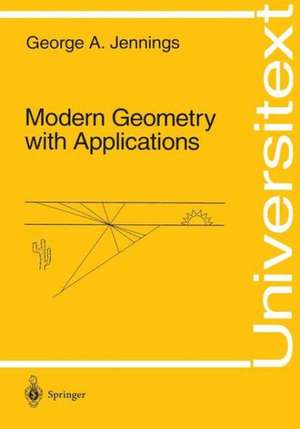
Modern Geometry with Applications: Universitext
Autor George A. Jenningsen Limba Engleză Paperback – 10 iun 1994
Publicată în seria Universitext la Springer, lucrarea Modern Geometry with Applications de George A. Jennings propune o restructurare pragmatică a curriculumului de geometrie pentru studenții de licență. Remarcăm decizia curajoasă a autorului de a omite geometria hiperbolică — un subiect standard, dar adesea abstract pentru nivelul introductiv — înlocuind-o cu geometria spațiu-timp aplicată în Teoria Relativității Restrânse. Această abordare transformă studiul axiomatic într-un instrument de înțelegere a universului fizic.
Suntem de părere că progresia materialului este riguros planificată, începând cu fundamentul geometriei euclidiene, unde accentul cade pe izometrii, reflexii și rotații. Găsim în capitolele următoare o tranziție fluidă către geometria sferică, esențială pentru navigație și astronomie, și către studiul conicelor, aplicate în determinarea orbitelor planetare. Cartea extinde cadrul propus de Geometry: from Isometries to Special Relativity prin integrarea unor aplicații directe în cartografie și artă (prin geometria proiectivă), oferind o viziune mai aplicată decât textul teoretic al lui Nam-Hoon Lee.
Structura capitolelor reflectă dorința de a echilibra derivarea teoretică cu utilitatea practică. De exemplu, capitolul despre geometria sferică nu se rezumă la formule, ci include probleme de navigație și proiecție stereografică. Față de Geometry and Its Applications de Walter Meyer, care menține o abordare axiomatică tradițională, volumul de față este mai selectiv, concentrându-se pe acele geometrii non-euclidiene care au impact vizibil în științele aplicate. Textul este calibrat pentru un semestru de studiu, oferind exerciții care provoacă cititorul să depășească simpla aplicare a unor algoritmi de calcul.
Din seria Universitext
- 13%
 Preț: 398.41 lei
 - 15%
 Preț: 559.13 lei
 - 15%
 Preț: 402.83 lei
 -
 Preț: 404.03 lei
 -
 Preț: 464.02 lei
 - 15%
 Preț: 522.85 lei
 -
 Preț: 406.96 lei
 -
 Preț: 415.00 lei
 - 13%
 Preț: 395.54 lei
 -
 Preț: 363.88 lei
 -
 Preț: 470.78 lei
 -
 Preț: 469.31 lei
 - 15%
 Preț: 511.22 lei
 -
 Preț: 458.21 lei
 - 15%
 Preț: 513.38 lei
 - 19%
 Preț: 469.00 lei
 -
 Preț: 490.45 lei
 - 15%
 Preț: 603.75 lei
 - 15%
 Preț: 459.73 lei
 -
 Preț: 491.89 lei
 -
 Preț: 383.79 lei
 - 20%
 Preț: 319.60 lei
 - 15%
 Preț: 620.17 lei
 - 15%
 Preț: 504.56 lei
 -
 Preț: 482.65 lei
 - 15%
 Preț: 609.03 lei
 - 15%
 Preț: 534.10 lei
 - 15%
 Preț: 529.04 lei
 - 15%
 Preț: 453.96 lei
 -
 Preț: 383.03 lei
 - 15%
 Preț: 477.44 lei
 -
 Preț: 402.52 lei
 - 15%
 Preț: 525.92 lei
 - 15%
 Preț: 616.59 lei
 - 20%
 Preț: 517.64 lei
 - 15%
 Preț: 605.99 lei
 -
 Preț: 401.63 lei
 -
 Preț: 476.65 lei
 -
 Preț: 442.80 lei
 - 15%
 Preț: 529.50 lei
 - 15%
 Preț: 476.18 lei
 - 15%
 Preț: 563.39 lei
 - 15%
 Preț: 656.08 lei
 -
 Preț: 494.60 lei
 -
 Preț: 454.23 lei
 - 15%
 Preț: 453.29 lei
 -
 Preț: 395.89 lei
 -
 Preț: 404.56 lei
 -
 Preț: 392.51 lei
 -
 Preț: 411.21 lei
Preț: 434.70 lei
Carte tipărită la comandă
Livrare economică 18 noiembrie-02 decembrie
Specificații
ISBN-10: 038794222X
Pagini: 204
Ilustrații: VIII, 204 p. 150 illus.
Dimensiuni: 155 x 233 x 12 mm
Greutate: 0.32 kg
Ediția:1994
Editura: Springer
Colecția Universitext
Seria Universitext
Locul publicării:New York, NY, United States
V-ar putea interesa
-
 Trigonometry Demystified 2/EStan GibiliscoPreț: 213.91 lei
 -
 Finite Geometries, Buildings, and Related TopicsWilliam M. Kantor-22%Preț: 295.46 lei379.60 lei
 -
 -33%Preț: 611.80 lei909.55 lei
 -
 Chaos and Fractals: An Elementary IntroductionDavid P. Feldman-10%Preț: 379.03 lei420.53 lei
 -
 Just-in-Time Algebra and Trigonometry for CalculusGuntram Müller-19%Preț: 472.06 lei582.79 lei
 -
 Chaos and FractalsHeinz-Otto Peitgen-23%Preț: 716.80 lei930.91 lei
 -
 Fractals and Scaling in FinanceBenoit B. Mandelbrot-18%Preț: 978.39 lei1193.15 lei
 -
 Topological GroupsMarkley-9%Preț: 774.05 lei850.60 lei
 -
 Topology and Geometry 2eStahl-9%Preț: 815.39 lei896.04 lei
 -
 -15%Preț: 665.77 lei783.25 lei
 -
 Ruler and CompassAndrew SuttonPreț: 52.24 lei
 -
 A Short Course in Computational Geometry and TopologyHerbert Edelsbrunner-15%Preț: 521.16 lei613.12 lei
 -
 Geometric Modeling in Probability and StatisticsOvidiu Calin-15%Preț: 591.67 lei696.09 lei
 -
 Complex Geometry - an IntroductionDaniel Huybrechts-15%Preț: 504.56 lei593.61 lei
 -
 Preț: 491.16 lei
 -
 Diagram GeometryFrancis Buekenhout-18%Preț: 706.53 lei861.62 lei
 -
 Non-metrisable ManifoldsDavid GauldPreț: 374.66 lei
Public țintă
Lower undergraduateDe ce să citești această carte
Această carte este ideală pentru studenții la matematică și viitorii profesori care doresc să înțeleagă legătura dintre geometrie și lumea reală. Cititorul câștigă o perspectivă modernă asupra spațiului, învățând cum geometria sferică ghidează navele sau cum geometria spațiu-timp explică fizica relativistă. Este o resursă valoroasă care înlocuiește demonstrațiile aride cu aplicații în astronomie, artă și navigație.