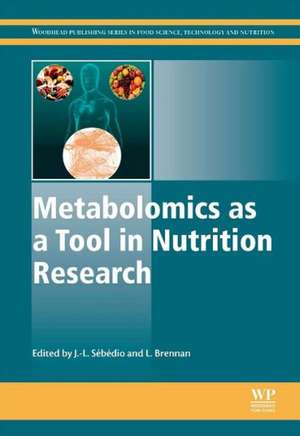
Metabolomics as a Tool in Nutrition Research: Woodhead Publishing Series in Food Science, Technology and Nutrition
Editat de J-L Sebedio, L Brennanen Limba Engleză Hardback – 8 dec 2014
Din seria Woodhead Publishing Series in Food Science, Technology and Nutrition
- 9%
 Preț: 1098.87 lei
 - 24%
 Preț: 1310.10 lei
 - 27%
 Preț: 988.89 lei
 - 9%
 Preț: 1241.52 lei
 - 28%
 Preț: 1220.16 lei
 - 27%
 Preț: 1224.15 lei
 - 27%
 Preț: 976.79 lei
 - 27%
 Preț: 1680.31 lei
 - 9%
 Preț: 1093.44 lei
 - 28%
 Preț: 1113.31 lei
 - 9%
 Preț: 949.28 lei
 - 9%
 Preț: 1036.36 lei
 - 27%
 Preț: 1227.37 lei
 - 27%
 Preț: 1191.60 lei
 - 9%
 Preț: 1108.09 lei
 - 9%
 Preț: 1238.58 lei
 - 27%
 Preț: 1196.91 lei
 - 9%
 Preț: 894.05 lei
 - 9%
 Preț: 1013.12 lei
 - 9%
 Preț: 1242.41 lei
 - 28%
 Preț: 822.30 lei
 - 27%
 Preț: 1372.29 lei
 - 9%
 Preț: 1048.99 lei
 - 9%
 Preț: 1076.41 lei
 - 27%
 Preț: 1165.12 lei
 - 9%
 Preț: 1032.89 lei
 - 23%
 Preț: 1770.55 lei
 - 9%
 Preț: 1315.26 lei
 - 27%
 Preț: 1079.99 lei
 - 9%
 Preț: 1251.57 lei
 - 27%
 Preț: 1168.05 lei
 - 27%
 Preț: 974.35 lei
 - 27%
 Preț: 1196.65 lei
 - 9%
 Preț: 978.12 lei
 - 27%
 Preț: 836.00 lei
 - 27%
 Preț: 1273.65 lei
 - 27%
 Preț: 824.97 lei
 - 27%
 Preț: 1171.61 lei
 - 27%
 Preț: 1461.32 lei
 - 31%
 Preț: 391.14 lei
 - 32%
 Preț: 1375.45 lei
 - 32%
 Preț: 1230.28 lei
 - 27%
 Preț: 897.71 lei
 - 9%
 Preț: 1096.46 lei
 - 27%
 Preț: 1345.42 lei
 - 9%
 Preț: 1050.25 lei
 - 9%
 Preț: 1199.13 lei
Preț: 949.85 lei
Preț vechi: 1457.67 lei
-35% Nou
Puncte Express: 1425
Preț estimativ în valută:
168.10€ • 197.14$ • 147.39£
168.10€ • 197.14$ • 147.39£
Carte tipărită la comandă
Livrare economică 19 ianuarie-02 februarie 26
Preluare comenzi: 021 569.72.76
Specificații
ISBN-13: 9781782420842
ISBN-10: 1782420843
Pagini: 268
Dimensiuni: 152 x 229 x 22 mm
Greutate: 0.53 kg
Editura: ELSEVIER SCIENCE
Seria Woodhead Publishing Series in Food Science, Technology and Nutrition
ISBN-10: 1782420843
Pagini: 268
Dimensiuni: 152 x 229 x 22 mm
Greutate: 0.53 kg
Editura: ELSEVIER SCIENCE
Seria Woodhead Publishing Series in Food Science, Technology and Nutrition
V-ar putea interesa
-
 -27%Preț: 1586.12 lei2172.77 lei
 -
 -27%Preț: 1245.70 lei1714.38 lei
 -
 The Microbiological Quality of Food: Foodborne SpoilersAntonio Bevilacqua-9%Preț: 1035.55 lei1137.97 lei
 -
 Cereal Grains: Assessing and Managing QualityColin Wrigley-32%Preț: 1049.33 lei1535.91 lei
 -
 Phase Transitions in FoodsYrjö H. Roos-32%Preț: 427.92 lei632.80 lei
 -
 -24%Preț: 518.23 lei682.79 lei
 -
 Egg Innovations and Strategies for ImprovementsPatricia Hester-31%Preț: 856.51 lei1243.42 lei
 -
 -27%Preț: 760.84 lei1039.32 lei
 -
 Sensory and Instrumental Evaluation of Alcoholic BeveragesHildegarde Heymann-27%Preț: 565.16 lei774.98 lei
 -
 Nutrition and OsteoporosisHarold H. Draper-18%Preț: 915.73 lei1116.74 lei
 -
 Preț: 388.04 lei
 -
 -15%Preț: 618.34 lei727.45 lei
 -
 Omega-3 Fatty Acids and HealthJoyce A. Nettleton-15%Preț: 625.44 lei735.81 lei
 -
 Fundamentals of Dairy ChemistryNoble P. Wong-18%Preț: 1085.59 lei1323.89 lei
 -
 Fruit ProcessingD. Arthey-18%Preț: 912.40 lei1112.68 lei
 -
 Food Choice and the ConsumerDavid W. Marshall-15%Preț: 622.11 lei731.90 lei
 -
 -18%Preț: 917.56 lei1118.98 lei
 -
 -18%Preț: 912.40 lei1112.68 lei
 -
 Preț: 368.23 lei
 -
 New Methods of Food PreservationGrahame W. Gould-18%Preț: 916.03 lei1117.10 lei
 -
 Milk QualityFrank Harding-15%Preț: 616.28 lei725.04 lei
 -
 Understanding Natural FlavorsA. Paterson-18%Preț: 915.73 lei1116.74 lei
 -
 The International Sugar TradeTony Hannah-27%Preț: 885.24 lei1217.66 lei
Cuprins
- List of contributors
- Woodhead Publishing Series in Food Science, Technology and Nutrition
- Preface
- Part One: Principles
- 1. Challenges in nutritional metabolomics: from experimental design to interpretation of data sets
- Abstract
- 1.1 Introduction
- 1.2 The experimental design
- 1.3 The analytical platform
- 1.4 Extraction of data sets and statistical analyses
- 1.5 Metabolite identification
- 1.6 Biological interpretations
- 1.7 Conclusion: do we need standardisation procedures and repositories?
- 2. Metabolic profiling as a tool in nutritional research: key methodological issues
- Abstract
- 2.1 Introduction
- 2.2 Key issues in nutritional research
- 2.3 The role of genomics, proteomics, metabolomics, and metagenomics in nutritional research
- 2.4 Applications of metabolomics in nutrition-related research
- 2.5 The use of metabolomics to assess the effects of diet on health
- 2.6 Methods for mapping dietary patterns
- 2.7 Observational and interventional studies into the effects of diet and nutrition on health
- 2.8 Analytical methods
- 2.9 Issues in analysing samples
- 3. Chemometrics methods for the analysis of genomics, transcriptomics, proteomics, metabolomics, and metagenomics datasets
- Abstract
- 3.1 Introduction
- 3.2 Unsupervised and supervised pattern recognition methods
- 3.3 Multivariate calibration methods for developing predictive models
- 3.4 Statistical data integration methods
- 3.5 Data integration: multiblock strategies
- 3.6 Data integration: calibration transfer methods
- 3.7 Data integration: multiway/multimodal analysis methods
- 3.8 Data integration: correlation-based approaches
- 3.9 Data integration: techniques for analysing different types of genomics datasets
- 3.10 Statistical data integration of different sample types
- 3.11 Statistical data integration of different molecular components in samples
- 3.12 Modelling relationships between molecular components
- 3.13 Conclusion and future trends
- 1. Challenges in nutritional metabolomics: from experimental design to interpretation of data sets
- Part Two: Applications in nutrition research
- 4. Application of lipidomics in nutrition research
- Abstract
- Acknowledgement
- 4.1 Introduction
- 4.2 Lipids
- 4.3 Lipidomics
- 4.4 Lipidomics in nutrition research
- 4.5 Conclusion and future trends
- 5. Analysing human metabolic networks using metabolomics: understanding the impact of diet on health
- Abstract
- Acknowledgements
- 5.1 Introduction
- 5.2 Metabolic network reconstruction
- 5.3 Human metabolic networks
- 5.4 Linking metabolomics data and metabolic network elements
- 5.5 Metabolism modelling, from pathways to network
- 5.6 Subnetwork extraction between identified metabolites
- 5.7 Conclusion and future directions
- 6. Using metabolomics to analyse the role of gut microbiota in nutrition and disease
- Abstract
- 6.1 Introduction: gut microbiota and human health
- 6.2 Metagenomics of gut microbiota
- 6.3 Metabolomics: uncovering complex host–microbe interactions
- 6.4 The marriage of metagenomics and metabolomics: microbiome–metabolome interactions
- 6.5 Future perspectives: personalised nutrition
- 7. Metabotyping: moving towards personalised nutrition
- Abstract
- 7.1 Introduction
- 7.2 The concept of the metabotype
- 7.3 Examples of metabotyping with a focus on nutrition
- 7.4 Extension of metabotypes to include markers of dietary origin
- 7.5 Conclusion and future trends
- 7.6 Sources of further information and advice
- 8. Using metabolomics to identify biomarkers for metabolic diseases: analytical methods and applications
- Abstract
- 8.1 Introduction
- 8.2 Using metabolomics to understand the relationship between nutrition and chronic metabolic diseases
- 8.3 Cohort studies and biomarker identification
- 8.4 Isolating in situ biomarkers
- 8.5 Conclusions and future trends
- 9. Using metabolomics to evaluate food intake: applications in nutritional epidemiology
- Abstract
- 9.1 Introduction
- 9.2 Biomarkers as a complementary approach to questionnaires
- 9.3 Definition of the food metabolome
- 9.4 Metabolomics as a tool for dietary biomarker discovery
- 9.5 Dietary patterns and metabolomic profiles: potential use of nutritypes
- 9.6 Validation of putative biomarkers
- 9.7 The future of metabolomics in dietary assessment
- 9.8 Conclusion
- 10. Metabolomics and nutritional challenge tests: what can we learn?
- Abstract
- 10.1 Introduction
- 10.2 Application of metabolomics to challenge tests
- 10.3 Conclusion and future trends
- 11. Using metabolomics to describe food in detail
- Abstract
- 11.1 Introduction
- 11.2 Using metabolomics to assess the effects of genetic selection and modification
- 11.3 Using metabolomics to assess the effects of organic versus conventional farming
- 11.4 Using metabolomics to identify the geographical origin of food products
- 11.5 Using metabolomics to assess the effects of rearing conditions on the quality of meat, eggs, and fish
- 11.6 Using metabolomics to assess the effects of processing on food quality
- 11.7 Using metabolomics to assess the effects of digestion on nutrient intake from particular foods
- 11.8 Conclusion
- Appendix: abbreviations
- 12. Future perspectives for metabolomics in nutrition research: a nutritionist’s view
- Abstract
- 12.1 Introduction
- 12.2 Metabolites identification and biological relevance
- 12.3 In vivo metabolomics
- 12.4 Conclusion
- 4. Application of lipidomics in nutrition research
- Index