
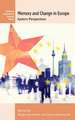
Memory and Change in Europe: Studies in Contemporary European History, cartea 16
Editat de Ma¿gorzata Pakier, Joanna Wawrzyniaken Limba Engleză Paperback – feb 2018
Din seria Studies in Contemporary European History
- 23%
 Preț: 765.64 lei
-
 Preț: 160.46 lei
- 23%
 Preț: 848.24 lei
-
 Preț: 262.69 lei
- 23%
 Preț: 848.89 lei
-
 Preț: 266.19 lei
- 23%
 Preț: 849.16 lei
-
 Preț: 309.43 lei
- 23%
 Preț: 760.27 lei
- 23%
 Preț: 765.08 lei
-
 Preț: 222.11 lei
-
 Preț: 267.39 lei
-
 Preț: 306.89 lei
-
 Preț: 309.91 lei
-
 Preț: 251.35 lei
- 23%
 Preț: 758.02 lei
- 23%
 Preț: 760.64 lei
- 23%
 Preț: 762.78 lei
-
 Preț: 159.53 lei
- 23%
 Preț: 759.24 lei
- 23%
 Preț: 760.12 lei
- 23%
 Preț: 763.32 lei
-
 Preț: 264.64 lei
- 23%
 Preț: 849.63 lei
-
 Preț: 268.12 lei
-
 Preț: 354.00 lei
- 23%
 Preț: 762.68 lei
Preț: 237.12 lei
Puncte Express: 356
Carte tipărită la comandă
Livrare economică 01-15 decembrie
Livrare prin curier în România Termenul estimat este afișat lângă disponibilitate.
Transport gratuit de la 400.00 lei Plată online sau ramburs, în funcție de opțiunile comenzii.
Retur gratuit în 14 zile Comandă securizată și suport în română.
Specificații
ISBN-13: 9781785338168
ISBN-10: 1785338161
Pagini: 388
Dimensiuni: 152 x 229 x 21 mm
Greutate: 0.56 kg
Editura: BERGHAHN BOOKS
Colecția Studies in Contemporary European History
Seria Studies in Contemporary European History
ISBN-10: 1785338161
Pagini: 388
Dimensiuni: 152 x 229 x 21 mm
Greutate: 0.56 kg
Editura: BERGHAHN BOOKS
Colecția Studies in Contemporary European History
Seria Studies in Contemporary European History
V-ar putea interesa
-
 The Kit-Cat ClubOphelia FieldPreț: 116.56 lei
-
 -37%Preț: 62.23 lei98.69 lei
-
 Why the Dreyfus Affair MattersLouis BegleyPreț: 343.36 lei
-
 The Insurgency in Chechnya and the North Caucasus: From Gazavat to JihadRobert W. Schaefer-29%Preț: 390.66 lei553.11 lei
-
 Preț: 61.96 lei
-
 Europe and the People Without HistoryEric R. WolfPreț: 259.92 lei
-
 The Legend of Basil the Bulgar-SlayerPaul StephensonPreț: 188.87 lei
-
 Curious Tales from West YorkshireHoward Peach-16%Preț: 94.49 lei112.11 lei
-
 Nordic Paths to ModernityJóhann Páll Árnason-23%Preț: 762.86 lei990.72 lei
-
 Political Violence in the Weimar Republic, 1918-1933Dirk SchumannPreț: 170.41 lei
-
 Hitler's Plans for Global DominationJochen Thies-23%Preț: 759.24 lei986.02 lei
-
 Austria, Germany, and the Cold WarRolf SteiningerPreț: 188.50 lei
-
 Constructing Nationalities in East Central EuropePieter M. JudsonPreț: 232.77 lei
-
 Alienating LabourEszter Bartha-23%Preț: 848.54 lei1102.00 lei
-
 The Wildest ProvinceRoderick BaileyPreț: 118.64 lei
Notă biografică
Malgorzata Pakier is Head of the Research Department at the POLIN Museum of the History of Polish Jews in Warsaw. Her publications include The Construction of European Holocaust Memory. German and Polish Cinema after 1989 (2013), and A European Memory?: Contested Histories and Politics of Remembrance (co-edited with Bo Stråth, 2010).
Cuprins
List of Illustrations
Foreword
Jeffrey Olick
Acknowledgments
Introduction: Memory and Change in Eastern Europe: How Special?
Malgorzata Pakier and Joanna Wawrzyniak
PART I: MEMORY DIALOGUES AND MONOLOGUES
Chapter 1. The Transformative Power of Memory
Aleida Assmann
Chapter 2. Political Correctness and Memories Constructed for 'Eastern Europe'
Andrzej Nowak
PART II: EUROPE AS A (UNIQUE) MEMORY FRAMEWORK?
Chapter 3. The (non-)Travelling Concept of Les Lieux de Mémoire: Central and Eastern European Perspectives
Maciej Górny and Kornelia Konczal
Chapter 4. Ain't Nothing Special
Slawomir Kapralski
Chapter 5. Biographical and Collective Memory: Mutual Influences in Central and Eastern European Context
Kaja Kazmierska
PART III: EASTERN EUROPEAN MEMORIES FACING HISTORICAL CHANGE AND CULTURAL TRANSFORMATIONS
Chapter 6. The Path of Bringing the Dark to Light: Memory of the Holocaust in Postcommunist Europe
Joanna Beata Michlic
Chapter 7. The Rise of an East European Community of Memory? On Lobbying for the Gulag Memory via Brussels
Lidia Zessin-Jurek
Chapter 8. Two Concepts of Victimhood: Property Restitution in the Czech Republic and Poland after 1989
Stanislaw Tyszka
Chapter 9. Shared Memory Culture? Nationalizing the 'Great Patriotic War' in the Ukrainian-Russian Borderlands
Tatiana Zhurzhenko
Chapter 10. History, Politics and Memory (Ukraine 1990s - 2000s)
Georgiy Kasianov
Chapter 11. Walking Memory through City Space in Sevastopol, Crimea
Judy Brown
PART IV: FOCI OF MEMORIES IN EASTERN EUROPE
Chapter 12. World War II in the Memory of Contemporary Polish Society
Piotr Tadeusz Kwiatkowski
Chapter 13. Auschwitz and Katyn in Bondage of Politics: The Process of Shaping Memory in Communist Poland
Jacek Chrobaczynski and Piotr Trojanski
Chapter 14. Germans in Eastern Europe as a Polish-German Lieu de Mémoire? On the Asymmetry of Memories
Matthias Weber
Chapter 15. Remembering Collectivization in Bulgaria
Iana Iancheva
Chapter 16. Uses and Misuses of Memory: Dealing with Communist Past in Postcommunist Bulgaria and Romania
Claudia-Florentina Dobre
Bibliography
Notes on Contributors
Index
Descriere
In studies of a common European past, there is a significant lack of scholarship on the former Eastern Bloc countries. This volume offers a reflection on memory in an Eastern European historical context, one that can be measured against and applied to historical experience in other parts of Europe.